---
title: "AHRMM26 Recap: 2026 Healthcare Supply Chain Trends"
description: "AHRMM26 recap: why proof beat promise, why clinical-supply chain relationships mattered most, and what health system leaders are prioritizing in 2026."
image: https://blog.bluebin.com/hubfs/ahrmm26-recap-hero.webp
---
[Skip to main content](https://blog.bluebin.com/ahrmm26-recap-supply-chain-trends-2026#main-content)
[BlueBin Rated #1 in Black Book 2026 Healthcare Supply Chain Report](https://bluebin.com/results/news/bluebin-ranked-number-one-black-book-2026-healthcare-supply-chain/)
-
-
-
-
-
[   ](https://bluebin.com/)
- [Show submenu for Solutions Solutions](https://bluebin.com/solutions/)
- [BlueBin Kanban](https://bluebin.com/solutions/hospital-kanban/)
- [BlueQ Analytics](https://bluebin.com/solutions/blueq-analytics/)
- [BlueQ SmartScan](https://bluebin.com/solutions/blueq-smartscan/)
- [Consulting & Training](https://bluebin.com/solutions/consulting/)
- [Kanban Supplies](https://bluebin.com/solutions/hospital-kanban-supplies/)
- [Show submenu for Results Results](https://bluebin.com/results/)
- [Case Studies](https://bluebin.com/results/case-studies/)
- [Videos](https://bluebin.com/results/videos/)
- [News](https://bluebin.com/results/news/)
- [Show submenu for About Us About Us](https://bluebin.com/company/)
- [Our Team + Our Story](https://bluebin.com/company/our-team-our-story/)
- [Partner with BlueBin](https://bluebin.com/company/partnering-with-bluebin/)
- [Events](https://bluebin.com/events/)
- [Careers](https://bluebin.com/company/careers/)
- [Get Support](mailto:bluebin.support@capsahealthcare.com?subject=Bluebin%20Support%20Request)
- [Show submenu for Resources Resources](https://bluebin.com/resources/)
- [Blog](https://blog.bluebin.com)
- [Whitepapers](https://bluebin.com/resources/whitepapers/)
- [Guides & Checklists](https://bluebin.com/resources/guides/)
- [Calculators](https://bluebin.com/resources/calculators/)
- [Newsletter Archive](https://bluebin.com/resources/bluebin-newsletter-archive/)
- [Contact](https://bluebin.com/contact/)
Open main navigation
Close main navigation
- Show submenu for Solutions Solutions
- [BlueBin Kanban](https://bluebin.com/solutions/hospital-kanban/)
- [BlueQ Analytics](https://bluebin.com/solutions/blueq-analytics/)
- [BlueQ SmartScan](https://bluebin.com/solutions/blueq-smartscan/)
- [Consulting & Training](https://bluebin.com/solutions/consulting/)
- [Kanban Supplies](https://bluebin.com/solutions/hospital-kanban-supplies/)
- Show submenu for Results Results
- [Case Studies](https://bluebin.com/results/case-studies/)
- [Videos](https://bluebin.com/results/videos/)
- [News](https://bluebin.com/results/news/)
- Show submenu for About Us About Us
- [Our Team + Our Story](https://bluebin.com/company/our-team-our-story/)
- [Partner with BlueBin](https://bluebin.com/company/partnering-with-bluebin/)
- [Events](https://bluebin.com/events/)
- [Careers](https://bluebin.com/company/careers/)
- [Get Support](mailto:bluebin.support@capsahealthcare.com?subject=Bluebin%20Support%20Request)
- Show submenu for Resources Resources
- [Blog](https://blog.bluebin.com)
- [Whitepapers](https://bluebin.com/resources/whitepapers/)
- [Guides & Checklists](https://bluebin.com/resources/guides/)
- [Calculators](https://bluebin.com/resources/calculators/)
- [Newsletter Archive](https://bluebin.com/resources/bluebin-newsletter-archive/)
- [Contact](https://bluebin.com/contact/)
Search
- [Reporting & Analytics](https://blog.bluebin.com/tag/reporting-analytics)
- [Inventory management](https://blog.bluebin.com/tag/inventory-management)
- [Clinical/Patient care](https://blog.bluebin.com/tag/clinical-patient-care)
- [Operations](https://blog.bluebin.com/tag/operations)
# AHRMM26 Recap: What Healthcare Supply Chain Leaders Are Prioritizing in 2026
 by [Jeremy Harvey](https://blog.bluebin.com/author/jeremy-harvey) Aug 03, 2026
Table of contents
AHRMM26 Recap: 2026 Healthcare Supply Chain Trends
10:10
Key Takeaways
- AHRMM26’s programming spanned five tracks, sourcing, operations, technology, clinical and value analysis, and the federal sector, plus a forum built around small and rural hospitals. A few threads ran through nearly every session: proof over promise, stronger clinical relationships, and resilience under pressure.
- Technology sessions were consistent: AI and automation hold real promise for health care supply chains, but the sessions were clear that promise is not the same as proof.
- A theme we heard as often at our booth as in the session rooms was relationships, specifically how supply chain leaders build and sustain trust with clinical and financial leaders, especially through a crisis.
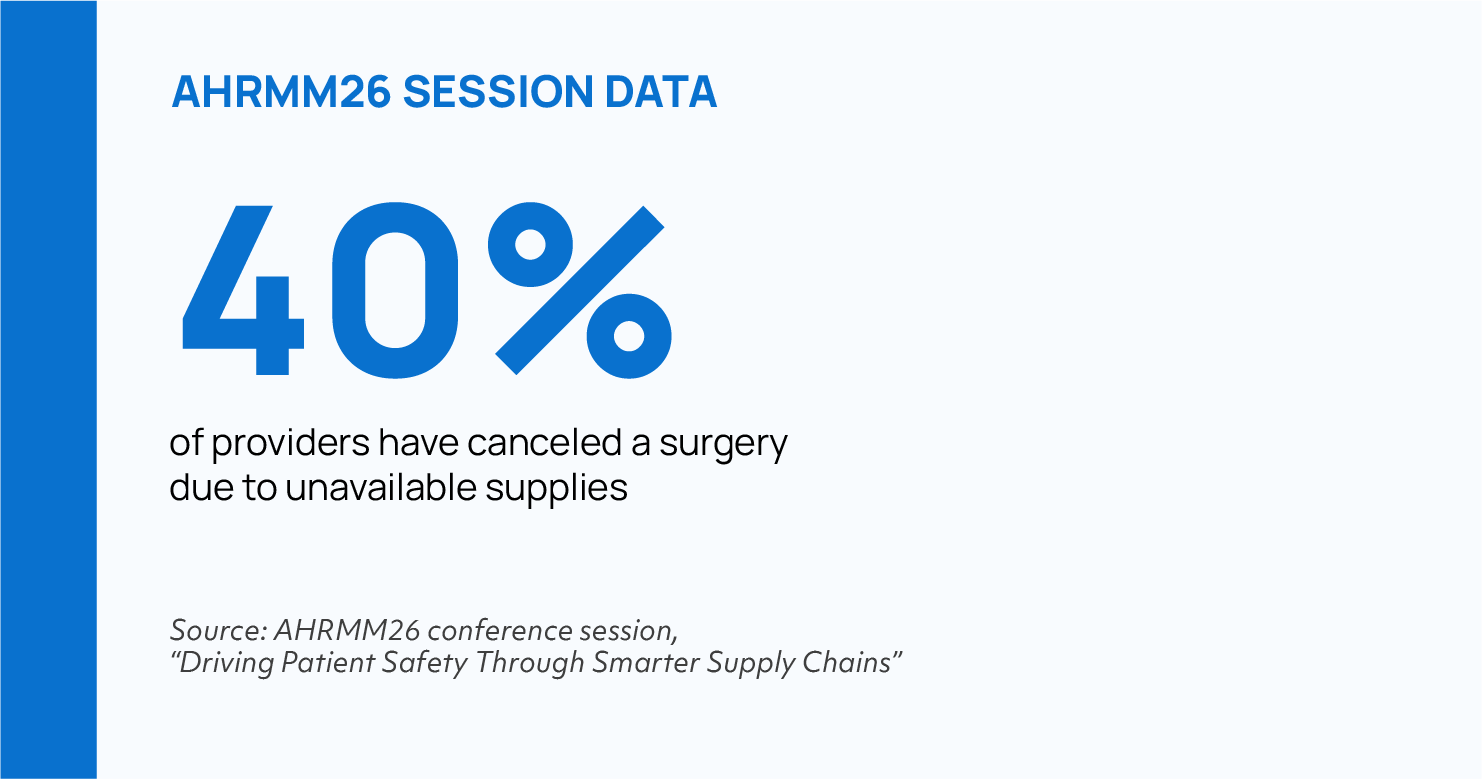
- One session on patient safety cited data showing 40% of providers have canceled a surgery due to unavailable supplies, and 27% report expired or recalled products reaching patient care areas.
- Visitors at our booth also described fatigue with technology-dependent point-of-use platforms, like weighted bins, that require ongoing hardware upkeep just to answer a basic availability question.
- BlueBin brings clinical and supply chain staff together at implementation and sustains that relationship afterward through the QCN change request process, the same discipline-first approach behind a large Midwest nonprofit health system's projected 7.4x ROI.
## Three Days In San Antonio
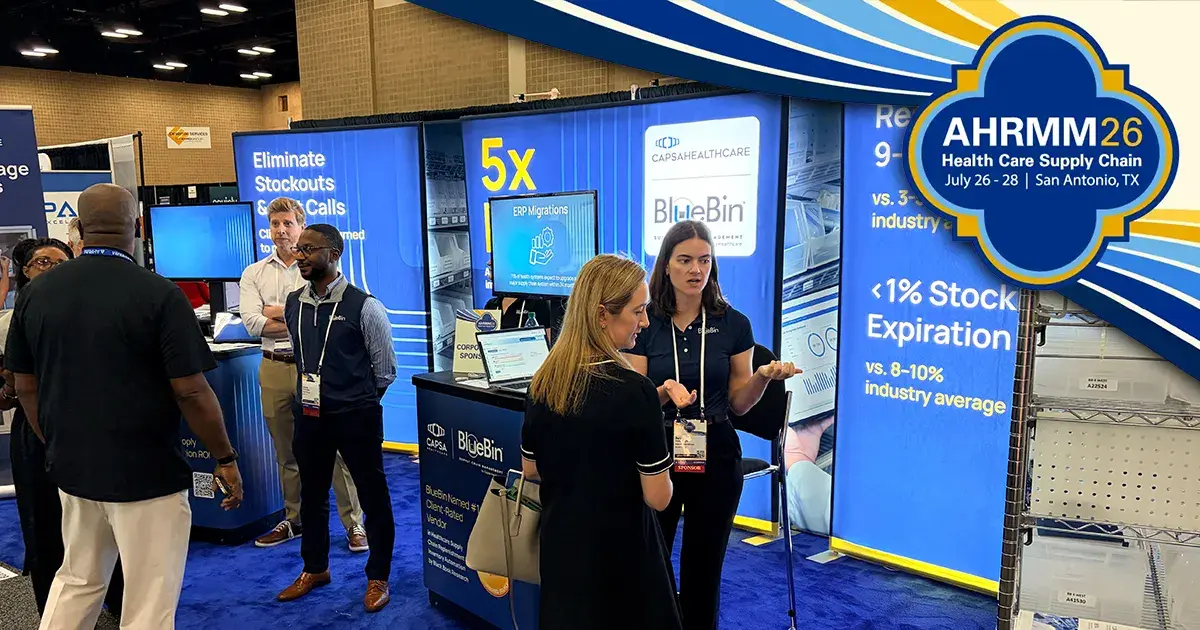
We just wrapped up three days at AHRMM26, the annual conference hosted by the [Association for Health Care Resource and Materials Management](https://www.ahrmm.org/), in San Antonio. Between the education sessions and three days on the exhibit floor talking with supply chain leaders at our booth, a handful of themes ran through nearly everything we saw and heard: proof over promise, relationships as real infrastructure, and resilience for hospitals of every size. This recap pulls those themes together, alongside what our own team learned talking with visitors.
## What The Conference Was Really About
AHRMM26 organized its programming around five tracks: sourcing, operations, technology and data, clinical and value analysis, and the federal sector, plus a dedicated Independent Link Forum built around the challenges facing small and rural hospitals. Workforce emerged as its own pressure point within that track; rural health systems described competing for the same shrinking labor pool as large non-healthcare employers moving into their markets, which only raises the stakes for getting more done with the staff already in place. That breadth matters. A conference built entirely around new hardware or new software would have missed most of what actually determines whether a supply chain transformation holds up: supplier relationships that survive a tariff shock, clinical trust that survives a crisis, and process discipline that survives whichever technology comes next. A few themes in particular kept surfacing across sessions and at our booth.
## Technology: Promise Versus Proof
Across the technology track, one idea surfaced again and again. AI and automation hold real promise for health care supply chains, but the sessions were consistent in warning that promise is not the same as proof. Presenters described choosing the right technology for a problem you have already diagnosed, rather than layering a new platform onto a broken workflow and hoping it resolves itself.
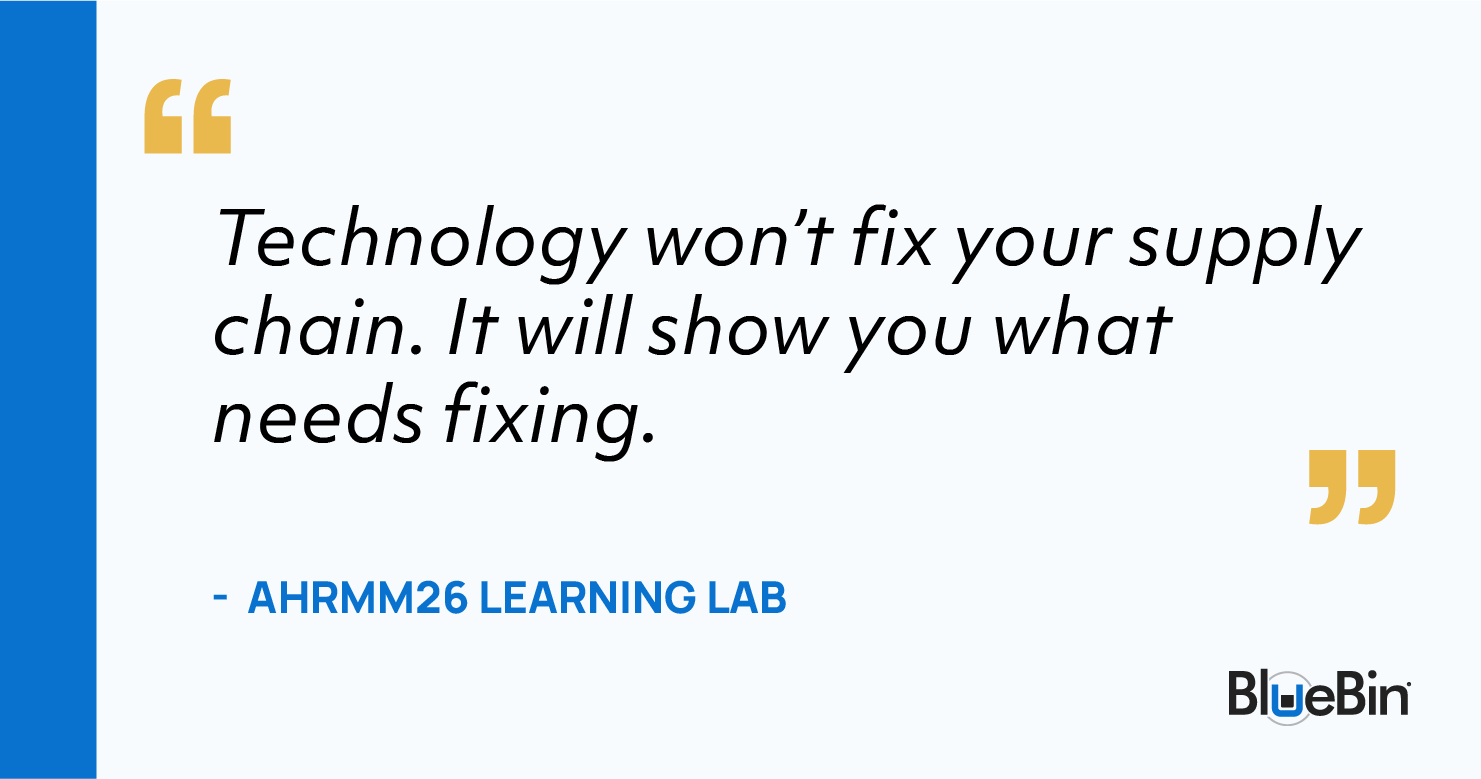
One learning lab made the point directly: technology will not fix a broken supply chain on its own; it will mostly just show you what needs fixing. That is a message we have been making for a while now, most recently in [How Two Bins Beat High-Tech](https://blog.bluebin.com/how-two-bins-beat-high-tech-case-process-first-solutions-healthcare-supply-chain-transformation), and it was good to hear it echoed from the main stage.
That same session described what happens in practice: new visibility tools kept surfacing problems that had gone unnoticed for years, mismatched item records, inventory sitting untracked, and orders that never flowed through the supply chain at all. Presenters were candid that this was uncomfortable, and that it was the point. Their conclusion matched the theme running through the rest of the technology track: data governance has to come before automation, not after. A tool cannot fix a foundation that it cannot see clearly.
## The Relationships That Hold Supply Chain Together
A theme we heard as often in the hallways as in the session rooms was relationships: specifically, how supply chain leaders build and maintain trust with clinical and financial leaders, and how that trust gets tested the moment a crisis hits. Sessions like "Earning Clinical Trust Through Supply Chain Insight" made the point that trust is not built through a single successful project. It is built through consistent, visible follow-through over time.
One case study made that concrete. A health system described replacing a monthly finance fire drill and unexplained inventory variances that the supply chain could only guess at with real-time visibility that eventually eliminated the physical year-end inventory count entirely and turned a monthly scramble into a routine weekly check-in. The bigger shift was cultural, not technical: leaders there talked about reframing clinician workarounds, shadow ordering, and informal stockpiling as a good-faith response to past scarcity and bad systems, not as a compliance problem to police. That distinction came up in more than one session this year, and it matches how we think about it, too.
One of our own team members heard the same thing from visitor after visitor at our booth: the health systems getting the most value from any point-of-use system were the ones where supply chain and clinical staff had a real, ongoing working relationship, not just a vendor relationship.
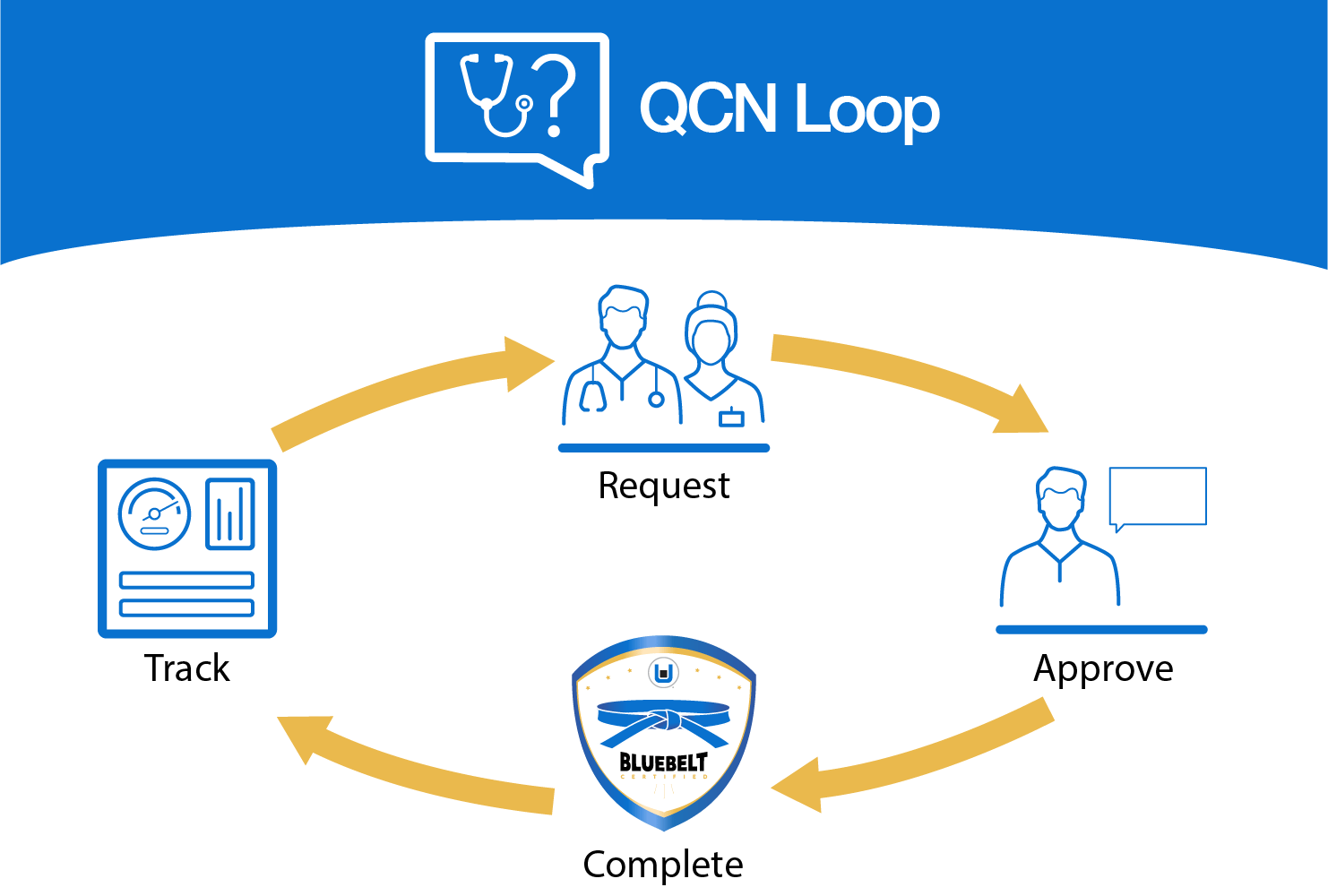
That matches what we see across our own installations. We bring clinical staff and supply chain teams together at implementation, when every supply area is redesigned around how care teams actually work rather than around what a piece of hardware requires. After go-live, that relationship does not end. Our QCN change request process gives clinical staff a formal channel to request adds, removals, or bin relocations as their unit’s needs change. A clinical manager approves the request, a [BlueBelt](https://bluebin.com/solutions/consulting/bluebelt-certification/) completes it, and a dashboard lets everyone track its status. It is a small mechanism, but it is the difference between a supply chain program clinicians tolerate and one they help run.
## Patient Safety And Supplier Resilience Were Not Separate Conversations
The stakes behind these themes showed up clearly, too. One session on patient safety cited data showing that 40 percent of providers have canceled a surgery due to unavailable supplies, and that 27 percent report expired or recalled products reaching patient care areas. Elsewhere, sessions on supplier partnerships and tariff-aware sourcing made a related point: the more fragile a health system’s supplier relationships, the more those availability problems compound. Increasingly, hospitals are treating supply availability, clinical safety, and sourcing resilience as one problem rather than three.
More than one session pointed to the same underlying shift: after years of thinning inventory down in the name of just-in-time efficiency, health systems and their military counterparts are moving back toward deliberate buffer stock. The catch is that buffer stock only helps if someone is actively managing it. Expiring, low-turn "just in case" inventory came up repeatedly as a real, unsolved cost problem: items purchased for a worst-case scenario that then sit until they expire, with no clean system for rotating or redistributing them before that happens.
It is also the reason automated dispensing cabinets and other point-of-use hardware do not automatically close the gap on their own. We wrote about why in “[Why Automated Dispensing Cabinets Fail to Deliver Expected ROI](https://blog.bluebin.com/why-automated-dispensing-cabinets-fail-deliver-expected-roi)”: hardware that requires clinician workarounds to function correctly does not solve an availability problem; it relocates it.
## What We Heard At Our Booth
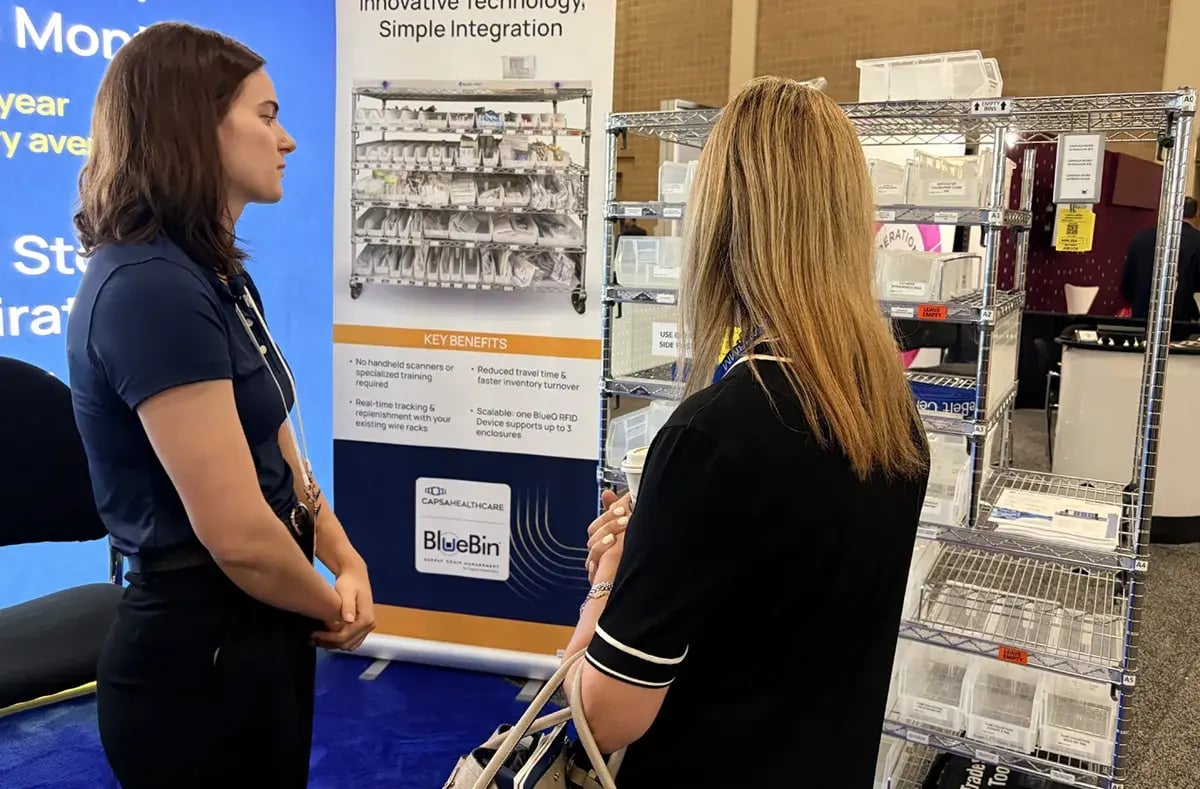
Across two days of the exhibition, two things came up more than anything else. First, and this lined up closely with what the sessions were saying, visitors wanted to talk about relationships: how to keep clinical leadership engaged after go-live, how to prove value to a CFO, and how to keep a program running when leadership changes. Second, several visitors described fatigue with technology-dependent point-of-use platforms, weighted bins in particular, that use a sensor to trigger a reorder as stock drops and need batteries, calibration, and ongoing upkeep just to answer a basic question: what is on the shelf. Neither conversation was really about hardware. Both were about whether a system holds up over the years, not just at go-live.
## What This Means For Your Supply Chain
If AHRMM26 is any indication, the industry conversation is shifting from a narrow focus on which technology to buy toward a broader question: what makes a supply chain program durable through a crisis, a leadership change, or five years of normal operations. In our experience, durability comes from three things working together:
- A disciplined process ([two-bin Kanban](https://bluebin.com/solutions/hospital-kanban/))
- A real relationship between clinical and supply chain teams, built at implementation and sustained through QCN
- And technology layered on top once the first two are solid ([BlueQ Analytics](https://bluebin.com/solutions/blueq-analytics/)).
That sequence, [process discipline before technology](https://bluebin.com/speed-to-quality-transformation/), is the core of BlueBin’s Speed to Quality Transformation approach, and it is why a large Midwest nonprofit health system reached a documented [7.4x return on investment](https://bluebin.com/results/case-studies/bjc-healthcare-7-9x-roi/) and $12.8 million in annual savings across 12 facilities in 36 months.
If you want to see where your own program stands, [our ROI calculator](https://bluebin.com/resources/calculators/supply-chain-roi-calculator/) is built around the same process-first math referenced throughout this post.
[](https://blog.bluebin.com/hs/cta/wi/redirect?encryptedPayload=AVxigLJzyJ5gp%2FMWDbsya3iCOXYmrHDcThC4N%2FjYeFZ2873VnVy5%2BWPba4%2FFnjkJotpVFIK689lMXS98zYfLO75JHJEBkziz8YmdzUTydXmEJFj7L%2Fa6LNX%2BXqr35Rd2IkGIsWO2gQoSIwfnDKbjZfcKN8JD37go2IGZ%2B5k0xFkQC4CZDwJqXRgiy%2F9TCoX%2FFp6yYz5GqjzvgGYzJtWyqdDonZ50bTCW%2F2UD2mUGJOfHUWBIeKA%2FE%2FD5iPdQjl5m&webInteractiveContentId=211480923145&portalId=9067872)
## Frequently Asked Questions
### What Is A Weighted Bin Inventory System?
A weighted bin inventory system uses a scale or load sensor under a storage bin to track how much of an item remains. As the weight on the sensor drops, indicating fewer items on hand, the system automatically triggers a reorder. It is a technology-dependent version of point-of-use replenishment that requires power, connectivity, and periodic calibration to stay accurate.
### How Is Two-Bin Kanban Different From A Weighted Bin System?
Two-bin Kanban uses two physical containers instead of a sensor. When the first bin empties, staff pull from the second, and the empty bin itself becomes the reorder signal. There is no battery, calibration, or network connection involved, so the process continues to run even during a connectivity outage or power interruption.
### Why Do Health Systems Choose Process-First Supply Chain Transformation Over New Technology?
Because technology amplifies whatever process it is layered on top of. Deployed on a disciplined process, it accelerates good outcomes. Deployed on a broken process, it automates the dysfunction, making it harder to see. Establishing process discipline first, then adding technology, is the sequence BlueBin has documented, delivering the strongest and most durable results.
### How Does BlueBin Help Supply Chain And Clinical Teams Build A Working Relationship?
BlueBin brings clinical staff and supply chain teams together at implementation to redesign each supply area around the actual clinical workflow. After go-live, the QCN change request process keeps that collaboration active: clinical staff submits requests to add, remove, or relocate items, a clinical manager approves the request, and a BlueBelt completes it, with a dashboard so everyone can track its status. It turns relationship-building into an ongoing process instead of a one-time event.
### What Did AHRMM26 Sessions Say About AI And Emerging Technology In The Supply Chain?
Several sessions described AI and automation as holding real promise for health care supply chains, but cautioned that many partners and use cases remain unproven. Presenters encouraged attendees to choose the right technology for a specific, already-diagnosed problem rather than adopting new tools broadly and hoping they resolve underlying process issues.
### Does BlueBin Use Technology, Or Just Process?
Both. BlueBin is not anti-technology; it just insists on sequencing: process discipline first, technology second. Once a two-bin Kanban process is running reliably, BlueQ Analytics is layered on top to provide real-time visibility, usage pattern analysis, and predictive intelligence across a facility. The technology accelerates a process that already works rather than covering one that does not.

Post by [Jeremy Harvey](https://blog.bluebin.com/author/jeremy-harvey)
Aug 3, 2026, 9:00:00 AM
Jeremy Harvey is the Senior Director of Marketing & Brand at BlueBin, where he architects content strategy and brand development for one of healthcare's leading supply chain solutions providers. With 21 years of marketing experience — including more than five years in healthcare supply chain and 13 years across B2B industries — he brings a strategic, data-informed approach to helping healthcare organizations understand the operational and financial value of smarter supply chain management. Jeremy holds a Bachelor's degree in Graphic Design & New Media and a minor in Industrial Technology, with a concentration in design.
[Follow me on LinkedIn](https://www.linkedin.com/in/thejeremyharvey/)
###### Explore Topics
- [Automation](https://blog.bluebin.com/tag/automation)
- [Clinical/Patient care](https://blog.bluebin.com/tag/clinical-patient-care)
- [Cybersecurity](https://blog.bluebin.com/tag/cybersecurity)
- [Data Standards](https://blog.bluebin.com/tag/data-standards)
- [ERP](https://blog.bluebin.com/tag/erp)
- [Financial](https://blog.bluebin.com/tag/financial)
- [Inventory management](https://blog.bluebin.com/tag/inventory-management)
- [Kanban](https://blog.bluebin.com/tag/kanban)
- [Leadership](https://blog.bluebin.com/tag/leadership)
- [Operations](https://blog.bluebin.com/tag/operations)
- [Optimization](https://blog.bluebin.com/tag/optimization)
- [Ordering & Receiving](https://blog.bluebin.com/tag/ordering-receiving)
- [Replenishment](https://blog.bluebin.com/tag/replenishment)
- [Reporting & Analytics](https://blog.bluebin.com/tag/reporting-analytics)
- [Resilience](https://blog.bluebin.com/tag/resilience)
- [Sustainability](https://blog.bluebin.com/tag/sustainability)
- [Warehousing](https://blog.bluebin.com/tag/warehousing)
- [supply chain disruption](https://blog.bluebin.com/tag/supply-chain-disruption)
- [transformation](https://blog.bluebin.com/tag/transformation)
###### Recent Articles
[Hospital Supply Chain Management Software: 7 Factors to Evaluate Before You Sign](https://blog.bluebin.com/hospital-supply-chain-management-software)
[9 Best Hospital Inventory Management Systems for ROI in 2026](https://blog.bluebin.com/best-hospital-inventory-management-systems-2026)
[AHRMM26 Recap: What Healthcare Supply Chain Leaders Are Prioritizing in 2026](https://blog.bluebin.com/ahrmm26-recap-supply-chain-trends-2026)
[When a Distributor's Warehouse Burns Down: What One Warehouse Fire Reveals About Healthcare Supply Chain Vulnerability](https://blog.bluebin.com/warehouse-fire-exposes-healthcare-supply-chain-vulnerability)
[54% of Healthcare Leaders Need Supply Chain ROI in 12 Months](https://blog.bluebin.com/ahrmm26-healthcare-supply-chain-roi)
[Hardware Solutions vs. Transformation: Why Storage Optimization Alone Isn't Enough](https://blog.bluebin.com/hardware-solutions-vs-transformation-why-storage-optimization-alone-isnt-enough)
[True Cost of Ownership: Comparing Kanban, Cabinets, and Manual PAR Systems](https://blog.bluebin.com/true-cost-ownership-comparing-kanban-cabinets-manual-par-systems)
[Hospital Supply Chain Disruption in 2026: What the Iran Conflict Reveals](https://blog.bluebin.com/hospital-supply-chain-disruption-2026)
[ESG and Healthcare: How Supply Chain Waste Reduction Supports Green Bond Eligibility](https://blog.bluebin.com/esg-healthcare-how-supply-chain-waste-reduction-supports-green-bond-eligibility)
[Hospital Supply Chain Resilience: From COVID-19 to Geopolitical Disruption](https://blog.bluebin.com/supply-chain-resilience-after-covid-19)
[](https://bluebin.com/)
Improving the healthcare supply chain process, ensuring that clinicians have the right supplies at the right time.
-
-
-
-
-
### CONTACT
- [bluebinsales@capsahealthcare.com](mailto:bluebinsales@capsahealthcare.com)
- (855) 896-2467
- 8170 Dove Pkwy
Canal Winchester, OH 43110
- QUICK LINKS
- [Supply Chain Solutions](https://bluebin.com/solutions/)
- [Healthcare Kanban](https://bluebin.com/solutions/hospital-kanban/)
- [BlueQ Analytics](https://bluebin.com/solutions/blueq-analytics/)
- [BlueQ SmartScan](https://bluebin.com/solutions/blueq-smartscan/)
- [Supply Chain Consulting](https://bluebin.com/solutions/consulting/)
- [Case Studies](https://bluebin.com/results/case-studies/)
- [About Us](https://bluebin.com/company/our-team-our-story/)
- - [Whitepapers](https://bluebin.com/resources/whitepapers/)
- [Guides & Checklists](https://bluebin.com/resources/guides/)
- [Calculators](https://bluebin.com/resources/calculators/)
- [Blog](https://blog.bluebin.com/)
- [Careers](https://bluebin.com/company/careers/)
- [Contact](https://bluebin.com/contact/)
- [Support](mailto:bluebin.support@capsahealthcare.com?subject=Bluebin%20Support%20Request)
© 2026 BlueBin Inc. All Rights Reserved
[Sitemap](https://bluebin.com/page-sitemap.xml?__hstc=51647990.6d18215ae56f1f7281d0f59df56a7960.1616739528041.1616739528041.1616739528041.1&__hssc=51647990.19.1616739528042&__hsfp=1866732115)
```json
{
"@context" : "https://schema.org",
"@type" : "BlogPosting",
"author" : {
"@type" : "Person",
"name" : "Jeremy Harvey",
"url" : "https://blog.bluebin.com/author/jeremy-harvey"
},
"dateModified" : "2026-09-30T17:05:02.747Z",
"datePublished" : "2026-08-03T16:00:00.000Z",
"headline" : "AHRMM26 Recap: 2026 Healthcare Supply Chain Trends",
"image" : [ "https://blog.bluebin.com/hubfs/ahrmm26-recap-hero.webp" ],
"mainEntityOfPage" : {
"@id" : "https://blog.bluebin.com/ahrmm26-recap-supply-chain-trends-2026",
"@type" : "WebPage"
},
"publisher" : {
"@type" : "Organization",
"logo" : {
"@type" : "ImageObject",
"url" : "https://blog.bluebin.com/hubfs/bluebin-logo.png"
},
"name" : "BlueBin"
}
}
```
```json
{
"@context" : "https://schema.org",
"@type" : "FAQPage",
"mainEntity" : [ {
"@type" : "Question",
"acceptedAnswer" : {
"@type" : "Answer",
"text" : "A weighted bin inventory system uses a scale or load sensor under a storage bin to track how much of an item remains. As the weight on the sensor drops, indicating fewer items on hand, the system automatically triggers a reorder. It is a technology-dependent version of point-of-use replenishment that requires power, connectivity, and periodic calibration to stay accurate."
},
"name" : "What Is A Weighted Bin Inventory System?"
}, {
"@type" : "Question",
"acceptedAnswer" : {
"@type" : "Answer",
"text" : "Two-bin Kanban uses two physical containers instead of a sensor. When the first bin empties, staff pull from the second and the empty bin itself becomes the reorder signal. There is no battery, calibration, or network connection involved, which is why the process keeps working even during a connectivity outage or power interruption."
},
"name" : "How Is Two-Bin Kanban Different From A Weighted Bin System?"
}, {
"@type" : "Question",
"acceptedAnswer" : {
"@type" : "Answer",
"text" : "Because technology amplifies whatever process it is layered on top of. Deployed on a disciplined process, it accelerates good outcomes. Deployed on a broken process, it automates the dysfunction and makes it harder to see. Establishing process discipline first, then adding technology, is the sequence BlueBin has documented delivering the strongest and most durable results."
},
"name" : "Why Do Health Systems Choose Process-First Supply Chain Transformation Over New Technology?"
}, {
"@type" : "Question",
"acceptedAnswer" : {
"@type" : "Answer",
"text" : "BlueBin brings clinical staff and supply chain teams together at implementation to redesign each supply area around actual clinical workflow. After go-live, the QCN change request process keeps that collaboration active: clinical staff submit requests to add, remove, or relocate items, a clinical manager approves the request, and a BlueBelt completes it, with a dashboard so everyone can track its status. It turns relationship-building into an ongoing process instead of a one-time event."
},
"name" : "How Does BlueBin Help Supply Chain And Clinical Teams Build A Working Relationship?"
}, {
"@type" : "Question",
"acceptedAnswer" : {
"@type" : "Answer",
"text" : "Several sessions described AI and automation as holding real promise for health care supply chains, but cautioned that many partners and use cases remain unproven. Presenters encouraged attendees to choose the right technology for a specific, already-diagnosed problem rather than adopting new tools broadly and hoping they resolve underlying process issues."
},
"name" : "What Did AHRMM26 Sessions Say About AI And Emerging Technology In The Supply Chain?"
}, {
"@type" : "Question",
"acceptedAnswer" : {
"@type" : "Answer",
"text" : "Both. BlueBin is not anti-technology, it just insists on sequencing: process discipline first, technology second. Once a two-bin Kanban process is running reliably, BlueQ Analytics is layered on top to provide real-time visibility, usage pattern analysis, and predictive intelligence across a facility. The technology accelerates a process that already works instead of covering for one that does not."
},
"name" : "Does BlueBin Use Technology, Or Just Process?"
} ]
}
```
```json
{
"@context" : "https://schema.org",
"@type" : "Person",
"jobTitle" : "Senior Director of Marketing & Brand",
"name" : "Jeremy Harvey",
"sameAs" : "https://www.linkedin.com/in/thejeremyharvey/",
"url" : "https://blog.bluebin.com/author/jeremy-harvey"
}
```