---
title: "Nurse Burnout and Supply Hunts: The $14B Crisis"
description: Nurses spend about 30 minutes a shift hunting for supplies, a $14B annual drain. See the real math and how supply chain fixes cut burnout and turnover.
image: https://blog.bluebin.com/hubfs/60-minutes-lost-every-shift.png
---
[Skip to main content](https://blog.bluebin.com/nurse-burnout-supply-hunts-the-14b-productivity-crisis-healthcare-ignores#main-content)
[BlueBin Rated #1 in Black Book 2026 Healthcare Supply Chain Report](https://bluebin.com/results/news/bluebin-ranked-number-one-black-book-2026-healthcare-supply-chain/)
-
-
-
-
-
[   ](https://bluebin.com/)
- [Show submenu for Solutions Solutions](https://bluebin.com/solutions/)
- [BlueBin Kanban](https://bluebin.com/solutions/hospital-kanban/)
- [BlueQ Analytics](https://bluebin.com/solutions/blueq-analytics/)
- [BlueQ SmartScan](https://bluebin.com/solutions/blueq-smartscan/)
- [Consulting & Training](https://bluebin.com/solutions/consulting/)
- [Kanban Supplies](https://bluebin.com/solutions/hospital-kanban-supplies/)
- [Show submenu for Results Results](https://bluebin.com/results/)
- [Case Studies](https://bluebin.com/results/case-studies/)
- [Videos](https://bluebin.com/results/videos/)
- [News](https://bluebin.com/results/news/)
- [Show submenu for About Us About Us](https://bluebin.com/company/)
- [Our Team + Our Story](https://bluebin.com/company/our-team-our-story/)
- [Partner with BlueBin](https://bluebin.com/company/partnering-with-bluebin/)
- [Events](https://bluebin.com/events/)
- [Careers](https://bluebin.com/company/careers/)
- [Get Support](mailto:bluebin.support@capsahealthcare.com?subject=Bluebin%20Support%20Request)
- [Show submenu for Resources Resources](https://bluebin.com/resources/)
- [Blog](https://blog.bluebin.com)
- [Whitepapers](https://bluebin.com/resources/whitepapers/)
- [Guides & Checklists](https://bluebin.com/resources/guides/)
- [Calculators](https://bluebin.com/resources/calculators/)
- [Newsletter Archive](https://bluebin.com/resources/bluebin-newsletter-archive/)
- [Contact](https://bluebin.com/contact/)
Open main navigation
Close main navigation
- Show submenu for Solutions Solutions
- [BlueBin Kanban](https://bluebin.com/solutions/hospital-kanban/)
- [BlueQ Analytics](https://bluebin.com/solutions/blueq-analytics/)
- [BlueQ SmartScan](https://bluebin.com/solutions/blueq-smartscan/)
- [Consulting & Training](https://bluebin.com/solutions/consulting/)
- [Kanban Supplies](https://bluebin.com/solutions/hospital-kanban-supplies/)
- Show submenu for Results Results
- [Case Studies](https://bluebin.com/results/case-studies/)
- [Videos](https://bluebin.com/results/videos/)
- [News](https://bluebin.com/results/news/)
- Show submenu for About Us About Us
- [Our Team + Our Story](https://bluebin.com/company/our-team-our-story/)
- [Partner with BlueBin](https://bluebin.com/company/partnering-with-bluebin/)
- [Events](https://bluebin.com/events/)
- [Careers](https://bluebin.com/company/careers/)
- [Get Support](mailto:bluebin.support@capsahealthcare.com?subject=Bluebin%20Support%20Request)
- Show submenu for Resources Resources
- [Blog](https://blog.bluebin.com)
- [Whitepapers](https://bluebin.com/resources/whitepapers/)
- [Guides & Checklists](https://bluebin.com/resources/guides/)
- [Calculators](https://bluebin.com/resources/calculators/)
- [Newsletter Archive](https://bluebin.com/resources/bluebin-newsletter-archive/)
- [Contact](https://bluebin.com/contact/)
Search
- [Optimization](https://blog.bluebin.com/tag/optimization)
- [Clinical/Patient care](https://blog.bluebin.com/tag/clinical-patient-care)
# Nurse Burnout and Supply Hunts: The $14B Productivity Crisis Healthcare Ignores
 by [Jeremy Harvey](https://blog.bluebin.com/author/jeremy-harvey) Feb 20, 2026
Table of contents
Nurse Burnout and Supply Hunts: The $14B Crisis
15:38
Key Takeaways
- The $14 billion figure rests on a simple formula: about half an hour per nurse per shift, about 250 shifts a year, across roughly 3 million nurses.
- For a 300-bed hospital with 800 nursing FTEs that is 100,000 nursing hours a year, roughly $4 million, and almost no one measures it.
- It is a process problem, not a nursing problem. Manual PAR guesswork, unstandardized supply rooms, hoarding, and thin replenishment all produce the same result.
- Supply availability shows up in nurse satisfaction surveys, in turnover, and in Magnet evaluations, which is why this is a workforce strategy and not just a cost initiative.
- Visual replenishment asks nothing of clinical staff. Supply hunts are virtually eliminated, and up to 60 minutes per shift goes back to patient care.
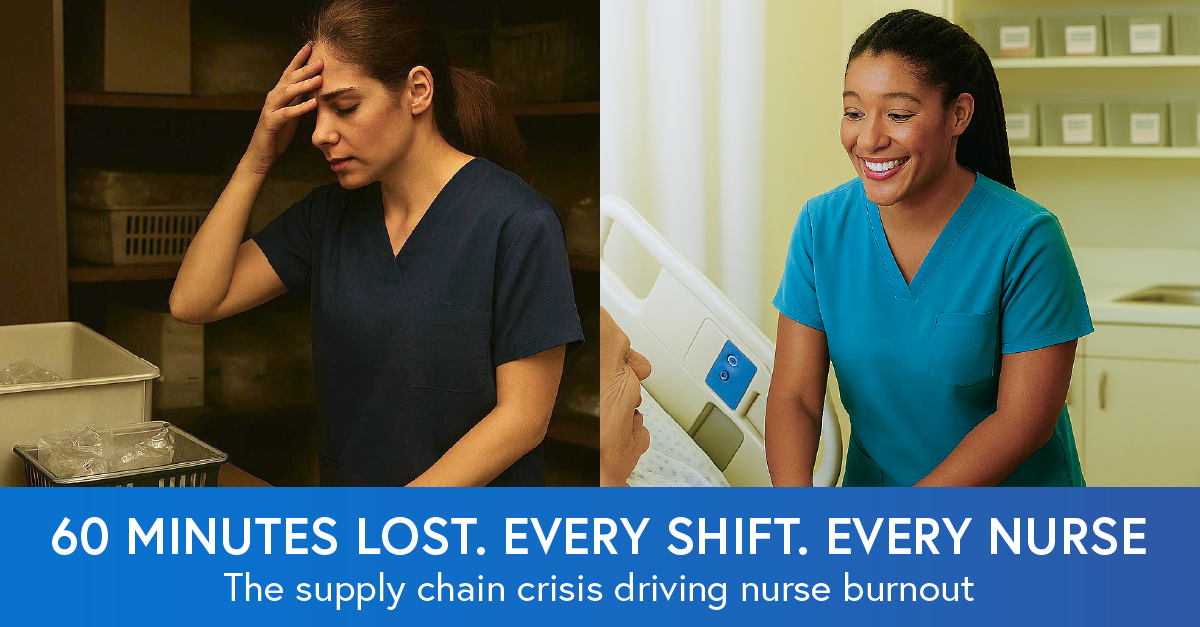
Every day, nurses spend part of every shift hunting through supply rooms, calling colleagues, and improvising when the things they need are not where they are supposed to be. This is not occasional frustration. It is a systematic drain on nursing time, costing healthcare roughly $14 billion a year.
It is also a burnout accelerant in an industry already short of nurses. When Press Ganey surveys identify "I have the supplies I need to do my job" as a top-10 source of dissatisfaction among nurses, the link between supply chain performance and workforce stability becomes less theoretical.
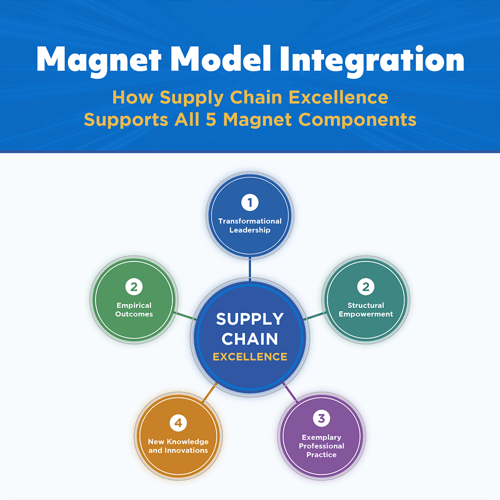
Organizations that fix this do not just recover productivity. They improve nurse satisfaction, retention, and patient care. This is why Einstein Medical Center calls supply chain transformation the number-one contributing factor in achieving Magnet status.
[](https://blog.bluebin.com/hubfs/speed-to-quality-transformation/magnet-model-integration.png)
Click image to view full infographic
---

## What the $14 Billion Actually Measures
Start with the number itself, because it is usually quoted without its math, and that is how it gets misused.
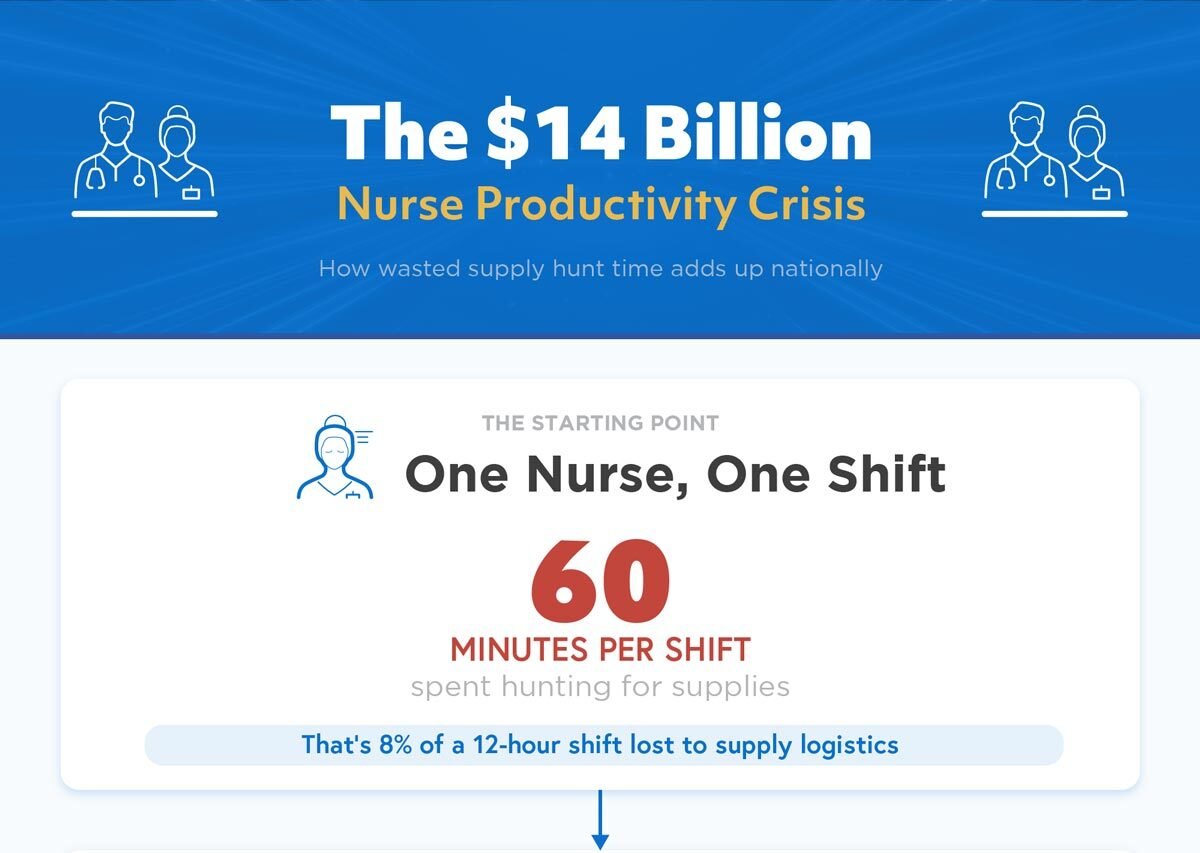
The estimate rests on three inputs: roughly half an hour per nurse per shift spent looking for supplies, about 250 shifts in a full-time year, and roughly 3 million working nurses in the United States.
- 0.5 hours per shift x 250 shifts = about 125 hours per nurse, per year
- 125 hours is 6 to 7% of a full-time nursing year, spent on supply logistics rather than patient care
- Across roughly 3 million nurses, that is about 375 million hours a year, which lands near $14 billion at prevailing nursing
That basis is not improvised. It comes from our [clinical time reclamation](https://www.bluebin.com/resources/whitepapers/clinical-time-reclamation/) research, which is also where the per-facility version of this calculation lives.
Two things are worth saying plainly. This is a modeled figure, not a measured one. And it is deliberately conservative: it counts only nursing time, at half an hour a shift, and ignores the surgical, anesthesia, and support staff pulled into the same searches.
[](https://blog.bluebin.com/hubfs/speed-to-quality-transformation/14b-nurse-productivity-crisis.png)
Click image to view full infographic
### What It Looks Like at One Hospital
The industry total is useful for framing. The number that moves a budget conversation is your own. For a 300-bed hospital with 800 nursing FTEs:
- 800 nurses x 0.5 hours per shift x 250 shifts = 100,000 nursing hours a year
- 100,000 hours x $40 per hour = roughly $4 million annually
Most organizations have never run this calculation, do not track the underlying time, and do not include it in supply chain performance metrics. That is precisely why it rarely appears in a business case, even though it is often comparable to the annual savings target from contract negotiations.

## Why Nurses Hunt for Supplies
The root causes are worth walking through, because each one shows why this is a supply chain problem rather than a nursing problem.
### Stock-Outs and Inadequate PAR Levels
Organizations using manual PAR systems rely on staff estimation of the right inventory levels. That guesswork produces:
- PAR levels set too low, causing frequent stock-outs
- PAR levels set too high for slow movers, while fast movers run out
- PARs that are never adjusted when usage patterns change
- Seasonal variation that static PAR lists cannot absorb
Manual PAR environments run at roughly 65% bin-fill accuracy, meaning the right item is in the right bin about two-thirds of the time. Every miss is a hunt. It is worth being precise here because these two numbers are often conflated: bin-fill accuracy is whether the bin holds what it should, and fill rate is whether the item was available at all. They are different measures and not interchangeable.
Systems built on [data-driven PAR optimization](https://bluebin.com/resources/guides/healthcare-supply-chain-management-guide/) and a 98% typical fill rate eliminate most hunting before it starts.
### Poor Supply Room Organization
When supply rooms lack standardization and visual organization:
- Items move locations without communication
- Similar products are stored in several places
- Labeling is inconsistent or missing
- New staff cannot find supplies without asking a colleague
- Even experienced staff lose time searching
Visual [two-bin Kanban](https://bluebin.com/solutions/hospital-kanban/) systems remove this failure mode. When every supply has a designated, labeled location that never changes, finding it becomes instant, and the empty bin is the signal. No scan, no count, no requisition.
### Hoarding and Workarounds
When nurses do not trust that supplies will be there, they build informal backup systems: personal stashes in lockers and drawers, hidden supplies in non-standard locations, borrowing from other units, over-ordering for procedures just in case.
Hoarding makes the underlying problem worse. It pulls supplies out of circulation, causes stock-outs in the locations that are actually tracked, and feeds a cycle of distrust and workarounds. A 98% typical fill rate removes the reason to hoard, because the bin can be trusted.
### Inadequate Replenishment Frequency
When supply coordinators visit each unit only once or twice a day, an item can run out of stock and remain empty for hours. That leaves nurses choosing among delaying care until the next cycle, searching other locations, using a suboptimal substitute, or calling for an emergency delivery. Optimized replenishment routes with multiple daily visits keep availability high enough that the choice never comes up.
### Procedure Delays and Cancellations
Premier's 2024 Supply Chain Resiliency Report, included in the American Hospital Association's [2025 Environmental Scan](https://www.aha.org/system/files/media/file/2024/11/Environmental-Scan-2025.pdf), found that 39% of providers cancel or reschedule cases or procedures at least quarterly due to product shortages.
Read that frequency again, because it is the part that matters. This is not a figure for how many organizations have ever had a bad day. It is how many are losing cases on a recurring basis, every quarter, to something as ordinary as not having the item on hand.
Each incident pulls in multiple staff to search, coordinate emergency procurement, and reschedule. The productivity cost extends well beyond nursing to surgical teams, anesthesia, and support staff, all of them pulled away from patient care by a supply chain failure.

## The Real Cost Beyond Productivity
The lost hours are the visible cost. The more serious damage shows up in workforce stability and quality of care.
### Nurse Satisfaction and Burnout
Frustration and powerlessness. Nurses trained to provide excellent care spend part of every shift searching for things that should be at hand. The result is a sense of being prevented from doing the job well by a system failure nobody owns.
Moral distress. When a supply issue forces a nurse to choose between hunting for an item and responding to a patient, the trade-off is psychologically damaging, and it repeats.
Loss of professional identity. Clinical professionals end up functioning as logistics coordinators. That role confusion is its own contributor to dissatisfaction.
When Press Ganey surveys place "I have the supplies I need to do my job" among the top 10 dissatisfaction factors, it is telling you that supply chain problems sit alongside staffing ratios and schedule flexibility as burnout drivers.
### Turnover and Replacement Costs
Replacing a single nurse is commonly estimated at $40,000 to $60,000 once recruiting, orientation, ramp-up time, lost institutional knowledge, and temporary staffing are accounted for. If supply availability contributes to even 2 to 3% of nurse turnover, the annual impact at a 300-bed hospital with 800 nursing FTEs runs well into seven figures.
The damage does not stop at replacement cost. Remaining nurses absorb extra shifts and watch colleagues leave, which raises their own risk of leaving. In a tight labor market, a reputation for supply chain problems makes recruiting harder. And higher turnover means more inexperienced nurses on the floor, which is a patient safety issue before it is a financial one.
### Patient Care Quality
Time spent hunting is time not spent responding to call lights, assessing patients, or providing care, and nurse responsiveness is among the strongest drivers of patient ratings of their stay. Rushed nurses who finally locate a supply are more prone to error, and substitutions introduce their own risks. Patients also notice that nurses repeatedly leave the room and return frustrated, which erodes confidence in the care they are receiving.
Organizations that achieve Magnet status, the gold standard for nursing excellence, consistently report that supply chain performance is a factor. Einstein Medical Center puts it directly: *"It was the #1 contributing factor to achieving our Magnet status. Our nurse satisfaction scores dramatically increased due to BlueBin's 2-Bin Kanban solution. Our patient satisfaction scores have benefited as well."*

## What Changes When the Hunting Stops
The result BlueBin sees across its customer base is straightforward: clinician supply hunts are virtually eliminated, and up to 60 minutes per shift goes back to patient care.
Applied to the 300-bed example above, most of those 100,000 hours are spent at the bedside, worth roughly $4 million a year at $40 an hour. But the productivity number is the least interesting part of what changes.
How quickly it changes is its own question, and it is usually the one that decides whether a CNO backs the project. A [speed to quality transformation](https://bluebin.com/speed-to-quality-transformation/) approach delivers a complete facility transformation in 9 to 15 months, compared with the 3 to 5 years an in-house lean implementation typically takes. For a nursing workforce, that is the difference between relief this budget year and relief sometime after the next two hiring cycles.
### Nurse Satisfaction Improvements
Hospitals that fix supply availability report consistent movement in nurse satisfaction, and the drivers are unglamorous: daily frustration disappears, nurses spend their time nursing, reliable availability means they no longer depend on someone else to locate an item, and the improvement is visible from the first week rather than arriving as a line in a quarterly report.
### Retention and Recruitment Benefits
Where supply issues contribute to turnover, removing them improves retention, and even a one- to two-point improvement is worth hundreds of thousands of dollars a year at a mid-sized hospital. It also becomes a recruiting line. *"We have the supplies you need to do your job"* is a more compelling promise than it sounds to anyone who has worked somewhere that couldn’t provide them.
### Patient Satisfaction and Outcomes
Recovered hours go toward patient interaction, assessment, and monitoring, which shows up in responsiveness scores and in clinical outcomes. Patient satisfaction scores carry real reimbursement weight through value-based purchasing, so the effect is both financial and clinical.
[](https://blog.bluebin.com/hs/cta/wi/redirect?encryptedPayload=AVxigLIimHVAmZphD4EbkfKO%2FgF%2BZ%2Bkzwt9kEYuyo7Nquls4QCEABafSPuHBrbndQ3jHXSqvVrU9ar0DJi4H9LYeckHWD7iIrLguP27nWYxn3dwUMRotevuk%2Bxfgi2JVtWmPqhZRpYEItb79%2BBV%2F5d2EkKad%2BZxVUZ0hStQiUqtN9hUUSMQe1MaMFbxm6eqzrLGYZ69a6PT1D7Z%2FGUAkYN8X0EwVZaYTZG5%2FUcW8gxMVxsfeGI5ZW%2FGQUElJTILCifI%3D&webInteractiveContentId=209796959344&portalId=9067872)

## Case Studies: Real Organizations, Real Impact
### Seattle Children's Hospital: Where Supply Chain Meets Magnet Recognition
Seattle Children's Hospital, proud holder of the [ANCC Magnet Recognition Program](https://blog.bluebin.com/achieving-magnet-status-supply-chain-secret-weapon-healthcare-leaders-overlook) designation, awarded to roughly 3% of hospitals nationwide. The hospital notes that the supply chain is part of the Magnet review process, which gauges nurses' involvement in improvement work.
In 2009, before implementing BlueBin, the hospital asked nurses to rate how well they had the right tools to do their jobs. A year into the new system, that rating was 20 percent higher, and it held at that level through the hospital's last survey in 2012. Search time for supplies dropped by 50 percent over the same period.
> *"Honestly, we wouldn't have believed on day one that we would see this kind of lasting impact."*
>
> \- Greg Beach, CBET, former Senior Director of Supply Chain, Seattle Children's Hospital
The deployment started in patient care areas and has since extended into laboratory, environmental sciences, and pharmacy, which is what sustained supply chain improvement tends to look like: it spreads because people ask for it.
### Einstein Medical Center: Magnet Achievement Through Supply Chain
Einstein Medical Center offers the most direct testimony on the Magnet connection. Their Director of Materials Management credits supply chain transformation as the single largest factor in the hospital's Magnet achievement:
> *"EMC has been using BlueBin's replenishment solution for years now. It was the #1 contributing factor to achieving our Magnet status. Our nurse satisfaction scores dramatically increased due to BlueBin's 2-Bin Kanban solution. Our patient satisfaction scores have benefited as well."*
>
> \- Joanne Erb, Director of Materials Management, Einstein Medical Center
### The Ohio State University-Wexner Medical Center: From Top-10 Dissatisfaction to Excellence
When Press Ganey surveys showed that *"I have the supplies I need to do my job"* ranked in the top 10 areas of nurse dissatisfaction at OSUWMC, leadership treated it as a supply chain problem rather than a nursing one.
Patricia Hoch, former Director of Distribution and Logistics, ran process mapping and time studies and concluded that *"we didn't have a people problem but rather a process problem."* The organization, as she put it, *"had an entire inventory system based on how good a guesser you were."* Nurse satisfaction scores improved as supply availability became reliable.
### A Major West Coast Children's Hospital: 70 to 75% Cost Reduction Plus Staff Satisfaction
A major West Coast children's hospital cut targeted OR supply spend by 70-75%, from $320,822.90 before implementation to $79,357.00 after implementation, while stock availability in those areas ranged from 92% to 100%.
Staff impact tracked alongside the cost result: easier access to supplies, less time spent on supply management, and a training process simple enough that a new hire can learn the basics in about 10 minutes. As the Clinical Services Manager put it, *"It has made a tremendous impact, and my staff is learning. They're adjusting to the change."*

## What Healthcare Leaders Should Do Differently
Run the formula against your own numbers:
- Nursing FTEs x 0.5 hours per shift x 250 shifts per year x average hourly rate
The method behind that formula, including how it applies at a single facility, is set out in our [clinical time reclamation](https://www.bluebin.com/resources/whitepapers/clinical-time-reclamation/) research.
Then add turnover costs if supply issues contribute to retention problems, and the reimbursement impact of patient satisfaction. Build it with finance, nursing leadership, and HR rather than inside the supply chain alone, because the magnitude is usually what surprises the executive team.
Our [supply chain ROI calculator](https://bluebin.com/resources/calculators/supply-chain-roi-calculator/) will model the supply expense side alongside it.
### Frame Supply Chain as Nurse Satisfaction
Stop presenting supply chain transformation as purely a cost-reduction initiative. Framed as a workforce strategy, it directly supports Magnet designation, since supply chain performance is part of the review process and nurse satisfaction scores are a critical indicator. CNOs, chief experience officers, and HR leaders become natural allies the moment the conversation is about nursing time rather than about contract savings.
### Invest in Reliable Fill Rates
Anything materially below a 98% typical fill rate means nurses keep hunting, and the productivity and satisfaction cost of that is higher than the cost of fixing it. Reaching and holding that level takes:
- Data-driven PAR optimization rather than guesswork
- Visual Kanban with standardized organization
- Replenishment frequency matched to actual usage
- Real-time visibility through analytics
- A continuous improvement mechanism that survives the project team
Real-time visibility is what keeps the other four honest, which is the role [BlueQ Analytics](https://bluebin.com/solutions/blueq-analytics/) plays: perpetual inventory tracking, so cycle counting no longer consumes supply chain and clinical staff time.
### Involve Nurses in Solution Design
Nurses know exactly where the problems are and what would help. Involve them in identifying high-priority supply issues, designing supply room layout, testing and refining, and training colleagues. Adoption is faster and more complete when the people using the system helped build it.
At Seattle Children's, that collaborative approach built a lasting connection between nurses and the supply chain that continues to shape operations today. Sustaining it past the initial project is a capability question, which is what [BlueBelt certification](https://bluebin.com/solutions/consulting/bluebelt-certification/) is built to answer: train supply chain technicians inside the building to run daily huddles, adjust PAR levels, and audit standard work without outside help.
### Track and Celebrate Progress
Measure the supply hunt time before and after. Survey nurses on availability. Track fill rate. Share the results openly. When nurses see their input producing measurable change in their own working day, engagement rises before the implementation is even finished.

## The Path Forward
The hours nurses spend hunting for supplies are not just a productivity problem. They are an accelerant on a workforce crisis at the worst possible moment.
As the nursing shortage intensifies and competition for talent grows, organizations that continue to treat supply chain failure as normal will struggle to recruit and retain the staff they have. Those that eliminate the hunting and give nurses that time back gain a workforce advantage that is difficult to copy.
The shift required is not really about supply chain performance. It is about recognizing that supply chain excellence is nursing excellence, patient care excellence, and a retention strategy, all at the same time.
Ready to give nurses their time back for patient care? [Request a nursing productivity assessment,](https://bluebin.com/contact/) and we will calculate your organization's supply hunt cost and the cost to recover it.
[](https://blog.bluebin.com/hs/cta/wi/redirect?encryptedPayload=AVxigLJUhb8tWVOzUahjGGmu6s1%2FiNUjDUg3ICk8rHvclbRB1Z5IugMMZkz1ZWBGhMYwvc8Uhg54wOrHWdKFlNCQBcNGN6ofRxrXLC9KxzFhwP84m0rBQTFCowaFzS8G%2FbjJ4crC9r767fKNMOuVPHM7Y0zNX%2BPX6v029S5h3dl7%2FtmMjwkPSzDxGBR%2BXhzzx6aLQgYQdgD624Qgn9ZIHi5YbNJWEEJI8clwysf%2F&webInteractiveContentId=199003260238&portalId=9067872)
# Frequently Asked Questions
### How Much Time Do Nurses Actually Spend Hunting for Supplies?
The working estimate is about half an hour per nurse per shift, which is roughly 125 hours a year for a full-time nurse. Published estimates range higher, and the honest answer is that very few hospitals have measured it in their own building. The half-hour figure is used here because it is conservative and serves as the basis for the $14 billion industry estimate.
### How Do We Quantify Supply Hunt Costs at Our Own Hospital?
Multiply nursing FTEs by 0.5 hours per shift by 250 shifts per year by your average hourly rate. Three ways to sharpen the input: shadow nurses for representative shifts and track search time directly; survey nurses about time spent searching; or start with the half-hour benchmark and refine later. The precise number matters less than establishing a baseline against which you can measure improvement.
### What Is the Connection Between Supply Chain and Magnet Status?
Magnet recognition requires demonstrating nursing excellence across several dimensions, including work environment and job satisfaction. Supply reliability affects all of them, and supply chain is part of the review process, which gauges nurses' involvement in improvement work. Einstein Medical Center calls it the number-one contributing factor to its Magnet achievement.
### How Quickly Do Nurse Satisfaction Scores Improve?
Organizations typically see measurable movement within three to six months of achieving reliable availability. The change tends to be pronounced because it is tangible: unlike most satisfaction initiatives, nurses feel this one on the first shift after the bins are in place.
### Do Supply Chain Improvements Help Clinical Staff Beyond Nurses?
Yes. Physicians, respiratory therapists, surgical techs, and perioperative staff all benefit, and procedure delays bring whole teams in at once. Nurses are the focus here because they are the largest clinical workforce and usually carry the most responsibility for supplies at the point of use, which means the $14 billion estimate understates the total clinical time involved.
### Can We Improve Nurse Satisfaction Without a Full Supply Chain Transformation?
Partial improvement helps, but the returns are not linear. Moving the fill rate from 85% to 92% still leaves nurses experiencing regular stock-outs, and hoarding and workarounds persist until the system is trusted. Reliability is what changes the daily experience, and reliability is a property of the whole system rather than of any single fix.
## Related Resources
[The $14 Billion Nursing Productivity Crisis Infographic](https://blog.bluebin.com/hubfs/speed-to-quality-transformation/14b-nurse-productivity-crisis.png)
[Case Study: Seattle Children's Hospital's Path to Magnet Status](https://bluebin.com/results/case-studies/seattle-childrens-hospital-research-foundation/)
[Magnet Model Integration: How supply chain excellence supports all 5 Magnet model components infographic](https://blog.bluebin.com/hubfs/speed-to-quality-transformation/magnet-model-integration.png)

Post by [Jeremy Harvey](https://blog.bluebin.com/author/jeremy-harvey)
Feb 20, 2026, 3:54:22 PM
Jeremy Harvey is the Senior Director of Marketing & Brand at BlueBin, where he architects content strategy and brand development for one of healthcare's leading supply chain solutions providers. With 21 years of marketing experience — including more than five years in healthcare supply chain and 13 years across B2B industries — he brings a strategic, data-informed approach to helping healthcare organizations understand the operational and financial value of smarter supply chain management. Jeremy holds a Bachelor's degree in Graphic Design & New Media and a minor in Industrial Technology, with a concentration in design.
[Follow me on LinkedIn](https://www.linkedin.com/in/thejeremyharvey/)
###### Explore Topics
- [Automation](https://blog.bluebin.com/tag/automation)
- [Clinical/Patient care](https://blog.bluebin.com/tag/clinical-patient-care)
- [Cybersecurity](https://blog.bluebin.com/tag/cybersecurity)
- [Data Standards](https://blog.bluebin.com/tag/data-standards)
- [ERP](https://blog.bluebin.com/tag/erp)
- [Financial](https://blog.bluebin.com/tag/financial)
- [Inventory management](https://blog.bluebin.com/tag/inventory-management)
- [Kanban](https://blog.bluebin.com/tag/kanban)
- [Leadership](https://blog.bluebin.com/tag/leadership)
- [Operations](https://blog.bluebin.com/tag/operations)
- [Optimization](https://blog.bluebin.com/tag/optimization)
- [Ordering & Receiving](https://blog.bluebin.com/tag/ordering-receiving)
- [Replenishment](https://blog.bluebin.com/tag/replenishment)
- [Reporting & Analytics](https://blog.bluebin.com/tag/reporting-analytics)
- [Resilience](https://blog.bluebin.com/tag/resilience)
- [Sustainability](https://blog.bluebin.com/tag/sustainability)
- [Warehousing](https://blog.bluebin.com/tag/warehousing)
- [supply chain disruption](https://blog.bluebin.com/tag/supply-chain-disruption)
- [transformation](https://blog.bluebin.com/tag/transformation)
###### Recent Articles
[Hospital Supply Chain Management Software: 7 Factors to Evaluate Before You Sign](https://blog.bluebin.com/hospital-supply-chain-management-software)
[9 Best Hospital Inventory Management Systems for ROI in 2026](https://blog.bluebin.com/best-hospital-inventory-management-systems-2026)
[AHRMM26 Recap: What Healthcare Supply Chain Leaders Are Prioritizing in 2026](https://blog.bluebin.com/ahrmm26-recap-supply-chain-trends-2026)
[When a Distributor's Warehouse Burns Down: What One Warehouse Fire Reveals About Healthcare Supply Chain Vulnerability](https://blog.bluebin.com/warehouse-fire-exposes-healthcare-supply-chain-vulnerability)
[54% of Healthcare Leaders Need Supply Chain ROI in 12 Months](https://blog.bluebin.com/ahrmm26-healthcare-supply-chain-roi)
[Hardware Solutions vs. Transformation: Why Storage Optimization Alone Isn't Enough](https://blog.bluebin.com/hardware-solutions-vs-transformation-why-storage-optimization-alone-isnt-enough)
[True Cost of Ownership: Comparing Kanban, Cabinets, and Manual PAR Systems](https://blog.bluebin.com/true-cost-ownership-comparing-kanban-cabinets-manual-par-systems)
[Hospital Supply Chain Disruption in 2026: What the Iran Conflict Reveals](https://blog.bluebin.com/hospital-supply-chain-disruption-2026)
[ESG and Healthcare: How Supply Chain Waste Reduction Supports Green Bond Eligibility](https://blog.bluebin.com/esg-healthcare-how-supply-chain-waste-reduction-supports-green-bond-eligibility)
[Hospital Supply Chain Resilience: From COVID-19 to Geopolitical Disruption](https://blog.bluebin.com/supply-chain-resilience-after-covid-19)
[](https://bluebin.com/)
Improving the healthcare supply chain process, ensuring that clinicians have the right supplies at the right time.
-
-
-
-
-
### CONTACT
- [bluebinsales@capsahealthcare.com](mailto:bluebinsales@capsahealthcare.com)
- (855) 896-2467
- 8170 Dove Pkwy
Canal Winchester, OH 43110
- QUICK LINKS
- [Supply Chain Solutions](https://bluebin.com/solutions/)
- [Healthcare Kanban](https://bluebin.com/solutions/hospital-kanban/)
- [BlueQ Analytics](https://bluebin.com/solutions/blueq-analytics/)
- [BlueQ SmartScan](https://bluebin.com/solutions/blueq-smartscan/)
- [Supply Chain Consulting](https://bluebin.com/solutions/consulting/)
- [Case Studies](https://bluebin.com/results/case-studies/)
- [About Us](https://bluebin.com/company/our-team-our-story/)
- - [Whitepapers](https://bluebin.com/resources/whitepapers/)
- [Guides & Checklists](https://bluebin.com/resources/guides/)
- [Calculators](https://bluebin.com/resources/calculators/)
- [Blog](https://blog.bluebin.com/)
- [Careers](https://bluebin.com/company/careers/)
- [Contact](https://bluebin.com/contact/)
- [Support](mailto:bluebin.support@capsahealthcare.com?subject=Bluebin%20Support%20Request)
© 2026 BlueBin Inc. All Rights Reserved
[Sitemap](https://bluebin.com/page-sitemap.xml?__hstc=51647990.6d18215ae56f1f7281d0f59df56a7960.1616739528041.1616739528041.1616739528041.1&__hssc=51647990.19.1616739528042&__hsfp=1866732115)
```json
{
"@context" : "https://schema.org",
"@type" : "BlogPosting",
"author" : {
"@type" : "Person",
"name" : "Jeremy Harvey",
"url" : "https://blog.bluebin.com/author/jeremy-harvey"
},
"dateModified" : "2026-09-17T20:07:43.663Z",
"datePublished" : "2026-02-20T23:54:22.000Z",
"headline" : "Nurse Burnout and Supply Hunts: The $14B Crisis",
"image" : [ "https://blog.bluebin.com/hubfs/60-minutes-lost-every-shift.png" ],
"mainEntityOfPage" : {
"@id" : "https://blog.bluebin.com/nurse-burnout-supply-hunts-the-14b-productivity-crisis-healthcare-ignores",
"@type" : "WebPage"
},
"publisher" : {
"@type" : "Organization",
"logo" : {
"@type" : "ImageObject",
"url" : "https://blog.bluebin.com/hubfs/bluebin-logo.png"
},
"name" : "BlueBin"
}
}
```
```json
{
"@context" : "https://schema.org",
"@type" : "FAQPage",
"mainEntity" : [ {
"@type" : "Question",
"acceptedAnswer" : {
"@type" : "Answer",
"text" : "The working estimate is about half an hour per nurse per shift, which is roughly 125 hours a year for a full-time nurse. Published estimates range higher, and the honest answer is that very few hospitals have measured it in their own building. The half-hour figure is used here because it is conservative and because it is the basis the $14 billion industry estimate is built on."
},
"name" : "How Much Time Do Nurses Actually Spend Hunting for Supplies?"
}, {
"@type" : "Question",
"acceptedAnswer" : {
"@type" : "Answer",
"text" : "Multiply nursing FTEs by 0.5 hours per shift by 250 shifts per year by your average hourly rate. Three ways to sharpen the input: shadow nurses for representative shifts and track search time directly, survey nurses on time spent searching, or start with the half-hour benchmark and refine later. The precise number matters less than establishing a baseline you can measure improvement against."
},
"name" : "How Do We Quantify Supply Hunt Costs at Our Own Hospital?"
}, {
"@type" : "Question",
"acceptedAnswer" : {
"@type" : "Answer",
"text" : "Magnet recognition requires demonstrating nursing excellence across several dimensions, including work environment and job satisfaction. Supply reliability affects all of them, and supply chain is part of the review process, which gauges nurses' involvement in improvement work. Einstein Medical Center calls it the number one contributing factor in their Magnet achievement."
},
"name" : "What Is the Connection Between Supply Chain and Magnet Status?"
}, {
"@type" : "Question",
"acceptedAnswer" : {
"@type" : "Answer",
"text" : "Organizations typically see measurable movement within three to six months of achieving reliable availability. The change tends to be pronounced because it is tangible: unlike most satisfaction initiatives, nurses feel this one on the first shift after the bins are in place."
},
"name" : "How Quickly Do Nurse Satisfaction Scores Improve?"
}, {
"@type" : "Question",
"acceptedAnswer" : {
"@type" : "Answer",
"text" : "Yes. Physicians, respiratory therapists, surgical techs and perioperative staff all benefit, and procedure delays pull in whole teams at once. Nurses are the focus here because they are the largest clinical workforce and usually carry the most responsibility for supplies at the point of use, which means the $14 billion estimate understates the total clinical time involved."
},
"name" : "Do Supply Chain Improvements Help Clinical Staff Beyond Nurses?"
}, {
"@type" : "Question",
"acceptedAnswer" : {
"@type" : "Answer",
"text" : "Partial improvement helps, but the returns are not linear. Moving fill rate from 85% to 92% still leaves nurses experiencing regular stock-outs, and the hoarding and workarounds do not stop until the system is trusted. Reliability is what changes the daily experience, and reliability is a property of the whole system rather than of any single fix."
},
"name" : "Can We Improve Nurse Satisfaction Without a Full Supply Chain Transformation?"
} ]
}
```
```json
{
"@context" : "https://schema.org",
"@type" : "Person",
"jobTitle" : "Senior Director of Marketing & Brand",
"name" : "Jeremy Harvey",
"sameAs" : "https://www.linkedin.com/in/thejeremyharvey/",
"url" : "https://blog.bluebin.com/author/jeremy-harvey"
}
```