

Key Takeaways
- Healthcare wastes $25.7 billion annually on preventable supply chain inefficiencies across 8 measurable categories—none of it from poor contract negotiation.
- Product expiration averages 8–10% of supply spend industrywide; organizations with best-in-class management reduce this to under 1% of supply spend.
- Nurses spend up to 60 minutes per shift hunting for supplies, costing U.S. healthcare an estimated $14 billion annually in clinical productivity loss.
- Organizations that systematically address these inefficiencies achieve 7% reductions in supply expenses, 30% operational efficiency gains, and supply hunts virtually eliminated.
The healthcare industry wastes $25.7 billion annually on supply chain inefficiencies. This staggering figure doesn't come from overpaying for supplies or getting unfavorable contract terms. It stems from operational waste that most organizations fail to measure: expired products sitting on shelves, excess inventory tying up capital, nurses spending an hour every shift hunting for supplies, and procedures delayed because critical items are unavailable.
This waste is preventable. Organizations that systematically address supply chain inefficiencies achieve 7% reductions in supply expenses, 30% gains in operational efficiency, and supply hunts are virtually eliminated, not through harder negotiating, but through better systems.
Understanding the components of this $25.7 billion problem is the first step toward capturing your share of the supply chain transformation opportunity.
The Eight Sources of Supply Chain Waste
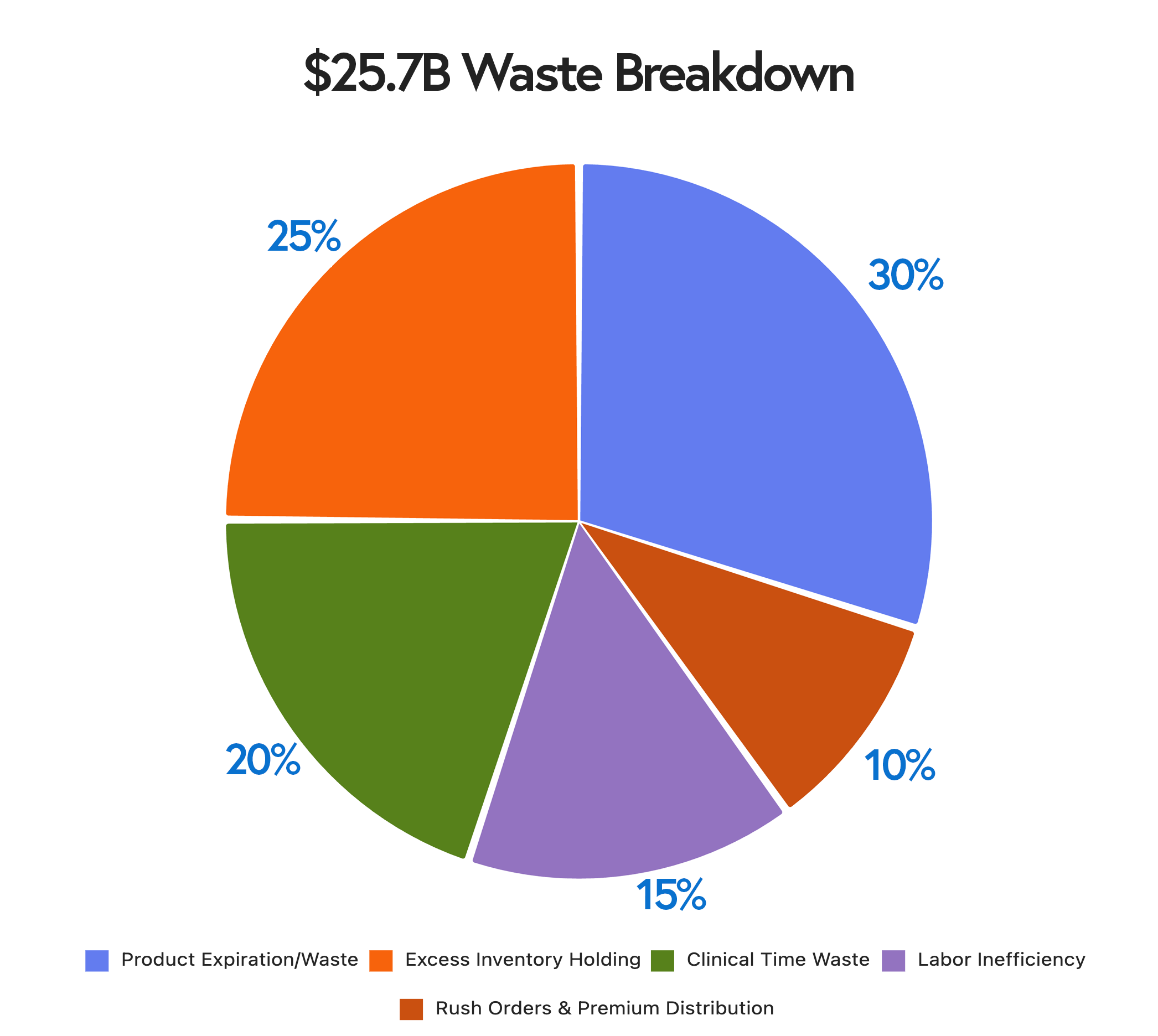
Healthcare supply chain waste manifests in eight distinct categories, each representing significant financial loss:
1. Product Expiration and Obsolescence
The average for product expiration in the healthcare industry is 8-10% of total supply spend. For a hospital spending $100 million annually on medical supplies, that's $8-10 million in products that expire before being used.
The math is devastating:
- Products purchased at full price
- Stored at significant carrying cost
- Never used for patient care
- Disposed of at additional cost
- Then repurchased to replace expired inventory
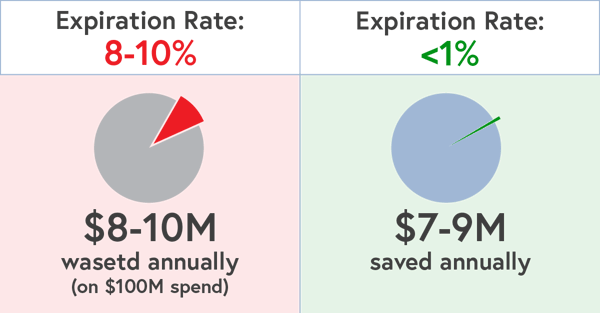
Organizations with proper supply chain visibility and management reduce expirations to less than 1%, saving $7-9 million annually for our example hospital. This single improvement alone often pays for a comprehensive supply chain transformation.
2. Excess Inventory and Carrying Costs
Hospitals typically carry 20-30% of annual supply spend in inventory. The carrying cost, the actual expense of maintaining that inventory, runs 20-30% annually.
For a hospital with $100M in annual supply spend:
- Average inventory: $25 million
- Carrying cost at 25%: $6.25 million annually
This carrying cost includes:
- Physical space that could generate revenue through patient care areas
- Insurance and security
- Obsolescence risk
- Capital cost (opportunity cost of money tied up in inventory)
- Management and handling labor
Organizations that optimize inventory levels through improved visibility and predictive ordering reduce inventory by 15-25%, freeing $3.75-$6.25 million in working capital and saving $1-$1.5 million annually in carrying costs.
3. Clinical Time Wasted on Supply Management
Perhaps the most expensive and overlooked waste: nurses spend up to 60 minutes per shift hunting for supplies instead of caring for patients.
With 3 million nurses in the United States earning an average of $35-45 per hour, the aggregate cost of supply hunting reaches $14 billion annually across the industry.
For a typical 300-bed hospital with 800 nursing FTEs:
- 800 nurses × 0.5 hours × 250 shifts = 292,000 hours
- 292,000 hours × $40/hour = $11.7 million annually in nursing time wasted on supply hunts
This waste is particularly damaging because:
- It reduces time available for patient care
- It impacts nurse satisfaction in an industry facing critical shortages
- It increases turnover risk (replacement cost: $40,000-60,000 per nurse)
- It affects patient satisfaction scores and reimbursement
Organizations that eliminate supply hunts save $5-6 million annually while dramatically improving nurse and patient satisfaction.
4. Procedure Delays and Cancellations
Research shows that 40% of healthcare staff have cancelled a case due to a lack of supplies. Each cancelled or delayed procedure represents:
- Lost revenue from the procedure itself
- OR time that can't be recovered
- Staff time wasted in preparation
- Patient dissatisfaction and potential safety issues
- Rescheduling costs
For a mid-sized hospital, procedure delays attributable to supply issues conservatively cost $2 million to $4 million annually in lost revenue and operational disruption.
5. Rush Orders and Emergency Deliveries
When supplies aren't available through normal channels, organizations pay premiums for expedited delivery:
- Same-day vendor deliveries at 50-100% premium
- Courier services for emergency transfers between facilities
- Emergency purchases from local sources at retail prices rather than contract rates
- Staff time coordinating emergency procurement
Organizations with poor supply chain visibility may spend $1 million to $2 million annually on avoidable rush orders and emergency deliveries, expenses that could be eliminated through better planning and inventory management.
6. Inefficient Distribution of Labor
Manual counting, guesswork-based replenishment, multiple trips to the same location, emergency deliveries that disrupt planned routes—these inefficiencies typically mean organizations deploy 30-50% more distribution labor than necessary. A two-bin Kanban system addresses these inefficiencies at the source, replacing manual counting with a simple visual signal that triggers replenishment only when supplies are actually needed.
For a hospital spending $3-4 million annually on supply chain distribution labor, eliminating 30% of waste saves $1 million to $1.2 million annually in direct labor costs, plus significant indirect benefits from better resource allocation.
7. Space Utilization Waste
Hospital space commands premium pricing, $400-$600 per square foot to build and $50-$100 per square foot annually to operate. Excess inventory occupies space that could be utilized to generate revenue through patient care areas.
Organizations that reduce inventory by 20-30% often reclaim 1,000-3,000 square feet per facility. Converted to revenue-generating space, this represents hundreds of thousands of dollars in annual value.
8. Staff Turnover from Dissatisfaction
Supply chain problems directly impact staff satisfaction. When Press Ganey surveys at Ohio State University-Wexner Medical Center asked nurses about dissatisfaction factors, "I have the supplies I need to do my job" ranked in the top 10 concerns.
The cost to replace a single nurse ranges from $40,000 to $60,000. If poor supply availability contributes to even a 2-3% increase in nurse turnover, the financial impact for a 300-bed hospital could exceed $1 million to $2 million annually.
The Cumulative Impact: A Mid-Sized Hospital Example
Let's quantify total waste for a typical mid-sized hospital spending $100 million annually on medical supplies:
- Product expiration (8%): $8 million
- Excess inventory carrying costs: $6.25 million
- Nursing time on supply hunts: $11.7 million
- Procedure delays/cancellations: $3 million
- Rush orders/emergency deliveries: $1.5 million
- Inefficient distribution labor: $1 million
- Space utilization waste: $0.5 million
- Incremental turnover: $1.5 million
Total Annual Waste: $33.45 million
This represents 33% additional cost beyond the purchase price of supplies. Waste that never appears as a line item in supply chain reports but profoundly impacts hospital economics.

Why This Waste Persists
If the problem is this large and this expensive, why hasn't it been solved?
Measurement Challenges
Most organizations don't calculate total supply chain waste because the components are distributed across multiple departments and budget lines:
- Expiration write-offs appear in multiple accounts
- Carrying costs aren't explicitly calculated
- Clinical time waste is buried in nursing labor costs
- Procedure impacts aren't tracked to supply causes
- Space costs are allocated to facilities, not supply chain
Without measurement, problems remain invisible. Without visibility, they don't get managed.
Organizational Silos
No single executive owns total supply chain economics:
- Purchase price is owned by supply chain
- Nursing labor reports to CNO
- Facilities costs report to operations
- Patient satisfaction falls under patient experience
- Clinical outcomes are quality and safety's domain
Cross-functional problems require cross-functional solutions, but organizational structures work against this.
Technology Illusion
Organizations often believe that technology alone will solve supply chain problems. They invest in automated dispensing cabinets, RFID systems, or enterprise software, expecting that better tools will automatically generate better results.
But technology without process discipline simply automates chaos. The West Coast Children's Hospital, which achieved a 70-75% cost reduction, demonstrated that process excellence consistently outperforms technology.

The Transformation Opportunity
Organizations that systematically address supply chain waste achieve remarkable results. The key is a comprehensive transformation that addresses the entire problem, not just individual components.
A Large Midwest Nonprofit Health System: Eliminating Waste at Scale
Their system-wide transformation demonstrates what's possible:
Investment: $6.70 million over 36 months
Returns:
- $12.8 million annually in supply expense reduction (eliminating purchase price waste, expiration, and inefficiencies)
- $5.8 million one-time working capital release (inventory optimization)
- $1.9 million annually in resource redeployment (distribution labor efficiency)
- Additional clinical time savings through virtually eliminating supply hunts
Total impact: Eliminating tens of millions in annual waste through systematic transformation
ROI: 7.4x
The Broader Pattern
The health system's experience isn't unique. Organizations that implement comprehensive supply chain transformation consistently achieve:
Financial Impact:
- 7% supply expense reduction
- 15-25% inventory reduction
- 30% operational efficiency gains
- 6-12 month cash ROI
Operational Performance:
- >98%+ fill rate (vs. 85-95% industry average)
- <1% expiration rate (vs. 8-10% industry norm)
- 99.9% bin fill accuracy (vs. 65% in manual environments)
- Near-zero stock-outs
Clinical Impact:
- Supply hunts virtually eliminated
- Thousands of hours given back to clinicians
- 80% decrease in expired products
- Significant improvement in staff satisfaction
Organizations achieving Magnet status consistently cite supply chain excellence as a contributing factor. Einstein Medical Center specifically identified supply chain transformation as the "#1 contributing factor to achieving Magnet status."
What Healthcare Leaders Should Do Differently
To capture your organization's share of the $25.7 billion opportunity:
Calculate Your Specific Waste
Use this framework to quantify your waste:
- Expiration rate × annual supply spend
- Average inventory × 25% carrying cost
- (Number of nurses × 0.5 hours per shift × hourly rate × 730 shifts per year)
- Estimate procedure delays/cancellations attributable to supply issues
- Quantify premium costs for rush orders and emergency deliveries
- Calculate excess distribution labor (estimate 20-40% waste)
- Evaluate space occupied by excess inventory
- Assess incremental turnover impact
Collaborate with finance to develop your comprehensive cost model. The magnitude of the opportunity will likely surprise executive leadership.

Build the Cross-Functional Business Case
Bring together stakeholders from:
- Supply chain (purchase price, distribution efficiency)
- Finance (carrying costs, working capital)
- Nursing (clinical time waste, satisfaction)
- Quality (procedure impacts, patient safety)
- Operations (space utilization, efficiency)
When the complete picture becomes visible, the business case for comprehensive transformation becomes compelling.
Invest in Visibility and Analytics
You can't manage what you can't measure. BlueQ Analytics and similar systems make waste visible through:
- Real-time expiration tracking and predictive alerts
- Heat maps showing problem areas
- Fill rate monitoring that reveals the true cost of stock-outs
- Labor time tracking that quantifies distribution efficiency
- Inventory optimization that identifies excess and dead stock
The visibility itself often reveals opportunities worth 10x the cost of the analytics platform.
Pursue Comprehensive Transformation, Not Point Solutions
Addressing individual waste components delivers limited returns. A comprehensive transformation that optimizes the entire system provides exponential results.
Organizations that achieve 7.4x ROI don't get there by nibbling around the edges. They systematically address expiration, inventory, clinical time waste, distribution efficiency, and space utilization simultaneously.

The Path Forward
The healthcare industry's $25.7 billion annual waste in supply chain operations represents both a crisis and an opportunity. Organizations that continue to manage supply chains the way they have always have will continue to generate the same waste. Those that embrace comprehensive transformation will eliminate tens of millions in annual losses while improving clinical operations and staff satisfaction.
The waste is measurable, the solutions are proven, and the returns are extraordinary. The question is whether your organization will continue to accept preventable waste or commit to a systematic transformation.
The organizations getting this right aren't just saving money on supplies. They're transforming healthcare delivery by ensuring that clinicians have precisely what they need, when they need it, while eliminating waste and building resilient systems that prioritize patient care.
Ready to quantify your supply chain waste? Explore BlueBin's hospital inventory management solutions to see how leading health systems have eliminated millions in annual losses — then request a comprehensive waste assessment to build your own business case.
Related Resources:
- Supply Chain Waste Calculator
- Case Study: Large Nonprofit Health System Eliminates $20M+ in Annual Waste
Frequently Asked Questions
