---
title: Why Automated Dispensing Cabinets Fail to Deliver Expected ROI for Everyday Supplies
description: Automated cabinets promise efficiency but often underdeliver. Discover why high-tech isn't always the answer and what works better for most hospitals.
image: https://blog.bluebin.com/hubfs/automated-cabinets-fail-roi.jpg
---
[Skip to main content](https://blog.bluebin.com/why-automated-dispensing-cabinets-fail-deliver-expected-roi#main-content)
[BlueBin Rated #1 in Black Book 2026 Healthcare Supply Chain Report](https://bluebin.com/results/news/bluebin-ranked-number-one-black-book-2026-healthcare-supply-chain/)
-
-
-
-
-
[   ](https://bluebin.com/)
- [Show submenu for Solutions Solutions](https://bluebin.com/solutions/)
- [BlueBin Kanban](https://bluebin.com/solutions/hospital-kanban/)
- [BlueQ Analytics](https://bluebin.com/solutions/blueq-analytics/)
- [BlueQ SmartScan](https://bluebin.com/solutions/blueq-smartscan/)
- [Consulting & Training](https://bluebin.com/solutions/consulting/)
- [Kanban Supplies](https://bluebin.com/solutions/hospital-kanban-supplies/)
- [Show submenu for Results Results](https://bluebin.com/results/)
- [Case Studies](https://bluebin.com/results/case-studies/)
- [Videos](https://bluebin.com/results/videos/)
- [News](https://bluebin.com/results/news/)
- [Show submenu for About Us About Us](https://bluebin.com/company/)
- [Our Team + Our Story](https://bluebin.com/company/our-team-our-story/)
- [Partner with BlueBin](https://bluebin.com/company/partnering-with-bluebin/)
- [Events](https://bluebin.com/events/)
- [Careers](https://bluebin.com/company/careers/)
- [Get Support](mailto:bluebin.support@capsahealthcare.com?subject=Bluebin%20Support%20Request)
- [Show submenu for Resources Resources](https://bluebin.com/resources/)
- [Blog](https://blog.bluebin.com)
- [Whitepapers](https://bluebin.com/resources/whitepapers/)
- [Guides & Checklists](https://bluebin.com/resources/guides/)
- [Calculators](https://bluebin.com/resources/calculators/)
- [Newsletter Archive](https://bluebin.com/resources/bluebin-newsletter-archive/)
- [Contact](https://bluebin.com/contact/)
Open main navigation
Close main navigation
- Show submenu for Solutions Solutions
- [BlueBin Kanban](https://bluebin.com/solutions/hospital-kanban/)
- [BlueQ Analytics](https://bluebin.com/solutions/blueq-analytics/)
- [BlueQ SmartScan](https://bluebin.com/solutions/blueq-smartscan/)
- [Consulting & Training](https://bluebin.com/solutions/consulting/)
- [Kanban Supplies](https://bluebin.com/solutions/hospital-kanban-supplies/)
- Show submenu for Results Results
- [Case Studies](https://bluebin.com/results/case-studies/)
- [Videos](https://bluebin.com/results/videos/)
- [News](https://bluebin.com/results/news/)
- Show submenu for About Us About Us
- [Our Team + Our Story](https://bluebin.com/company/our-team-our-story/)
- [Partner with BlueBin](https://bluebin.com/company/partnering-with-bluebin/)
- [Events](https://bluebin.com/events/)
- [Careers](https://bluebin.com/company/careers/)
- [Get Support](mailto:bluebin.support@capsahealthcare.com?subject=Bluebin%20Support%20Request)
- Show submenu for Resources Resources
- [Blog](https://blog.bluebin.com)
- [Whitepapers](https://bluebin.com/resources/whitepapers/)
- [Guides & Checklists](https://bluebin.com/resources/guides/)
- [Calculators](https://bluebin.com/resources/calculators/)
- [Newsletter Archive](https://bluebin.com/resources/bluebin-newsletter-archive/)
- [Contact](https://bluebin.com/contact/)
Search
- [Inventory management](https://blog.bluebin.com/tag/inventory-management)
- [Automation](https://blog.bluebin.com/tag/automation)
- [Financial](https://blog.bluebin.com/tag/financial)
# Why Automated Dispensing Cabinets Fail to Deliver Expected ROI for Everyday Supplies
 by [Jeremy Harvey](https://blog.bluebin.com/author/jeremy-harvey) Dec 18, 2025
Table of contents
Why Automated Dispensing Cabinets Fail to Deliver Expected ROI for Everyday Supplies
14:11
Key Takeaways
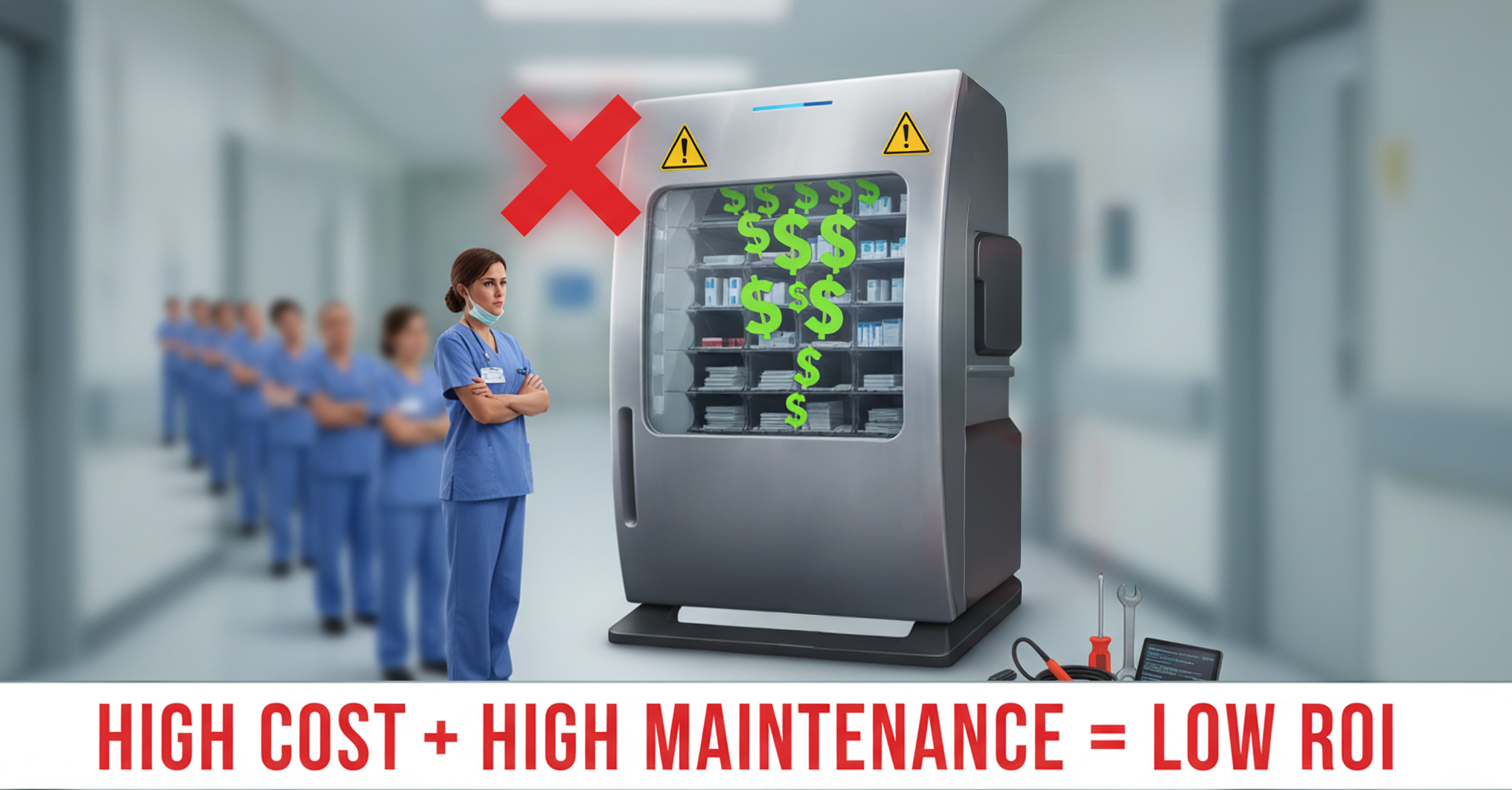
- ADCs deliver strong ROI in pharmacy, lab, and procedural areas—but for 85–90% of everyday clinical supplies, they consistently underdeliver on expected returns.
- Annual maintenance contracts run 15–20% of original purchase price, creating a compounding cost cycle that grows year over year.
- The Queen's Health System replaced aging Omnicell cabinets after determining the upgrade cost was prohibitive relative to supply chain value delivered.
- Two-bin Kanban systems consistently outperform ADCs on total cost of ownership for general medical/surgical supplies—with no maintenance contracts and 98%+ fill rates.
When The Queen's Health System faced aging automated dispensing cabinets requiring expensive system-wide upgrades, they discovered what many healthcare organizations learn too late: automated dispensing cabinets (ADCs) often cost more than they save. With prohibitive replacement costs, high ongoing maintenance expenses, and clinicians waiting in line just to access supplies, Queen's made a strategic decision that would transform their entire supply chain. The question isn't whether ADCs seemed like a good idea at the time; it's why they consistently fail to deliver the ROI that hospitals expect.
## The Hidden Costs Healthcare Systems Can't Ignore
[Automated dispensing cabinets](https://www.capsahealthcare.com/product-category/automated-dispensing-cabinets/) have always had strong utility and positive results in certain areas of the hospital. They can be highly effective in pharmacy, lab, and some procedural areas where high-dollar, chargeable items require precise tracking and security. In these specialized settings, ADCs deliver clear value through controlled access, detailed usage documentation, and compliance with regulatory requirements.
The issue starts with the other 85-90% of medical supplies in the hospital. For these everyday clinical items, the promise of automated dispensing cabinets has always been compelling: improved inventory control, reduced waste, and better supply chain visibility. Yet after implementation, many healthcare systems find themselves trapped in a costly cycle of hardware maintenance, limited flexibility, and minimal actual efficiency gains. According to Matt Sasai, Senior Director of Supply Chain Operations and Purchasing at [The Queen's Health System](https://bluebin.com/results/case-studies/queens-health-system-case-study/), the high maintenance costs delivered limited supply chain value, particularly for medical supplies versus pharmacy.

## The True Cost Structure of Automated Dispensing Cabinets
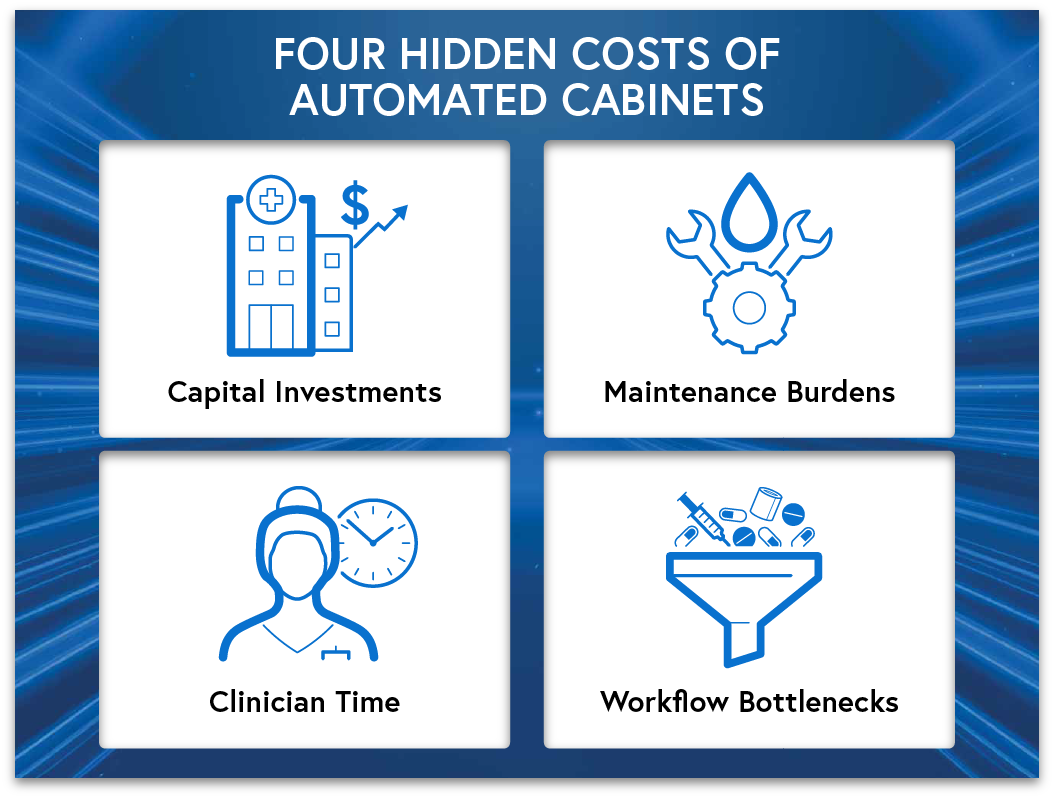
Healthcare executives evaluating ADC systems typically focus on the upfront capital investment; however, the real financial burden becomes apparent over time through multiple cost layers that compound year after year.
### Capital Intensive Infrastructure Investments
The initial capital investment for automated dispensing cabinets represents a substantial financial commitment. Large health systems can spend millions implementing ADC infrastructure across multiple facilities. But the upfront costs are only the beginning.
Equipment lifecycle creates recurring capital demands. As technology evolves and hardware ages, systems require expensive upgrades or complete replacement. The Queen's Health System faced exactly this scenario with their aging Omnicell cabinets—the cost to upgrade their existing system across all facilities was prohibitive, forcing a strategic reevaluation of their entire point-of-use approach.
### High Ongoing Maintenance Burden
Annual maintenance contracts typically range from 15 to 20 percent of the original purchase price, creating a perpetual expense that continues year after year. These contracts are essential. Without them, systems quickly become inoperable, leaving hospitals vulnerable to disruptions in their supply chains.
Technical support requirements add additional labor costs. When cabinets malfunction, supplies become inaccessible, creating urgent situations that require immediate intervention from IT and materials management. These troubleshooting incidents occur regularly and demand dedicated staff time that could be spent on value-added supply chain optimization activities.
### Limited Supply Chain Value for Medical Supplies
While ADCs provide reasonable functionality for controlled pharmacy items, their value proposition becomes questionable when applied to general medical supplies. The Queen's Health System identified this disconnect as a primary concern. The maintenance costs and system complexity delivered limited benefit for the vast majority of supplies that don't require the security features ADCs provide.
Cabinet space limitations create additional costs. Physical constraints limit the amount of supplies that can be stored in ADCs, necessitating the use of parallel inventory management systems and duplicate processes. This split approach eliminates the efficiency gains that ADCs promise while maintaining the full cost burden of the hardware infrastructure.
#### Subscribe to our Blog!

## The Clinician Time Tax: Hidden Productivity Losses
Beyond direct hardware and maintenance expenses, ADCs impose substantial hidden costs through their impact on clinical workflow. Industry research shows nurses lose an average of 60 minutes per shift hunting for supplies; a problem that ADCs were supposed to solve but often exacerbate.
### Wait Times and Workflow Interruptions
Matt Sasai from The Queen's Health System described a scenario familiar to many healthcare organizations: clinicians waiting in line at Omnicells to access needed supplies. "They used to talk about how there used to be a waiting line at the Omnicells when they'd have to pull supplies," he noted, highlighting one of the fundamental workflow problems with ADC systems.
Unlike traditional storage, where multiple clinicians can access supplies simultaneously, ADCs create bottlenecks. Only one user can interact with a cabinet at a time, forcing others to wait. During peak activity periods, such as shift changes, emergencies, or procedure preparation, these wait times compound, pulling nurses away from patient care precisely when their clinical expertise is most needed.
### System Dependence and Intervention Requirements
The Queen's Health System discovered that its ADC system required constant clinician intervention to order accurately, leading to artificially inflated PAR levels. Staff learned to manipulate the PeopleSoft system to obtain the necessary supplies, entering zero counts to trigger complete PAR orders instead of accurate inventory figures.
This workaround behavior reveals a critical failure mode: when the technology becomes more burdensome than helpful, clinical staff develop unofficial processes that undermine the system's intended benefits. The result is inaccurate data, inflated inventory levels, and increased costs–the opposite of what ADCs promise.
## Comparing Total Cost of Ownership: ADCs vs. Process-First Solutions
A comprehensive total cost of ownership analysis reveals the financial reality of automated dispensing cabinets compared to process-first alternatives, such as 2-bin Kanban systems. The difference extends far beyond the initial purchase price.
### 10-Year TCO Analysis
#### **Automated Dispensing Cabinet Total Cost:**
- Initial capital investment: $800K to $2M per facility
- Annual maintenance (18% of purchase): $144K to $360K/year
- Mid-cycle upgrades (Year 5): $400K to $1M
- Technical support and troubleshooting labor: $50K to $100K/year
- Lost clinician productivity (wait times, workarounds): Difficult to quantify but substantial
**10-Year Total: $3.6M to $7.6M+ (excluding productivity losses)**
#### **Process-First Kanban System Total Cost:**
- Initial implementation: $6.70M (includes hardware, coaching, analytics, transformation)
- Annual software/analytics: $84K/year
- No major hardware refreshes required
- Minimal technical support needs
- Enhanced clinician productivity (grab-and-go access, no wait times)
**10-Year Total: $7.54M with proven 7.4x ROI delivering $12.8M+ annual savings**
### The Value Equation Difference
The critical distinction lies in what organizations receive for their investment. ADC systems consume resources without delivering transformation. Process-first solutions, such as BlueBin's 2-Bin Kanban approach, deliver comprehensive [supply chain transformation](https://bluebin.com/speed-to-quality-transformation/) with documented outcomes, including a 7 percent reduction in supply expenses, 30 percent operational efficiency gains, and a 50 percent decrease in supply hunting time.
[A large Midwest nonprofit health system's](https://bluebin.com/results/case-studies/bjc-healthcare-7-9x-roi/)'s implementation demonstrates this value difference clearly: a $6.70M investment delivered a 7.4x ROI, resulting in $12.8M in annual recurring savings, plus $5.8M in one-time inventory reduction and $1.9M in resource redeployment. This level of financial return doesn't materialize with ADC-only approaches.
# 10-Year Total Cost of Ownership Analysis
System-Wide Implementation: 12 Healthcare Facilities
Based on a Large Midwest nonprofit health system's actual implementation data
#### ADC Approach (Pyxis/Omnicell) 12 Facilities
Initial Capital (per facility avg $1.4M): $16.8M
Annual Maintenance (18% avg): $3.02M/yr
10-Year Maintenance Total: $30.2M
Mid-Cycle Upgrades (Year 5): $8.4M
Technical Support (10 years): $9.0M
10-Year TCO: $64.4M
#### BlueBin Kanban Midwest Nonprofit 12 Facilities
Implementation Teams (36 mo): $5.23M
Hardware Investment: $1.36M
BlueQ Analytics (36 mo): $0.25M
Ongoing Analytics (Years 4-10): $0.70M
No Hardware Refreshes: $0
10-Year TCO: $7.54M
Total Cost Avoidance vs ADC Approach
$56.9 Million
That's an **88% cost reduction** over 10 years
Average savings of **$5.69M per year**
Midwest Nonprofit Achieved
7.4x ROI
$6.70M Investment Delivering Measurable Annual Returns
$12.8M/yr
Annual Recurring Savings
(Medical Supplies)
$5.8M
One-Time Inventory
Reduction Value
$1.9M/yr
Annual Resource
Redeployment Value
### Why the TCO Difference is So Dramatic
- **No Perpetual Maintenance Burden:** ADC contracts (15-20% annually) create $30M+ in recurring expenses over 10 years for a 12-facility system
- **No Technology Obsolescence:** BlueBin eliminates the $8M+ mid-cycle upgrade costs that cabinet systems require
- **Lower Capital Barrier:** $6.70M initial investment vs $16.8M for ADC infrastructure—freeing $10M for other strategic initiatives
- **Minimal Technical Support:** Process-first solutions don't require the $9M in technical support that complex hardware systems demand
- **Guaranteed Performance:** BlueBin delivers 98% fill rates without the compliance workarounds and workflow disruptions that drive hidden ADC costs
- **Faster Time to Value:** 9-15 month transformation vs 3-5 year ADC implementations means ROI compounds earlier
#### 📊 About This Analysis
**ADC Costs:** Based on mid-range estimates from actual market data: $800K-$2M initial capital per facility, 15-20% annual maintenance, mid-cycle upgrade requirements, and technical support needs.
**BlueBin Costs:** Based on their actual 36-month implementation across 12 regional facilities.
**ROI Validation:** All savings figures are documented in their verified case study, including 7.4x ROI with $12.8M annual recurring savings at 3% expense reduction (5% reduction scenario delivers $21.4M annually).
## Flexibility and Scalability Limitations
Automated dispensing cabinets impose significant operational constraints that limit an organization's ability to adapt to changing needs, scale across facilities, or optimize supply configurations based on actual clinical workflows.
### Complex Installation and Space Requirements
ADC installations require extensive planning, electrical work, network connectivity, and allocation of physical space. Each unit demands dedicated floor space, power supply, and IT infrastructure support. Once installed, relocating cabinets becomes a significant undertaking requiring professional service, system reconfiguration, and potential downtime.
The economics of space are particularly troubling for general medical supplies. Healthcare real estate is costly, yet ADCs require substantial floor space regardless of the value of the items they store. When expensive clinical square footage is dedicated to automated cabinets housing low-dollar supplies, the total cost of ownership becomes difficult to justify, especially when simpler, more flexible solutions can achieve the same inventory control without the physical footprint or capital expense.
This rigidity prevents the kind of iterative optimization that drives continuous improvement. When clinical teams identify better supply configurations or workflow patterns, implementing these improvements with ADC systems requires substantial investment and technical coordination, creating barriers to evidence-based process refinement.
### Limited Ability to Support Clinical Workflow Redesign
The Queen's Health System valued the unprecedented clinical engagement their BlueBin implementation enabled. Through mock events, clinical staff could completely redesign their supply nodes to match actual workflow patterns. This level of clinical involvement and customization isn't feasible with ADC infrastructure.
Cabinet drawer configurations, locking mechanisms, and technology interfaces dictate supply organization rather than allowing clinical workflow to drive supply placement. This technology-first approach requires clinicians to adapt to the system, rather than configuring it to support optimal clinical practice.

## What The Queen's Health System Discovered: A Better Path Forward
When The Queen's Health System evaluated its options for replacing aging Omnicell cabinets, it chose BlueBin's 2-Bin Kanban system for a fundamental reason: the need to reduce the time clinicians spend in the supply chain process. Matt Sasai explained their decision clearly: "The biggest reason why we went with BlueBin was just to reduce the amount of time that clinicians are spending in the supply chain process itself... BlueBin kind of, well, the Kanban system, in general, kind of solves both of those larger issues and streamlines the supply chain replenishment process."
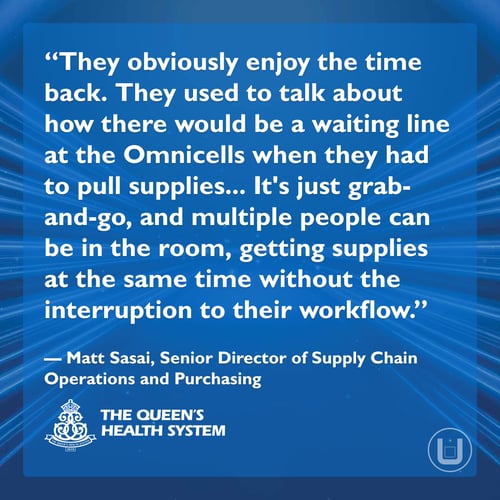
The results validated their choice. Clinical feedback has been "nothing but positive" according to Sasai, with staff expressing enthusiasm for the clean appearance and ease of use. The transformation was immediate and visible: "They obviously enjoy the time back. They used to talk about how there used to be a waiting line at the Omnicells when they'd have to pull supplies... It's just grab-and-go, and multiple people can be in the room, getting supplies at the same time without the interruption to their workflow."
### The Strategic Value of Data-Driven Transformation
Beyond immediate workflow improvements, The Queen's Health System recognized the strategic value of [supply chain analytics](https://bluebin.com/solutions/blueq-analytics/). They plan to leverage BlueQ Analytics data for inventory reduction ROI analysis, optimization of supply chain storage rooms, supplier performance evaluation, and departmental spend analysis for improved benchmarking.
This analytical capability, managing over 1.3 million bins daily across hundreds of locations with a 98+ percent fill rate, provides visibility that ADC systems cannot deliver. The difference isn't just operational; it's strategic, enabling data-driven decision making that drives continuous improvement and measurable financial outcomes.

## Key Takeaways for Healthcare Executives
As healthcare systems evaluate point-of-use supply solutions, the evidence reveals clear patterns about where true ROI originates. ADCs fail to deliver expected returns not because the technology is inherently bad, but because hardware alone cannot transform supply chain operations.
**Critical factors for success:**
- Process transformation must precede technology investment
- Total cost of ownership extends far beyond initial capital investment
- Clinician time and workflow impact create substantial hidden costs
- Flexibility and scalability determine long-term value
- Analytics-driven continuous improvement delivers sustainable results
Healthcare organizations trapped in expensive ADC maintenance cycles have alternatives. The question isn't whether to invest in supply chain improvement, it's whether to invest in hardware that maintains the status quo or in a transformation that delivers measurable, sustainable ROI.
## **Ready to Transform Your Supply Chain?**
Discover why healthcare systems, such as The Queen's Health System, are moving beyond expensive ADC hardware to a process-first transformation with [two-bin Kanban](https://bluebin.com/solutions/hospital-kanban/), that delivers a proven 7.4x ROI. [Contact BlueBin](https://bluebin.com/contact/) today for a comprehensive supply chain assessment.
[](https://blog.bluebin.com/hs/cta/wi/redirect?encryptedPayload=AVxigLI%2BU%2Fg5FDmN5VnSdlJGqiXRTT6ZAo0zSHXjpOzBIzwKmsy1AZ8uQcJKq49FpXOYzjOCHB9qrsFwC7TECCi6cwhO0Sfd%2BbA%2FafkxTdttUZCEk%2F9luWoWVx8KCW1AvDi0AGe0Ye9RDMZCL0H6yEDlOyVTWZmzQ7cPFCe3rIszcA2FJ7TM22m90R1TUXRxM6nUpZQebwjykxrkIK9d%2FgGG%2B5KRRFiIGr4qOOYg&webInteractiveContentId=199003260238&portalId=9067872)
## Frequently Asked Questions
### How do automated dispensing cabinet costs compare to 2-Bin Kanban systems over 10 years?
ADC systems typically cost $3.6M to $7.6M+ over 10 years due to capital investments, annual maintenance (18 percent of purchase price), mid-cycle upgrades, and ongoing technical support. Process-first Kanban approaches, such as BlueBin, cost approximately $7.54M over the same period and typically return 5 to 7 times the investment. At one large Midwest nonprofit health system, a $6.70M BlueBin investment delivered a documented 7.4x ROI over 36 months, with $12.8M in annual recurring savings, $5.8M in one-time inventory reduction, and $1.9M in resource redeployment, returns that ADC-only implementations cannot match.
### Why do clinicians wait in line at automated dispensing cabinets?
ADCs create workflow bottlenecks because only one user can interact with a cabinet at a time. During peak periods, such as shift changes or procedure preparation, multiple clinicians require supplies simultaneously, resulting in wait times that divert nurses from patient care. The Queen's Health System specifically cited these waiting lines as a key driver for switching to BlueBin's grab-and-go approach, where multiple people can access supplies simultaneously without workflow interruption.
### What are the hidden costs of ADC maintenance contracts?
Beyond the 15 to 20 percent annual maintenance fees, ADC contracts create hidden costs through required technical support labor, troubleshooting time when systems malfunction, and lost productivity during cabinet downtime. Healthcare systems also face mid-cycle upgrade costs and eventual complete system replacement every 7 to 10 years. The Queen's Health System found that these maintenance costs delivered limited supply chain value, particularly for medical supplies compared to pharmacy items.
### How do ADC systems impact clinical satisfaction compared to process-first solutions?
The Queen's Health System reported overwhelmingly positive clinical feedback after implementing BlueBin, with staff enjoying the time saved and the elimination of wait lines. Their clinicians specifically praised the clean appearance, ease of use, and ability for multiple people to access supplies simultaneously. This contrasts sharply with their previous ADC experience, where constant system intervention was required, wait times frustrated staff, and workarounds undermined inventory accuracy.
### Can healthcare systems transition from ADCs to Kanban systems in a cost-effective manner?
Yes. The Queen's Health System successfully transitioned from aging Omnicell cabinets to BlueBin's 2-Bin Kanban system across four acute care hospitals and 10 laboratories. The transition delivered immediate workflow improvements, eliminated wait times, and positioned the organization for long-term ROI through reduced supply expenses, optimized inventory, and enhanced analytics capabilities. Organizations can often redeploy existing ADC equipment to pharmacy-specific applications where security features provide clear value while implementing Kanban for general medical supplies.

Post by [Jeremy Harvey](https://blog.bluebin.com/author/jeremy-harvey)
Dec 18, 2025, 5:23:01 PM
Jeremy Harvey is the Senior Director of Marketing & Brand at BlueBin, where he architects content strategy and brand development for one of healthcare's leading supply chain solutions providers. With 21 years of marketing experience — including more than five years in healthcare supply chain and 13 years across B2B industries — he brings a strategic, data-informed approach to helping healthcare organizations understand the operational and financial value of smarter supply chain management. Jeremy holds a Bachelor's degree in Graphic Design & New Media and a minor in Industrial Technology, with a concentration in design.
[Follow me on LinkedIn](https://www.linkedin.com/in/thejeremyharvey/)
###### Explore Topics
- [Automation](https://blog.bluebin.com/tag/automation)
- [Clinical/Patient care](https://blog.bluebin.com/tag/clinical-patient-care)
- [Cybersecurity](https://blog.bluebin.com/tag/cybersecurity)
- [Data Standards](https://blog.bluebin.com/tag/data-standards)
- [ERP](https://blog.bluebin.com/tag/erp)
- [Financial](https://blog.bluebin.com/tag/financial)
- [Inventory management](https://blog.bluebin.com/tag/inventory-management)
- [Kanban](https://blog.bluebin.com/tag/kanban)
- [Leadership](https://blog.bluebin.com/tag/leadership)
- [Operations](https://blog.bluebin.com/tag/operations)
- [Optimization](https://blog.bluebin.com/tag/optimization)
- [Ordering & Receiving](https://blog.bluebin.com/tag/ordering-receiving)
- [Replenishment](https://blog.bluebin.com/tag/replenishment)
- [Reporting & Analytics](https://blog.bluebin.com/tag/reporting-analytics)
- [Resilience](https://blog.bluebin.com/tag/resilience)
- [Sustainability](https://blog.bluebin.com/tag/sustainability)
- [Warehousing](https://blog.bluebin.com/tag/warehousing)
- [supply chain disruption](https://blog.bluebin.com/tag/supply-chain-disruption)
- [transformation](https://blog.bluebin.com/tag/transformation)
###### Recent Articles
[Hospital Supply Chain Management Software: 7 Factors to Evaluate Before You Sign](https://blog.bluebin.com/hospital-supply-chain-management-software)
[9 Best Hospital Inventory Management Systems for ROI in 2026](https://blog.bluebin.com/best-hospital-inventory-management-systems-2026)
[AHRMM26 Recap: What Healthcare Supply Chain Leaders Are Prioritizing in 2026](https://blog.bluebin.com/ahrmm26-recap-supply-chain-trends-2026)
[When a Distributor's Warehouse Burns Down: What One Warehouse Fire Reveals About Healthcare Supply Chain Vulnerability](https://blog.bluebin.com/warehouse-fire-exposes-healthcare-supply-chain-vulnerability)
[54% of Healthcare Leaders Need Supply Chain ROI in 12 Months](https://blog.bluebin.com/ahrmm26-healthcare-supply-chain-roi)
[Hardware Solutions vs. Transformation: Why Storage Optimization Alone Isn't Enough](https://blog.bluebin.com/hardware-solutions-vs-transformation-why-storage-optimization-alone-isnt-enough)
[True Cost of Ownership: Comparing Kanban, Cabinets, and Manual PAR Systems](https://blog.bluebin.com/true-cost-ownership-comparing-kanban-cabinets-manual-par-systems)
[Hospital Supply Chain Disruption in 2026: What the Iran Conflict Reveals](https://blog.bluebin.com/hospital-supply-chain-disruption-2026)
[ESG and Healthcare: How Supply Chain Waste Reduction Supports Green Bond Eligibility](https://blog.bluebin.com/esg-healthcare-how-supply-chain-waste-reduction-supports-green-bond-eligibility)
[Hospital Supply Chain Resilience: From COVID-19 to Geopolitical Disruption](https://blog.bluebin.com/supply-chain-resilience-after-covid-19)
[](https://bluebin.com/)
Improving the healthcare supply chain process, ensuring that clinicians have the right supplies at the right time.
-
-
-
-
-
### CONTACT
- [bluebinsales@capsahealthcare.com](mailto:bluebinsales@capsahealthcare.com)
- (855) 896-2467
- 8170 Dove Pkwy
Canal Winchester, OH 43110
- QUICK LINKS
- [Supply Chain Solutions](https://bluebin.com/solutions/)
- [Healthcare Kanban](https://bluebin.com/solutions/hospital-kanban/)
- [BlueQ Analytics](https://bluebin.com/solutions/blueq-analytics/)
- [BlueQ SmartScan](https://bluebin.com/solutions/blueq-smartscan/)
- [Supply Chain Consulting](https://bluebin.com/solutions/consulting/)
- [Case Studies](https://bluebin.com/results/case-studies/)
- [About Us](https://bluebin.com/company/our-team-our-story/)
- - [Whitepapers](https://bluebin.com/resources/whitepapers/)
- [Guides & Checklists](https://bluebin.com/resources/guides/)
- [Calculators](https://bluebin.com/resources/calculators/)
- [Blog](https://blog.bluebin.com/)
- [Careers](https://bluebin.com/company/careers/)
- [Contact](https://bluebin.com/contact/)
- [Support](mailto:bluebin.support@capsahealthcare.com?subject=Bluebin%20Support%20Request)
© 2026 BlueBin Inc. All Rights Reserved
[Sitemap](https://bluebin.com/page-sitemap.xml?__hstc=51647990.6d18215ae56f1f7281d0f59df56a7960.1616739528041.1616739528041.1616739528041.1&__hssc=51647990.19.1616739528042&__hsfp=1866732115)
```json
{
"@context" : "https://schema.org",
"@type" : "BlogPosting",
"author" : {
"@type" : "Person",
"name" : "Jeremy Harvey",
"url" : "https://blog.bluebin.com/author/jeremy-harvey"
},
"dateModified" : "2026-09-30T16:57:12.738Z",
"datePublished" : "2025-12-19T01:23:01.000Z",
"headline" : "Why Automated Dispensing Cabinets Fail to Deliver Expected ROI for Everyday Supplies",
"image" : [ "https://blog.bluebin.com/hubfs/automated-cabinets-fail-roi.jpg" ],
"mainEntityOfPage" : {
"@id" : "https://blog.bluebin.com/why-automated-dispensing-cabinets-fail-deliver-expected-roi",
"@type" : "WebPage"
},
"publisher" : {
"@type" : "Organization",
"logo" : {
"@type" : "ImageObject",
"url" : "https://blog.bluebin.com/hubfs/bluebin-logo.png"
},
"name" : "BlueBin"
}
}
```
```json
{
"@context" : "https://schema.org",
"@type" : "FAQPage",
"mainEntity" : [ {
"@type" : "Question",
"acceptedAnswer" : {
"@type" : "Answer",
"text" : "ADC systems typically cost $3.6M to $7.6M+ over 10 years due to capital investments, annual maintenance (18 percent of purchase price), mid-cycle upgrades, and ongoing technical support. Process-first Kanban approaches, such as BlueBin, cost approximately $7.54M over the same period and typically return 5 to 7 times the investment. At one large Midwest nonprofit health system, a $6.70M BlueBin investment delivered a documented 7.4x ROI over 36 months, with $12.8M in annual recurring savings, $5.8M in one-time inventory reduction, and $1.9M in resource redeployment, returns that ADC-only implementations cannot match."
},
"name" : "How do automated dispensing cabinet costs compare to 2-Bin Kanban systems over 10 years?"
}, {
"@type" : "Question",
"acceptedAnswer" : {
"@type" : "Answer",
"text" : "ADCs create workflow bottlenecks because only one user can interact with a cabinet at a time. During peak periods, such as shift changes or procedure preparation, multiple clinicians require supplies simultaneously, resulting in wait times that divert nurses from patient care. The Queen's Health System specifically cited these waiting lines as a key driver for switching to BlueBin's grab-and-go approach, where multiple people can access supplies simultaneously without workflow interruption."
},
"name" : "Why do clinicians wait in line at automated dispensing cabinets?"
}, {
"@type" : "Question",
"acceptedAnswer" : {
"@type" : "Answer",
"text" : "Beyond the 15 to 20 percent annual maintenance fees, ADC contracts create hidden costs through required technical support labor, troubleshooting time when systems malfunction, and lost productivity during cabinet downtime. Healthcare systems also face mid-cycle upgrade costs and eventual complete system replacement every 7 to 10 years. The Queen's Health System found that these maintenance costs delivered limited supply chain value, particularly for medical supplies compared to pharmacy items."
},
"name" : "What are the hidden costs of ADC maintenance contracts?"
}, {
"@type" : "Question",
"acceptedAnswer" : {
"@type" : "Answer",
"text" : "The Queen's Health System reported overwhelmingly positive clinical feedback after implementing BlueBin, with staff enjoying the time saved and the elimination of wait lines. Their clinicians specifically praised the clean appearance, ease of use, and ability for multiple people to access supplies simultaneously. This contrasts sharply with their previous ADC experience, where constant system intervention was required, wait times frustrated staff, and workarounds undermined inventory accuracy."
},
"name" : "How do ADC systems impact clinical satisfaction compared to process-first solutions?"
}, {
"@type" : "Question",
"acceptedAnswer" : {
"@type" : "Answer",
"text" : "Yes. The Queen's Health System successfully transitioned from aging Omnicell cabinets to BlueBin's 2-Bin Kanban system across four acute care hospitals and 10 laboratories. The transition delivered immediate workflow improvements, eliminated wait times, and positioned the organization for long-term ROI through reduced supply expenses, optimized inventory, and enhanced analytics capabilities. Organizations can often redeploy existing ADC equipment to pharmacy-specific applications where security features provide clear value while implementing Kanban for general medical supplies."
},
"name" : "Can healthcare systems transition from ADCs to Kanban systems in a cost-effective manner?"
} ]
}
```
```json
{
"@context" : "https://schema.org",
"@type" : "Person",
"jobTitle" : "Senior Director of Marketing & Brand",
"name" : "Jeremy Harvey",
"sameAs" : "https://www.linkedin.com/in/thejeremyharvey/",
"url" : "https://blog.bluebin.com/author/jeremy-harvey"
}
```