---
title: "Achieving Magnet Status: The Supply Chain Secret Weapon Healthcare Leaders Overlook"
description: Supply chain efficiency is a hidden driver of Magnet status. See how hospitals use supply optimization to boost nurse satisfaction and patient outcomes.
image: https://blog.bluebin.com/hubfs/1-contributing-factor-magnet-success.jpg
---
[Skip to main content](https://blog.bluebin.com/achieving-magnet-status-supply-chain-secret-weapon-healthcare-leaders-overlook#main-content)
[BlueBin Rated #1 in Black Book 2026 Healthcare Supply Chain Report](https://bluebin.com/results/news/bluebin-ranked-number-one-black-book-2026-healthcare-supply-chain/)
-
-
-
-
-
[   ](https://bluebin.com/)
- [Show submenu for Solutions Solutions](https://bluebin.com/solutions/)
- [BlueBin Kanban](https://bluebin.com/solutions/hospital-kanban/)
- [BlueQ Analytics](https://bluebin.com/solutions/blueq-analytics/)
- [BlueQ SmartScan](https://bluebin.com/solutions/blueq-smartscan/)
- [Consulting & Training](https://bluebin.com/solutions/consulting/)
- [Kanban Supplies](https://bluebin.com/solutions/hospital-kanban-supplies/)
- [Show submenu for Results Results](https://bluebin.com/results/)
- [Case Studies](https://bluebin.com/results/case-studies/)
- [Videos](https://bluebin.com/results/videos/)
- [News](https://bluebin.com/results/news/)
- [Show submenu for About Us About Us](https://bluebin.com/company/)
- [Our Team + Our Story](https://bluebin.com/company/our-team-our-story/)
- [Partner with BlueBin](https://bluebin.com/company/partnering-with-bluebin/)
- [Events](https://bluebin.com/events/)
- [Careers](https://bluebin.com/company/careers/)
- [Get Support](mailto:bluebin.support@capsahealthcare.com?subject=Bluebin%20Support%20Request)
- [Show submenu for Resources Resources](https://bluebin.com/resources/)
- [Blog](https://blog.bluebin.com)
- [Whitepapers](https://bluebin.com/resources/whitepapers/)
- [Guides & Checklists](https://bluebin.com/resources/guides/)
- [Calculators](https://bluebin.com/resources/calculators/)
- [Newsletter Archive](https://bluebin.com/resources/bluebin-newsletter-archive/)
- [Contact](https://bluebin.com/contact/)
Open main navigation
Close main navigation
- Show submenu for Solutions Solutions
- [BlueBin Kanban](https://bluebin.com/solutions/hospital-kanban/)
- [BlueQ Analytics](https://bluebin.com/solutions/blueq-analytics/)
- [BlueQ SmartScan](https://bluebin.com/solutions/blueq-smartscan/)
- [Consulting & Training](https://bluebin.com/solutions/consulting/)
- [Kanban Supplies](https://bluebin.com/solutions/hospital-kanban-supplies/)
- Show submenu for Results Results
- [Case Studies](https://bluebin.com/results/case-studies/)
- [Videos](https://bluebin.com/results/videos/)
- [News](https://bluebin.com/results/news/)
- Show submenu for About Us About Us
- [Our Team + Our Story](https://bluebin.com/company/our-team-our-story/)
- [Partner with BlueBin](https://bluebin.com/company/partnering-with-bluebin/)
- [Events](https://bluebin.com/events/)
- [Careers](https://bluebin.com/company/careers/)
- [Get Support](mailto:bluebin.support@capsahealthcare.com?subject=Bluebin%20Support%20Request)
- Show submenu for Resources Resources
- [Blog](https://blog.bluebin.com)
- [Whitepapers](https://bluebin.com/resources/whitepapers/)
- [Guides & Checklists](https://bluebin.com/resources/guides/)
- [Calculators](https://bluebin.com/resources/calculators/)
- [Newsletter Archive](https://bluebin.com/resources/bluebin-newsletter-archive/)
- [Contact](https://bluebin.com/contact/)
Search
- [Leadership](https://blog.bluebin.com/tag/leadership)
- [Clinical/Patient care](https://blog.bluebin.com/tag/clinical-patient-care)
- [Operations](https://blog.bluebin.com/tag/operations)
# Achieving Magnet Status: The Supply Chain Secret Weapon Healthcare Leaders Overlook
 by [Jeremy Harvey](https://blog.bluebin.com/author/jeremy-harvey) Mar 09, 2026
Table of contents
Achieving Magnet Status: The Supply Chain Secret Weapon Healthcare Leaders Overlook
20:53

Key Takeaways
- Only 3% of U.S. hospitals achieve Magnet Recognition — and supply chain performance is a direct but often overlooked factor in achieving it.
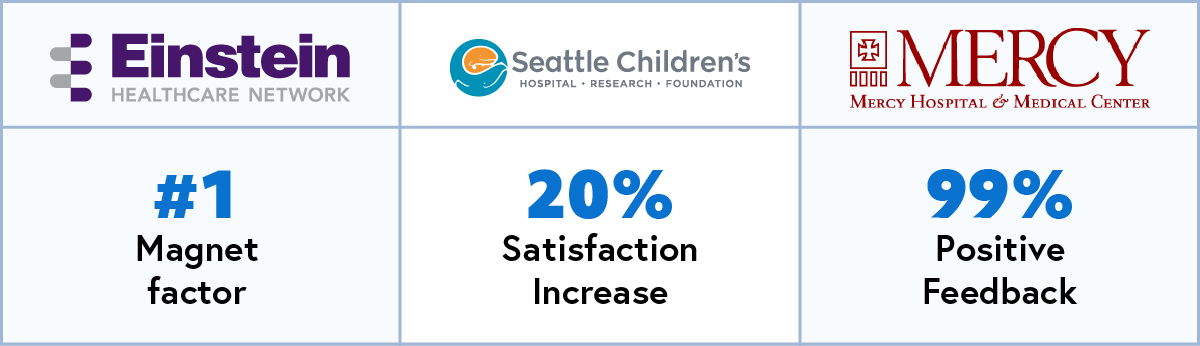
- Einstein Medical Center identified its supply chain transformation as the "#1 contributing factor to achieving Magnet status." (Joanne Erb, Director of Materials Management)
- Supply chain affects all five Magnet model components — including Transformational Leadership, Structural Empowerment, and Empirical Outcomes.
- Seattle Children's Hospital confirms that Magnet reviewers specifically assess nurses' involvement in supply chain improvement initiatives.
- When nurses spend 60 minutes per shift hunting for supplies, exemplary professional practice — a core Magnet requirement — becomes impossible to sustain.
When Einstein Medical Center achieved Magnet Recognition, leadership pointed to a surprising #1 contributing factor: its supply chain transformation enabled by BlueBin's 2-Bin Kanban system. Joanne Erb, Director of Materials Management, stated it plainly: *"It was the #1 contributing factor to achieving our Magnet status."* This revelation challenges conventional wisdom about Magnet designation—that it's purely about nursing excellence and clinical protocols. In reality, supply chain performance directly impacts the nursing experience, patient satisfaction, and organizational culture that Magnet reviewers evaluate. Yet many hospitals pursuing Magnet status overlook this powerful advantage.
Magnet Recognition, awarded by the [American Nurses Credentialing Center](https://www.nursingworld.org/magnet/), represents the gold standard for nursing excellence. Only 3 percent of all hospitals in the country achieve this prestigious designation. The rigorous review process examines quality patient care, nursing excellence, innovations in professional nursing practice, and, critically, nurses' involvement in improvement initiatives. Supply chain plays a direct role in this assessment, yet it remains one of the most underutilized strategies for Magnet success.
## Understanding Magnet Recognition and Its Supply Chain Connection
The Magnet Recognition Program evaluates healthcare organizations across multiple dimensions that appear clinical on the surface but have deep operational roots. Supply chain performance influences nearly every aspect of the Magnet assessment, from nurse satisfaction surveys to patient care quality metrics.
### The Magnet Model Components and Supply Chain Impact
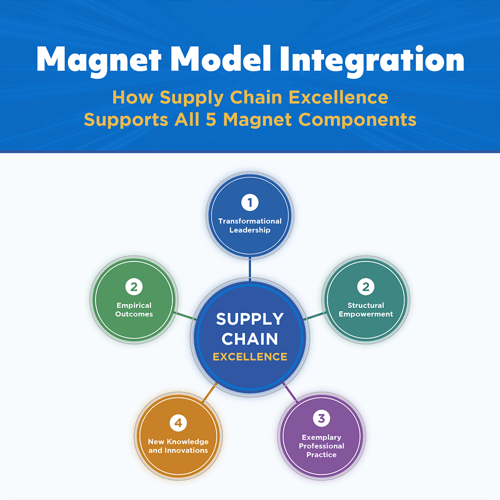
Magnet designation evaluates five key components, each directly affected by supply chain operations:
**1. Transformational Leadership:** Magnet hospitals demonstrate strategic planning, advocacy, and organizational change management. Supply chain transformation exemplifies these leadership qualities, particularly when clinical staff actively participate in redesigning supply workflows and continuous improvement initiatives.
**2. Structural Empowerment:** Organizations must show professional development, community involvement, and shared decision-making. Supply chain redesign processes that engage nurses in mock events, Gemba audits, and improvement suggestions demonstrate exactly this kind of structural empowerment.
**3. Exemplary Professional Practice:** Magnet hospitals provide high-quality patient care with strong interdisciplinary collaboration. When nurses spend 60 minutes per shift hunting for supplies, exemplary practice becomes impossible. Reliable supply availability directly enables the clinical excellence Magnet recognizes.
**4. New Knowledge, Innovation, and Improvement:** Organizations must demonstrate continuous improvement and evidence-based practice. Supply chain transformation through lean methodology, data-driven optimization, and documented improvements in outcome provides concrete evidence of this commitment.
**5. Empirical Outcomes:** Magnet designation requires measurable quality improvements. Supply chain metrics such as nurse satisfaction scores, improvements in patient satisfaction, reduced procedure delays, and decreased supply-related incidents provide quantifiable evidence of organizational excellence.
[](https://blog.bluebin.com/hubfs/speed-to-quality-transformation/magnet-model-integration.png)
Click image to view full infographic
---
### The Supply Chain Review Process
[Seattle Children's Hospital](https://bluebin.com/results/case-studies/seattle-childrens-hospital-research-foundation/), proud holder of Magnet Recognition designation, emphasizes that supply chain is part of the Magnet review process. Reviewers specifically gauge nurses' involvement in supply chain improvement initiatives. This assessment recognizes what operational leaders understand: supply chain performance fundamentally affects nursing practice, morale, and the ability to deliver exceptional patient care.
Organizations pursuing Magnet status cannot segregate supply chain operations from clinical excellence. The connection is direct and measurable, affecting nurse satisfaction surveys, patient care metrics, and the cultural indicators that Magnet reviewers assess during site visits.

## The Hidden Cost of Supply Chain Dysfunction on Nurse Satisfaction
Nurse satisfaction represents a critical Magnet metric. Organizations pursuing designation must demonstrate strong nursing morale, professional satisfaction, and a supportive work environment. Supply chain dysfunction silently erodes these factors, often leaving the damage invisible until satisfaction surveys reveal it.
### The 60-Minute Supply Hunt Problem
Industry research reveals that nurses lose an average of 60 minutes per shift hunting for supplies. This represents approximately 12.5 percent of a standard shift, a time that should be devoted to patient care, clinical assessment, family communication, and the compassionate nursing practice that defines Magnet hospitals.
The financial impact alone is staggering: the healthcare industry wastes $14 billion annually on supply hunting. But the cost to nurse morale and professional satisfaction cannot be quantified so easily. Nurses entered the profession to care for patients, not to search for supplies. When supply chain dysfunction forces clinical professionals into logistics roles, satisfaction inevitably suffers.
### Seattle Children's Hospital: 20 Percent Satisfaction Increase in One Year
Seattle Children's Hospital documented the supply chain impact on nursing satisfaction through a specific survey question: nurses rated whether they had the right tools to do their job on a scale of 1 to 5. In 2009, before BlueBin implementation, responses established a baseline. Just one year later, in 2010, nurses' response to this question was 20 percent higher, and sustained at that level through 2012 and beyond.
Greg Beach, CBET, former Senior Director of Supply Chain at Seattle Children's Hospital, reflected on these results: *"Honestly, we wouldn't have believed on day one that we would see this kind of lasting impact."* The sustained improvement, maintained years after implementation, demonstrates that the satisfaction gains weren't temporary enthusiasm but a fundamental transformation of daily nursing experience.
In addition to satisfaction improvements, Seattle Children's Hospital reduced supply search time by 50 percent. This dramatic productivity gain meant nurses spent less time frustrated by supply issues and more time engaged in meaningful patient care, exactly the kind of professional environment that Magnet designation recognizes.
### Einstein Medical Center: Supply Chain as #1 Magnet Factor
Einstein Medical Center's experience provides even more direct evidence of the supply chain's role in Magnet achievement. Joanne Erb, Director of Materials Management, explicitly credited supply chain transformation as the primary factor: *"EMC has been using BlueBin's replenishment solution for years now. It was the #1 contributing factor to achieving our Magnet status. Our nurse satisfaction scores dramatically increased due to BlueBin's 2-Bin Kanban solution."*
The connection extended beyond nursing to patient experience: *"Our patient satisfaction scores have benefited as well. As a result, we have seen significant ROI and supply chain efficiencies throughout our hospital."* This comprehensive impact, with nurses more satisfied, patients more satisfied, and improved financial performance, created exactly the kind of operational excellence and positive organizational culture that Magnet reviewers seek.

## Patient Satisfaction: The Direct Link Between Supply Chain and Care Quality
While nurse satisfaction affects internal culture and recruitment, patient satisfaction directly impacts Magnet designation, reimbursement rates, public reputation, and competitive position. Supply chain performance influences patient experience through multiple pathways that often remain unrecognized.
### Procedure Delays and Cancellations
Research shows that 40 percent of procedures are cancelled due to missing supplies, while 69 percent of perioperative staff have experienced case delays. These statistics represent more than operational inefficiency—they reflect patient anxiety, family disruption, rescheduling burden, and lost confidence in the organization's ability to deliver care.
Patients arriving for scheduled procedures expect reliability and professionalism. Supply-related cancellations undermine this expectation, creating negative experiences that impact satisfaction surveys and online reviews. Magnet hospitals must demonstrate operational excellence that prevents these disruptions, making supply chain reliability essential to maintaining their designation.
### The Nurse Presence Effect
Patient satisfaction correlates strongly with perceived nurse attentiveness, responsiveness, and bedside presence. When nurses spend significant time searching for supplies instead of attending to patients, satisfaction inevitably declines. Patients notice when nurses seem rushed, distracted, or unable to respond promptly to needs.
Mercy Hospital provides concrete evidence of this connection. Before BlueBin implementation, the hospital received nearly 100 calls daily from staff searching for supplies. Post-implementation, that number dropped to less than 100 per month.
*"BlueBin has had a tremendously positive impact on our ability to service our patients and families. Now, nurses don't have to worry about supplies, it's all done for them."* When nurses spend less time hunting supplies and more time with patients, this naturally influences patient satisfaction scores.
[](https://blog.bluebin.com/hs/cta/wi/redirect?encryptedPayload=AVxigLKke9UlRhtLRHtHevn7E7aMGn9FRxI8D0bRDtDAKZHbaESL7xlmy6SE8SFrVWpOK06bvmXgZ54TuejtMqdQmJNP1pXh9Yq3jv3xt4yYNkPTf3sMF2gQ%2BjswG%2BaLeamQl7GF0OzJBkDgwxTKYpH4GyFHJBKKbYL%2FQX4h9Sd01s0DCHS31sE2SVOQuHh5ceyKUXeET2QObacEd7g9Z5ruIF%2FP7ocORU%2BzLtqkaOGhCqN0sGu5sb%2B3f32FtwfIg6U%3D&webInteractiveContentId=209796959344&portalId=9067872)

## Clinical Engagement: Involving Nurses in Supply Chain Improvement
Magnet reviewers specifically evaluate nurses' involvement in improvement initiatives. Supply chain transformation provides exceptional opportunities for meaningful clinical engagement that strengthens Magnet applications while delivering operational benefits.
### Mock Events and Workflow Redesign
Seattle Children's Hospital emphasized the importance of clinical engagement through BlueBin's implementation approach. The hospital fostered a strong connection between nurses and the supply chain that continues to influence operations years later. This ongoing relationship demonstrates a sustained improvement culture rather than one-time initiative enthusiasm.
Mercy Hospital's experience illustrates the kind of clinical involvement that impresses Magnet reviewers: *"The neat thing about the 2-Bin Kanban system is that the nursing staff is involved in deciding what supplies are needed, where they want them laid out, and how to place them."* This level of professional autonomy and process ownership exemplifies the shared decision-making that Magnet designation recognizes.
### Gemba Audits and Continuous Improvement
BlueBin's approach includes Gemba audits conducted "where the work happens"—at the point of care where nurses interact with supplies daily. These audits engage clinical staff in process evaluation, problem identification, and the formulation of improvement recommendations. The systematic approach to continuous improvement demonstrates organizational commitment to evidence-based practice and staff empowerment.
Daily huddles surface issues same-day and ensure accountability across the organization. This tiered accountability structure, which spans from bedside to executive level, demonstrates the kind of transparent communication and collaborative problem-solving that characterizes Magnet organizations.
[](https://blog.bluebin.com/hs/cta/wi/redirect?encryptedPayload=AVxigLIemwRQDK%2BTR5ZQI5YzhcAxyaI486s0rx338ofDUQZXGZyM%2ByiINMMd5H2xROYwLxardeWkd6%2FcQKNhNLuod%2Bsv81f1GhY2bBERGqghLEmlRqB0l238JkQne5dZ%2FHu8SWngqmhlBtHMCWm6CwmR%2BR84gHQ0x7Eg0HcI29%2FhtpSwEiE4HFSE8LPMK7JS83skhljpti1RQbPxoW1mz1hhwMTO%2B3xnVAJe2HsO&webInteractiveContentId=199003260238&portalId=9067872)

## Measurable Outcomes: Building Your Magnet Application Evidence
Magnet applications require concrete evidence of quality improvements, financial stewardship, and operational excellence. Supply chain transformation through proven methodology delivers quantifiable metrics across all dimensions that reviewers evaluate.
### Quality and Safety Metrics
**Expiration Reduction:** Industry-average expiration rates range from 8 to 10 percent, and 24 percent of clinicians report having seen expired products used. BlueBin implementations reduce expirations to under 1 percent. This 80-90% improvement demonstrates a commitment to patient safety and waste elimination.
**Fill Rate Excellence:** BlueBin systems maintain 98% fill rates, compared to the industry average of 85-95%. This reliability prevents procedure delays, reduces clinical frustration, and ensures the availability of supplies when needed for patient care.
**Stock-Out Elimination:** Predictive analytics warn of potential disruptions 5 to 7 weeks in advance, enabling proactive mitigation that prevents the stock-outs affecting patient care. This anticipatory approach exemplifies the operational sophistication that Magnet hospitals demonstrate.
### Workforce Metrics
**Supply Hunt Time Reduction:** Average 30-50% decrease in time spent searching for supplies translates into thousands of clinical hours returned to patient care. Seattle Children's Hospital achieved a 50 percent reduction in supply search time and sustained improvements in satisfaction.
**Nurse Satisfaction Scores:** Seattle Children's Hospital documented a 20 percent improvement in nurse satisfaction regarding having the right tools for their jobs, sustained over multiple years. Einstein Medical Center reported dramatic increases in nurse satisfaction, directly attributed to the supply chain transformation.
**Clinical Staff Feedback:** Mercy Hospital surveyed nursing staff post-implementation: 99 percent said the new system was much better than the previous process. This near-universal approval demonstrates meaningful improvement in daily nursing experience.
### Financial Stewardship
**Supply Expense Reduction:** Organizations achieve a 7 percent reduction in supply expense as a percentage of net patient revenue. This financial performance demonstrates fiscal responsibility, freeing resources for patient care investments, professional development, and quality initiatives.
**Inventory Optimization:** 15-25% inventory reduction releases working capital while maintaining exceptional fill rates. Mercy Hospital reduced bulk storage space by nearly 50 percent and saved the equivalent of four full-time employees in labor hours.
**Return on Investment:** A large Midwest nonprofit health system documented 7.4x ROI with $12.8M annual recurring savings. This level of financial return allows organizations to invest in nursing professional development, advanced clinical technology, and improvements in patient experience, all of which support Magnet designation.

## Strategic Advantages: Magnet Hospitals Attract the Best Nurses
Magnet designation creates a competitive advantage in nurse recruitment and retention. As Seattle Children's Hospital noted, Magnet hospitals draw the best nurses in the country. Supply chain excellence supports this advantage by creating a practice environment that attracts and retains top nursing talent.
### The Professional Practice Environment
Exceptional nurses seek practice environments where they can focus on clinical excellence rather than fighting operational dysfunction. Supply chain reliability removes barriers to professional practice, enabling nurses to apply their expertise, exercise clinical judgment, and deliver compassionate care without logistics frustrations.
Organizations competing for top nursing talent differentiate themselves through operational excellence. Reliable supply availability, efficient workflows, and demonstrated commitment to reducing non-clinical burden signal respect for nursing professionals and understanding of their practice needs.
### Long-Term Sustainability Through Embedded Excellence
Seattle Children's Hospital's sustained satisfaction improvements, maintained through 2012 and beyond, demonstrate that supply chain transformation creates lasting cultural change rather than temporary improvement. This sustainability distinguishes organizations pursuing Magnet designation from those simply seeking short-term metrics improvement.
The embedding mechanisms that foster sustainability, such as BlueBelt certification, daily management systems, Gemba audits, and a continuous improvement culture, provide concrete evidence of the organization’s commitment to excellence. Magnet reviewers recognize these sustainable approaches as indicators of genuine transformation versus superficial compliance.

## Implementation Strategy: Leveraging Supply Chain for Magnet Success
Healthcare organizations pursuing Magnet designation should strategically position supply chain transformation as a core component of their application. The evidence demonstrates clear connections between supply chain excellence and every component of the Magnet model.
### Timeline Considerations
Organizations should implement supply chain transformation 12 to 18 months before submitting the Magnet application. This timeline allows sufficient data collection on satisfaction improvements, financial outcomes, operational metrics, and sustained performance. Seattle Children's Hospital showed a 20 percent improvement in satisfaction within one year, providing compelling evidence for applications while allowing additional time to demonstrate sustainability.
### Documentation Requirements
Establish baseline metrics before implementation across all relevant dimensions: nurse satisfaction scores specifically related to supply availability and tools; patient satisfaction metrics; supply hunt time measurements; expiration rates; fill rates; procedure delays; and financial performance. Post-implementation measurement against these baselines provides quantifiable evidence of improvement.
Document clinical engagement throughout implementation: mock event participation, Gemba audit involvement, daily huddle attendance, improvement suggestions generated, and ongoing continuous improvement activities. This documentation demonstrates the shared decision-making and professional empowerment that Magnet designation requires.
### Narrative Development
Develop compelling narratives that connect supply chain transformation to Magnet model components. Einstein Medical Center's statement, *"It was the #1 contributing factor to achieving our Magnet status,"* provides a template for articulating the supply chain's strategic importance rather than positioning it as an operational detail.
Frame supply chain transformation within broader organizational commitments to nursing excellence, patient experience, quality improvement, and financial stewardship. The integration demonstrates strategic thinking and a comprehensive approach to operational excellence, both of which characterize Magnet organizations.
## The Competitive Advantage: Why Supply Chain Matters for Magnet Designation
With only 3 percent of hospitals achieving Magnet designation, organizations must demonstrate exceptional performance across all evaluated dimensions. Supply chain transformation delivers measurable improvements in nurse satisfaction, patient experience, operational excellence, financial performance, and a culture of continuous improvement, addressing every component of the Magnet model.
Einstein Medical Center, Seattle Children's Hospital, and Mercy Hospital demonstrate that supply chain excellence isn't tangential to Magnet designation; it can be the defining factor differentiating successful applications from unsuccessful ones. Organizations overlooking this powerful strategy miss opportunities for quantifiable improvements that support the achievement of designations while delivering sustainable operational and financial benefits.
Healthcare leaders aiming for Magnet designation already know that the supply chain plays a crucial role; evidence clearly shows its importance. The real question is whether they will intentionally utilize supply chain transformation as a key strategy to set their organization apart and achieve the comprehensive excellence required for Magnet Recognition.
## Frequently Asked Questions
### How does supply chain performance directly impact Magnet designation?
Supply chain affects every Magnet model component: nurse satisfaction (60 minutes per shift saved from supply hunts), patient satisfaction (eliminating procedure delays), clinical engagement (nurses involved in workflow redesign), continuous improvement (Gemba audits and daily huddles), and measurable outcomes (98 percent fill rates, under 1 percent expirations). Einstein Medical Center explicitly cited the supply chain as the #1 contributing factor in achieving Magnet status, while Seattle Children's Hospital documented a 20 percent improvement in nurse satisfaction sustained over multiple years.
### What specific metrics should organizations track for Magnet applications?
Establish baselines before implementation and measure post-implementation performance: nurse satisfaction scores related to having right tools, supply hunt time per shift, patient satisfaction metrics, procedure delay rates, expiration percentages (targeting under 1 percent versus 8 to 10 percent industry norm), fill rate percentages (achieving 98 percent), clinical engagement participation, and financial outcomes including supply expense as percentage of net patient revenue. Seattle Children's Hospital used a specific survey question about having the right tools for the job, achieving a 20% improvement within 1 year.
### How long before the Magnet application should organizations implement supply chain transformation?
Organizations should implement 12 to 18 months before submitting the application. This timeline enables data collection on satisfaction improvements, the establishment of sustained performance patterns, the documentation of a continuous improvement culture, and the demonstration that results represent lasting transformation rather than temporary enthusiasm for an initiative. Seattle Children's Hospital demonstrated significant improvements within one year, with sustained results through 2012 and beyond, providing compelling evidence of both rapid impact and long-term sustainability.
### Can supply chain transformation help organizations maintain Magnet designation during redesignation?
Yes. Magnet redesignation requires continued demonstration of excellence and sustained improvements. Supply chain systems with embedded continuous improvement, such as BlueBelt certification, daily management systems, and Gemba audits, provide ongoing evidence of operational sophistication and quality commitment. Seattle Children's Hospital's sustained improvements in satisfaction years after implementation exemplify the kind of lasting cultural change that supports redesignation. The ongoing data from BlueQ Analytics provides quantifiable metrics demonstrating continued excellence.
### What role does clinical engagement in the supply chain play in Magnet applications?
Magnet reviewers specifically evaluate nurses' involvement in improvement initiatives. Supply chain transformation offers exceptional engagement opportunities through mock events where nurses redesign workflows, Gemba audits in which clinical staff evaluate processes, daily huddles that foster shared accountability, and continuous improvement suggestions that demonstrate professional empowerment. Mercy Hospital emphasized that nursing staff involvement in deciding supply placement and layout exemplifies the shared decision-making Magnet designation requires. This engagement demonstrates respect for nursing expertise and commitment to collaborative operations.
## Related Resources
[Magnet Model Integration: How supply chain excellence supports all 5 Magnet model components infographic](https://blog.bluebin.com/hubfs/speed-to-quality-transformation/magnet-model-integration.png)
[Preventing Nurse Burnout in Hospital Procurement Management](https://blog.bluebin.com/preventing-nurse-burnout-in-hospital-procurement-management)

Post by [Jeremy Harvey](https://blog.bluebin.com/author/jeremy-harvey)
Mar 9, 2026, 8:00:00 AM
Jeremy Harvey is the Senior Director of Marketing & Brand at BlueBin, where he architects content strategy and brand development for one of healthcare's leading supply chain solutions providers. With 21 years of marketing experience — including more than five years in healthcare supply chain and 13 years across B2B industries — he brings a strategic, data-informed approach to helping healthcare organizations understand the operational and financial value of smarter supply chain management. Jeremy holds a Bachelor's degree in Graphic Design & New Media and a minor in Industrial Technology, with a concentration in design.
[Follow me on LinkedIn](https://www.linkedin.com/in/thejeremyharvey/)
###### Explore Topics
- [Automation](https://blog.bluebin.com/tag/automation)
- [Clinical/Patient care](https://blog.bluebin.com/tag/clinical-patient-care)
- [Cybersecurity](https://blog.bluebin.com/tag/cybersecurity)
- [Data Standards](https://blog.bluebin.com/tag/data-standards)
- [ERP](https://blog.bluebin.com/tag/erp)
- [Financial](https://blog.bluebin.com/tag/financial)
- [Inventory management](https://blog.bluebin.com/tag/inventory-management)
- [Kanban](https://blog.bluebin.com/tag/kanban)
- [Leadership](https://blog.bluebin.com/tag/leadership)
- [Operations](https://blog.bluebin.com/tag/operations)
- [Optimization](https://blog.bluebin.com/tag/optimization)
- [Ordering & Receiving](https://blog.bluebin.com/tag/ordering-receiving)
- [Replenishment](https://blog.bluebin.com/tag/replenishment)
- [Reporting & Analytics](https://blog.bluebin.com/tag/reporting-analytics)
- [Resilience](https://blog.bluebin.com/tag/resilience)
- [Sustainability](https://blog.bluebin.com/tag/sustainability)
- [Warehousing](https://blog.bluebin.com/tag/warehousing)
- [supply chain disruption](https://blog.bluebin.com/tag/supply-chain-disruption)
- [transformation](https://blog.bluebin.com/tag/transformation)
###### Recent Articles
[Hospital Supply Chain Management Software: 7 Factors to Evaluate Before You Sign](https://blog.bluebin.com/hospital-supply-chain-management-software)
[9 Best Hospital Inventory Management Systems for ROI in 2026](https://blog.bluebin.com/best-hospital-inventory-management-systems-2026)
[AHRMM26 Recap: What Healthcare Supply Chain Leaders Are Prioritizing in 2026](https://blog.bluebin.com/ahrmm26-recap-supply-chain-trends-2026)
[When a Distributor's Warehouse Burns Down: What One Warehouse Fire Reveals About Healthcare Supply Chain Vulnerability](https://blog.bluebin.com/warehouse-fire-exposes-healthcare-supply-chain-vulnerability)
[54% of Healthcare Leaders Need Supply Chain ROI in 12 Months](https://blog.bluebin.com/ahrmm26-healthcare-supply-chain-roi)
[Hardware Solutions vs. Transformation: Why Storage Optimization Alone Isn't Enough](https://blog.bluebin.com/hardware-solutions-vs-transformation-why-storage-optimization-alone-isnt-enough)
[True Cost of Ownership: Comparing Kanban, Cabinets, and Manual PAR Systems](https://blog.bluebin.com/true-cost-ownership-comparing-kanban-cabinets-manual-par-systems)
[Hospital Supply Chain Disruption in 2026: What the Iran Conflict Reveals](https://blog.bluebin.com/hospital-supply-chain-disruption-2026)
[ESG and Healthcare: How Supply Chain Waste Reduction Supports Green Bond Eligibility](https://blog.bluebin.com/esg-healthcare-how-supply-chain-waste-reduction-supports-green-bond-eligibility)
[Hospital Supply Chain Resilience: From COVID-19 to Geopolitical Disruption](https://blog.bluebin.com/supply-chain-resilience-after-covid-19)
[](https://bluebin.com/)
Improving the healthcare supply chain process, ensuring that clinicians have the right supplies at the right time.
-
-
-
-
-
### CONTACT
- [bluebinsales@capsahealthcare.com](mailto:bluebinsales@capsahealthcare.com)
- (855) 896-2467
- 8170 Dove Pkwy
Canal Winchester, OH 43110
- QUICK LINKS
- [Supply Chain Solutions](https://bluebin.com/solutions/)
- [Healthcare Kanban](https://bluebin.com/solutions/hospital-kanban/)
- [BlueQ Analytics](https://bluebin.com/solutions/blueq-analytics/)
- [BlueQ SmartScan](https://bluebin.com/solutions/blueq-smartscan/)
- [Supply Chain Consulting](https://bluebin.com/solutions/consulting/)
- [Case Studies](https://bluebin.com/results/case-studies/)
- [About Us](https://bluebin.com/company/our-team-our-story/)
- - [Whitepapers](https://bluebin.com/resources/whitepapers/)
- [Guides & Checklists](https://bluebin.com/resources/guides/)
- [Calculators](https://bluebin.com/resources/calculators/)
- [Blog](https://blog.bluebin.com/)
- [Careers](https://bluebin.com/company/careers/)
- [Contact](https://bluebin.com/contact/)
- [Support](mailto:bluebin.support@capsahealthcare.com?subject=Bluebin%20Support%20Request)
© 2026 BlueBin Inc. All Rights Reserved
[Sitemap](https://bluebin.com/page-sitemap.xml?__hstc=51647990.6d18215ae56f1f7281d0f59df56a7960.1616739528041.1616739528041.1616739528041.1&__hssc=51647990.19.1616739528042&__hsfp=1866732115)
```json
{
"@context" : "https://schema.org",
"@type" : "BlogPosting",
"author" : {
"@type" : "Person",
"name" : "Jeremy Harvey",
"url" : "https://blog.bluebin.com/author/jeremy-harvey"
},
"dateModified" : "2026-09-30T00:29:10.622Z",
"datePublished" : "2026-03-09T15:00:00.000Z",
"headline" : "Achieving Magnet Status: The Supply Chain Secret Weapon Healthcare Leaders Overlook",
"image" : [ "https://blog.bluebin.com/hubfs/1-contributing-factor-magnet-success.jpg" ],
"mainEntityOfPage" : {
"@id" : "https://blog.bluebin.com/achieving-magnet-status-supply-chain-secret-weapon-healthcare-leaders-overlook",
"@type" : "WebPage"
},
"publisher" : {
"@type" : "Organization",
"logo" : {
"@type" : "ImageObject",
"url" : "https://blog.bluebin.com/hubfs/bluebin-logo.png"
},
"name" : "BlueBin"
}
}
```
```json
{
"@context" : "https://schema.org",
"@type" : "FAQPage",
"mainEntity" : [ {
"@type" : "Question",
"acceptedAnswer" : {
"@type" : "Answer",
"text" : "Supply chain affects every Magnet model component: nurse satisfaction (60 minutes per shift saved from supply hunts), patient satisfaction (eliminating procedure delays), clinical engagement (nurses involved in workflow redesign), continuous improvement (Gemba audits and daily huddles), and measurable outcomes (98 percent fill rates, under 1 percent expirations). Einstein Medical Center explicitly cited the supply chain as the #1 contributing factor in achieving Magnet status, while Seattle Children's Hospital documented a 20 percent improvement in nurse satisfaction sustained over multiple years."
},
"name" : "How does supply chain performance directly impact Magnet designation?"
}, {
"@type" : "Question",
"acceptedAnswer" : {
"@type" : "Answer",
"text" : "Organizations should implement 12 to 18 months before submitting the application. This timeline enables data collection on satisfaction improvements, the establishment of sustained performance patterns, the documentation of a continuous improvement culture, and the demonstration that results represent lasting transformation rather than temporary enthusiasm for an initiative. Seattle Children's Hospital demonstrated significant improvements within one year, with sustained results through 2012 and beyond, providing compelling evidence of both rapid impact and long-term sustainability."
},
"name" : "What specific metrics should organizations track for Magnet applications?"
}, {
"@type" : "Question",
"acceptedAnswer" : {
"@type" : "Answer",
"text" : "Yes. Magnet redesignation requires continued demonstration of excellence and sustained improvements. Supply chain systems with embedded continuous improvement, such as BlueBelt certification, daily management systems, and Gemba audits, provide ongoing evidence of operational sophistication and quality commitment. Seattle Children's Hospital's sustained improvements in satisfaction years after implementation exemplify the kind of lasting cultural change that supports redesignation. The ongoing data from BlueQ Analytics provides quantifiable metrics demonstrating continued excellence."
},
"name" : "Can supply chain transformation help organizations maintain Magnet designation during redesignation?"
}, {
"@type" : "Question",
"acceptedAnswer" : {
"@type" : "Answer",
"text" : "Magnet reviewers specifically evaluate nurses' involvement in improvement initiatives. Supply chain transformation offers exceptional engagement opportunities through mock events where nurses redesign workflows, Gemba audits in which clinical staff evaluate processes, daily huddles that foster shared accountability, and continuous improvement suggestions that demonstrate professional empowerment. Mercy Hospital emphasized that nursing staff involvement in deciding supply placement and layout exemplifies the shared decision-making Magnet designation requires. This engagement demonstrates respect for nursing expertise and commitment to collaborative operations."
},
"name" : "What role does clinical engagement in the supply chain play in Magnet applications?"
} ]
}
```
```json
{
"@context" : "https://schema.org",
"@type" : "Person",
"jobTitle" : "Senior Director of Marketing & Brand",
"name" : "Jeremy Harvey",
"sameAs" : "https://www.linkedin.com/in/thejeremyharvey/",
"url" : "https://blog.bluebin.com/author/jeremy-harvey"
}
```