

Key Takeaways
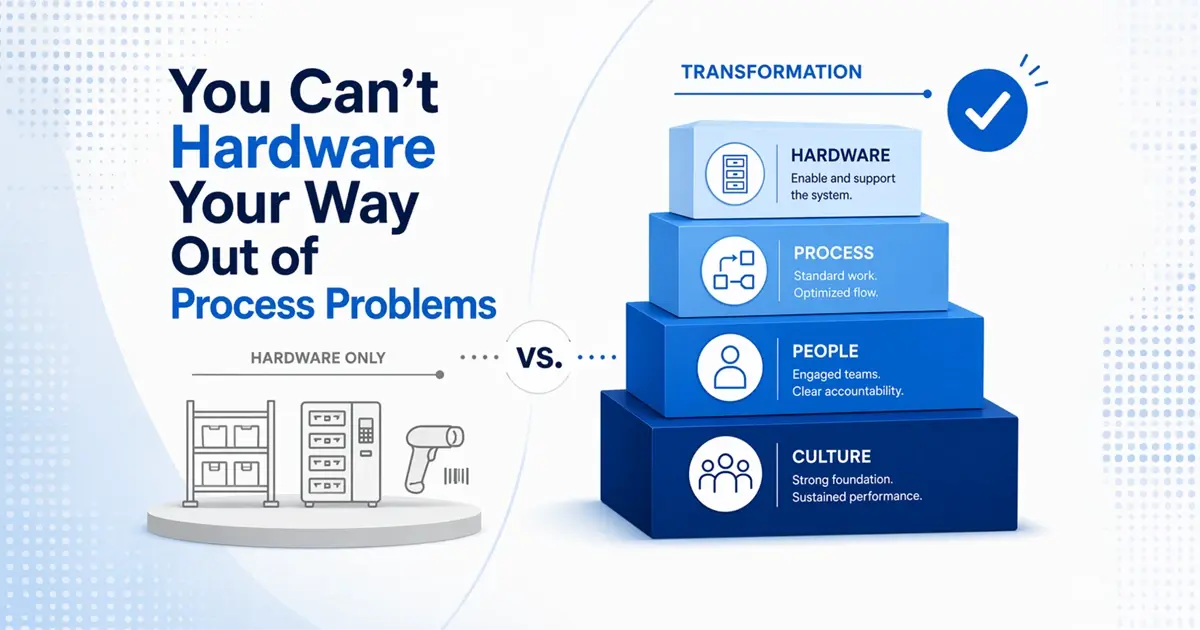
- Hardware alone cannot fix broken processes. Technology layered onto dysfunction organizes it more efficiently, not less.
- True supply chain transformation integrates people, process, culture, and appropriate hardware, in that order. You can buy cabinets, but not accountability.
- A large Midwest nonprofit health system achieved 7.4x ROI over 36 months through standard work, embedded coaching, and continuous improvement, not hardware investment alone.
- Comprehensive transformation delivers a 7% net supply expense reduction, 30% efficiency gains, and 98% fill rates, with results that compound over time.
Healthcare organizations facing supply chain challenges often gravitate toward visible, tangible solutions, such as new shelving systems, advanced cabinets, high-density storage, or sophisticated scanning technology. These hardware investments promise quick fixes to complex problems. However, organizations that achieve sustainable supply chain excellence recognize a fundamental truth: you cannot hardware your way out of process problems. True transformation requires addressing the underlying workflows, accountability structures, and cultural patterns that create inefficiency, not just reorganizing how supplies are shelved.

The Seductive Appeal of Hardware Solutions
The Tangibility Trap
Hardware solutions appeal to healthcare leaders because they're visible and concrete. New racks, bins, cabinets, and technology create an impression of progress. Capital investments produce tangible assets that boards and administrators can see and tour. The act of purchasing and installing equipment feels like decisive action addressing supply chain problems.
This tangibility creates psychological satisfaction that process improvement initiatives often lack. Telling stakeholders about new automated cabinets or high-density racking sounds more impressive than describing improved standard work or cultural change. However, this psychological appeal often leads organizations to invest in hardware that doesn't address the root causes of supply chain dysfunction.
The Technology-First Fallacy
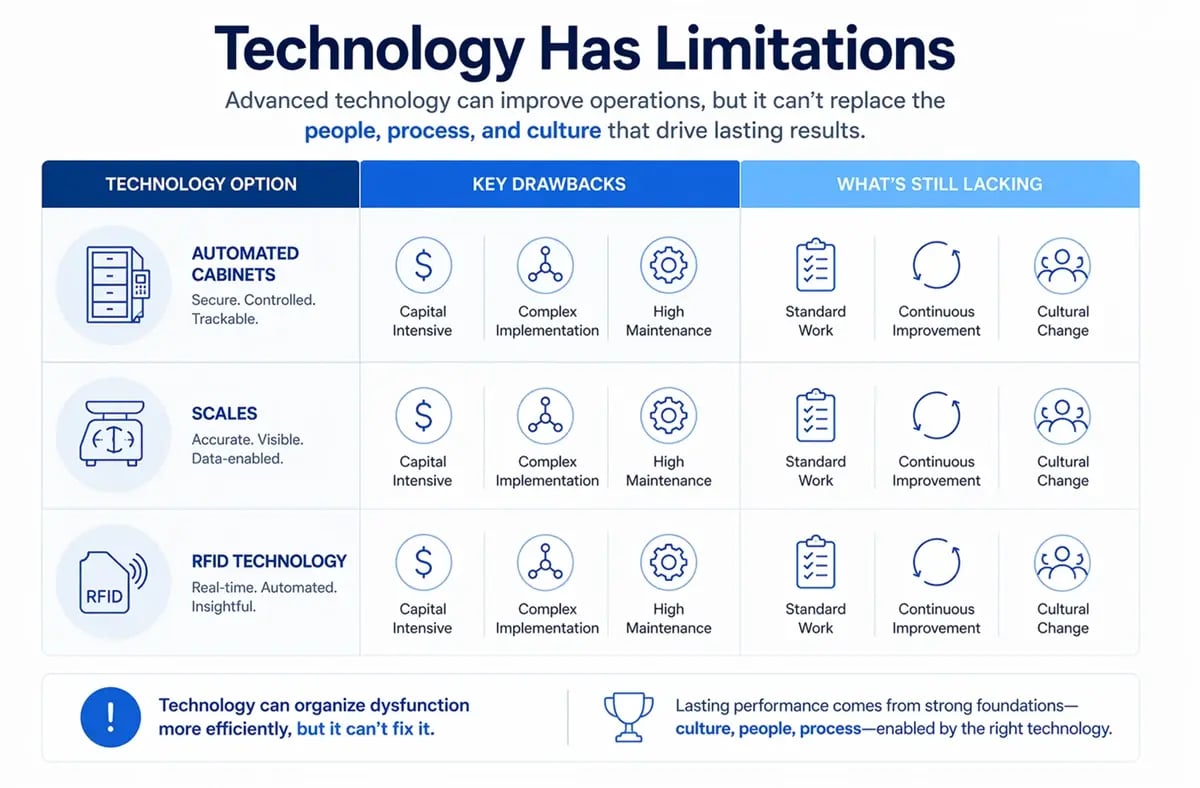
Many organizations assume advanced technology automatically improves operations. Scanning systems, RFID tags, automated cabinets, scales, cameras, and high-density racks all promise efficiency gains through technological sophistication. The implicit belief is that better technology compensates for process weaknesses or eliminates the need for process discipline.
However, technology layered onto dysfunctional processes simply automates dysfunction. When PAR levels are set through guesswork, sophisticated technology just tracks the wrong quantities faster. When accountability is unclear, advanced systems don't clarify responsibilities. When staff lack standard work processes, technology doesn't create consistency. Organizations discover that expensive hardware investments fail to deliver promised benefits because the underlying process problems remain unaddressed.
Missing the Critical Elements
Hardware solutions typically lack the elements that actually drive supply chain excellence. Standard work processes ensure everyone performs tasks consistently, minimizing variation and error. Continuous improvement methodologies systematically identify and address problems rather than working around them. Cultural change establishes accountability and engagement that sustain performance in the long term.
Organizations cannot purchase these critical elements. You can buy cabinets, but not accountability. You can install racks, but not standard work. You can deploy technology, but not cultural transformation. When hardware investments neglect these foundational elements, they address symptoms rather than causes and deliver disappointing results despite substantial spending.

What Hardware-Only Approaches Miss
Process Discipline and Standard Work
The Ohio State University Wexner Medical Center discovered they didn't have a people problem but rather a process problem. Supply coordinators used a par-cart push inventory system and spent extensive time estimating inventory levels. The organization had an entire inventory system based on how good individuals were at guessing. Supplies were disorganized or hidden because there wasn't a standard for supply room design, leading to confusion and rework.
New shelving or technology wouldn't fix these process problems. The organization needed standard work defining how supplies should be organized, how inventory should be counted, how replenishment should occur, and how accountability should be established. Without these process foundations, any hardware investment would simply create more organized chaos rather than true efficiency.
Standard work provides a common understanding of processes, draws attention to abnormal conditions, improves predictability of results, and serves as the basis for continuous improvement. Great results don't just happen through better hardware; they happen through disciplined processes that minimize variation and ensure everyone performs work consistently.
Cultural Transformation and Engagement
The former Director of Supply Chain Operations at OSU-WMC, Patricia Hoch, recognized that technology alone wouldn't solve their issues. Organizations need cultural change that establishes new patterns of accountability, engagement, and continuous improvement. Hardware solutions don't create this cultural foundation. A sophisticated cabinet doesn't make staff more accountable for supply management. Advanced racks don't engage clinicians in improving workflows.
True transformation requires clinical staff involvement in redesigning supply nodes, setting PARs based on actual needs rather than historical inertia, and committing to maintaining organized, efficient supply environments. This engagement cannot be purchased; it must be cultivated through leadership, training, and process design that respects clinical workflow while ensuring supply chain discipline.
Continuous Improvement Mechanisms
Hardware solutions represent one-time improvements. Once installed, cabinets and racks don't get better over time without active management and optimization. Organizations need continuous improvement methodologies that systematically identify problems, test solutions, and implement refinements. This ongoing optimization creates value that compounds year after year.
Gemba walks, daily management systems, quarterly tune-ups, and BlueBelt certification programs establish continuous improvement as standard practice rather than special projects. These mechanisms ensure supply chain performance improves continuously rather than degrading after initial implementation enthusiasm fades. Hardware alone provides no mechanism for this ongoing improvement.
Data-Driven Optimization
While technology can capture data, hardware solutions typically don't include the analytics and optimization capabilities that turn data into actionable intelligence. Organizations need systems that not only track inventory but also suggest optimal PAR levels, identify slow-moving items, predict potential stock-outs, and enable data-driven decision making.
The Queen's Health System specifically cited data visibility as transformative. Real-time velocity reports, immediate identification of items not being scanned, suggested PAR levels based on usage data, and visual dashboards eliminated guesswork. This intelligence enables right-sizing inventory from the start rather than guessing and adjusting over months or years. Hardware-focused solutions rarely offer this level of analytical depth.

The Transformation-First Approach
Process Design Before Technology Selection
True transformation begins with process analysis rather than hardware selection. Organizations should start by documenting current processes, identifying the root causes of dysfunction, mapping desired future-state workflows, and designing standard work that eliminates waste and error. Only after establishing process fundamentals should organizations select technology and hardware that support these optimized processes.
This process-first approach ensures hardware investments actually address identified problems rather than creating expensive solutions in search of problems to solve. When organizations clearly understand their process requirements, they can select appropriate technology levels—sometimes discovering that simpler solutions work better than sophisticated alternatives.
People and Process, Then Technology
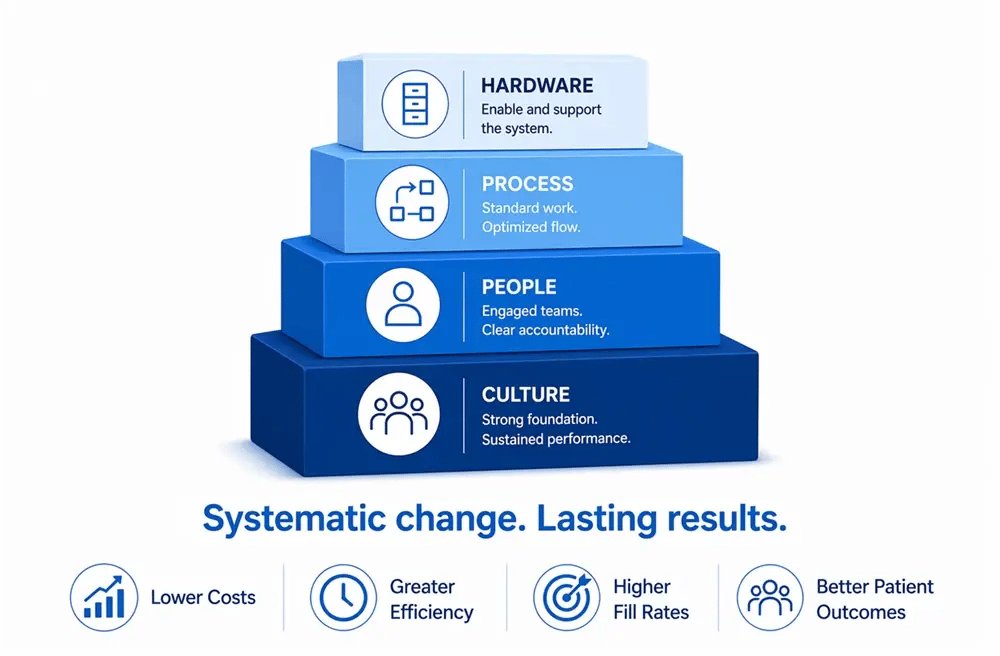
The transformation sequence matters critically. Organizations should first develop their people through training, engagement, and cultural change. Next, establish robust processes through standard work and continuous improvement mechanisms. Finally, implement technology and hardware that support excellent processes performed by engaged people. This sequence ensures each element reinforces others rather than working at cross-purposes.
Patricia Hoch noted that BlueBin was selected because it drives accountability and standard work, so clinicians have what they need when they need it. The emphasis was on process discipline and engagement first, with hardware serving these objectives rather than substituting for them. This people-and-process foundation created sustainable results that hardware alone never achieves.
Embedded Coaching and Knowledge Transfer
Hardware vendors install equipment and leave. Transformation partners embed coaches who transfer knowledge, build internal capabilities, and establish sustainable practices. This coaching component proves essential for long-term success. Organizations need expertise in Lean methodology, change management, clinical engagement, and supply chain optimization—capabilities that don't come with hardware purchases.
BlueBelt certification programs ensure organizations develop internal expertise to sustain and expand transformation after initial implementation. This knowledge transfer prevents the year-three stall that plagues many supply chain initiatives. When organizations build internal capabilities rather than just buying equipment, they can continue improving long after external support ends.
Turnkey Implementation vs. DIY Hardware
Organizations attempting DIY supply chain improvements with purchased hardware often face multi-year timelines, inconsistent results, and stalled implementations. The complexity of simultaneously redesigning processes, engaging staff, establishing accountability, implementing technology, and sustaining improvements exceeds most internal capabilities while staff handle ongoing operations.
Turnkey transformation delivers speed-to-quality results through dedicated on-site implementation teams working 5 days per week. These teams bring proven methodologies, specialized expertise, and full-time focus that internal staff cannot match while maintaining daily operations. Organizations achieve transformation four times faster than typical internal programs while avoiding the trial-and-error waste that consumes resources in DIY approaches.

The Drawbacks of Hardware-First Investments
Capital Intensive Without Guaranteed Returns
Hardware-focused solutions typically require substantial capital investment up front. Automated cabinets, RFID systems, and high-density storage can cost millions for system-wide implementation. These capital requirements create financial constraints that limit other strategic investments. Worse, when hardware doesn't deliver expected benefits due to unaddressed process problems, organizations have little recourse except to invest additional capital in alternatives.
The Queen's Health System faced this exact scenario with aging Omnicell cabinets requiring expensive upgrades and prohibitive costs for system-wide replacement. Capital locked into underperforming hardware becomes unavailable for more effective alternatives. Organizations should invest in a transformation that delivers measurable ROI rather than in hardware that may or may not improve performance.
Complex Installation and Maintenance
Sophisticated hardware solutions require complex installation processes that disrupt operations. Integration with existing systems, staff training, workflow adaptation, and troubleshooting consume months of time and extensive resources. After installation, ongoing maintenance requirements create perpetual costs and potential points of failure that simpler solutions avoid.
High-maintenance hardware also creates dependency on vendors for repairs, updates, and support. When cabinets malfunction or technology fails, organizations cannot access supplies until vendor technicians arrive. This dependency introduces operational risk and ongoing costs that simple, reliable solutions eliminate.
Minimal Efficiency Gains Without Process Change
Perhaps the most significant drawback of hardware-only approaches is disappointing efficiency gains. When organizations install new equipment without addressing underlying processes, they achieve minimal sustained improvement. New cabinets organizing supplies more neatly don't solve problems with PAR accuracy, expiration management, or staff accountability. High-density storage, fitting more items into less space, doesn't address the root causes of excess inventory or prevent continued accumulation.
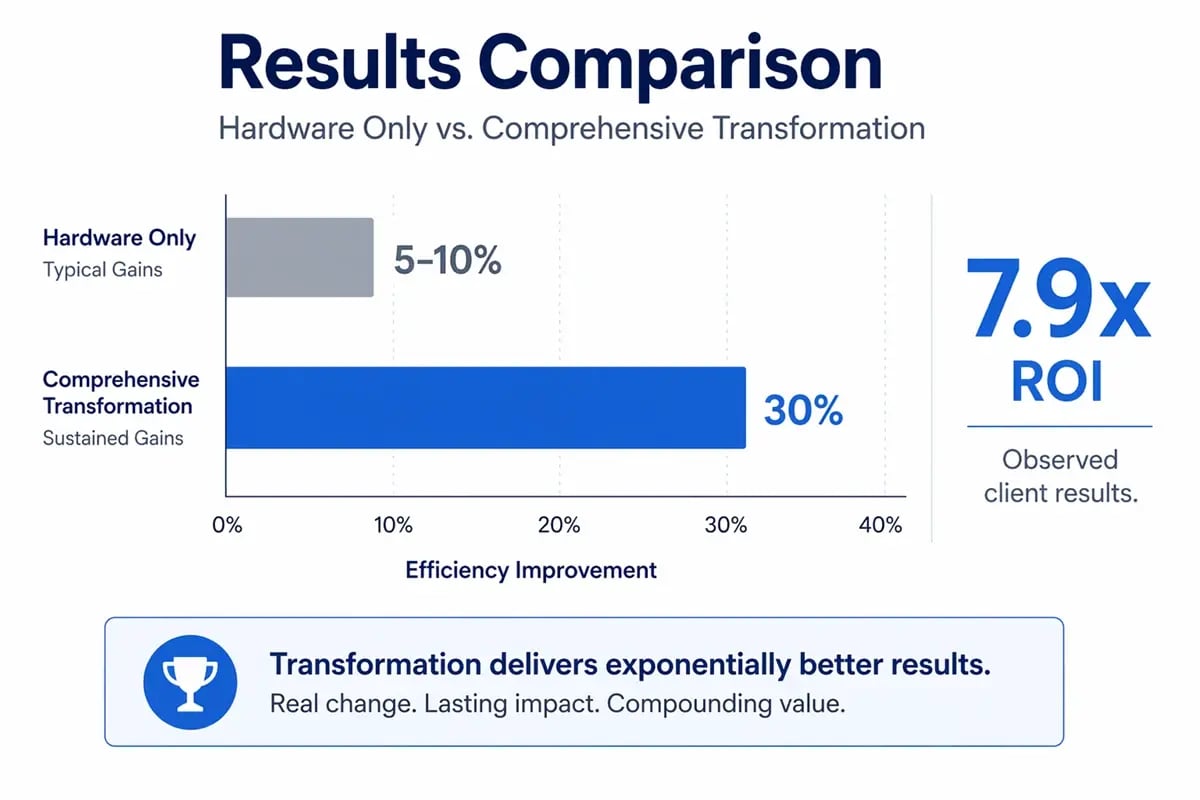
Organizations implementing comprehensive transformation typically achieve 30% supply chain efficiency improvements—double the 15-20% Lean benchmarks from process improvement alone. This dramatic difference reflects the multiplicative effect of integrating process excellence, cultural engagement, data analytics, and appropriate hardware. Hardware alone delivers only a fraction of this potential improvement.

What Comprehensive Transformation Delivers
Measurable Performance Improvements
Transformation-focused approaches deliver measurable results that hardware-only solutions cannot match. Organizations achieve a 7% reduction in supply expenses as a percentage of net patient revenue, not by negotiating better prices but by eliminating waste and optimizing inventory. Fill rates exceed 98%, compared to 85-95% industry averages, because processes ensure reliable replenishment rather than relying on expensive technology to compensate for process weaknesses.
Bin-fill accuracy reaches 99% versus 65% in manual environments because standard work eliminates guesswork and variation. Expirations drop below 1% from 8-10% industry norms through FIFO/FEFO protocols and PAR optimization. These improvements directly impact financial performance while also improving clinical satisfaction and patient care quality.
Sustainable Culture of Continuous Improvement
Comprehensive transformation establishes sustainable practices that improve continuously rather than degrade after initial implementation. Daily management systems, Gemba audits, BlueBelt certification, and quarterly tune-ups ensure organizations maintain and build upon initial gains. This sustainability prevents the year-three stall that plagues hardware-focused investments.
The culture of continuous improvement means organizations keep getting better long after implementation teams depart. Staff identify and solve problems proactively rather than waiting for external experts. Processes evolve to accommodate changing needs rather than becoming rigid constraints. This adaptive capability proves invaluable in dynamic healthcare environments where static solutions quickly become obsolete.
Strong ROI Through a Comprehensive Approach
Organizations implementing a complete transformation document a typical 5–7x return on investment, with flagship implementations such as the large Midwest nonprofit’s 7.4x ROI across 12 facilities over 36 months. This substantial ROI comes from multiple value streams:
- Recurring savings on medical expense supplies
- One-time inventory reduction
- Releasing working capital
- Resource redeployment
- Creating capacity for higher-value work
- Clinical time savings
- Improving nurse satisfaction and patient care
- And improved fill rates, eliminating procedure delays and cancellations.
Hardware-only approaches rarely achieve this comprehensive value creation. Transformation ROI reflects the multiplicative effect of process excellence, cultural engagement, and appropriate technology working together rather than the additive effect of individual improvements in isolation. Organizations should evaluate investment options based on documented, sustainable ROI rather than capital costs or promises of technology-driven efficiency.

Making the Right Investment Decision
Evaluating Hardware vs. Transformation
Healthcare organizations evaluating supply chain investments should ask critical questions. Does the proposed solution address root causes or just symptoms? Does it include process redesign and the establishment of standard work? What cultural change mechanisms does it incorporate? How does it build internal capabilities for sustained improvement? What evidence demonstrates sustainable ROI rather than just implementation success?
Organizations should be skeptical of solutions promising that new technology or hardware alone will solve supply chain problems. Look for comprehensive approaches that integrate people, processes, and technology. Prioritize vendors who emphasize transformation over equipment sales and who demonstrate sustained customer results rather than just installation success stories.
The Role of Appropriate Hardware
This is not an argument against hardware entirely. Appropriate hardware plays an important supporting role in supply chain excellence. Simple, durable bins enable visual management. Purpose-built racks support FIFO/FEFO rotation. Scanning technology captures data for analytics. The key is that hardware should support excellent processes rather than attempting to compensate for poor ones.
Ohio State's Hoch noted that what they were building was racks, plastic bins, plastic pipes, and stickers—all simple but sensible. Even the technology dashboard was straightforward, asking fundamental questions and providing what staff needed. This simplicity reflected process-first thinking rather than technology-first assumptions. The hardware served the process rather than dictating it.
Short-Term Costs vs. Long-Term Value
Comprehensive transformation requires a higher initial investment than simple hardware purchases. However, this short-term cost delivers long-term value that hardware alone never achieves. Organizations should view supply chain investments through a lifecycle cost and value-creation lens rather than initial price. The turnkey transformation costs more upfront but delivers 5-7x ROI, substantially outperforming cheaper hardware that fails to transform operations.
Additionally, transformation-focused investments often prove more economical over time. Organizations avoid the expensive trial-and-error cycles, technology replacement requirements, and ongoing maintenance burdens that characterize hardware-focused approaches. The sustainable improvements mean organizations achieve target performance quickly and maintain it indefinitely rather than experiencing the boom-bust cycle of initial gains followed by gradual degradation.

Conclusion: Investing in Transformation, Not Just Infrastructure
Healthcare organizations cannot hardware their way out of supply chain problems. New cabinets, racks, and technology applied to dysfunctional processes simply automate or organize dysfunction more efficiently. True supply chain excellence requires a comprehensive transformation that integrates people, processes, culture, and technology. Hardware plays a supporting role in this transformation, but cannot substitute for process discipline, cultural engagement, and continuous improvement.
Organizations should evaluate supply chain investments based on comprehensive transformation capabilities rather than hardware features or capital costs. Look for approaches that establish standard work, build internal capabilities, create sustainable continuous-improvement cultures, and deliver documented ROI across multiple value streams. Be skeptical of solutions promising that technology or hardware alone will solve complex operational challenges.
The difference between hardware purchases and comprehensive transformation appears in the results. Hardware-focused approaches deliver minimal efficiency gains, require expensive ongoing maintenance, and often disappoint despite substantial capital investments. Transformation-focused approaches achieve 5-7x ROI, 30% efficiency improvements, and sustainable cultures of excellence that continuously improve long after initial implementation. For healthcare organizations committed to supply chain excellence, comprehensive transformation represents an investment in long-term success rather than short-term fixes through equipment purchases.
Frequently Asked Questions
