---
title: From Clinical Insights to Hospital Supply Chain Automation
description: Learn how clinical insights, point-of-use systems, and EHR integration transform hospital supply chains, and how automation drives efficiency & patient care quality.
image: https://blog.bluebin.com/hubfs/hospital-business-data.jpg
---
[Skip to main content](https://blog.bluebin.com/hospital-supply-chain-automation-clinical-insights#main-content)
[BlueBin Rated #1 in Black Book 2026 Healthcare Supply Chain Report](https://bluebin.com/results/news/bluebin-ranked-number-one-black-book-2026-healthcare-supply-chain/)
-
-
-
-
-
[   ](https://bluebin.com/)
- [Show submenu for Solutions Solutions](https://bluebin.com/solutions/)
- [BlueBin Kanban](https://bluebin.com/solutions/hospital-kanban/)
- [BlueQ Analytics](https://bluebin.com/solutions/blueq-analytics/)
- [BlueQ SmartScan](https://bluebin.com/solutions/blueq-smartscan/)
- [Consulting & Training](https://bluebin.com/solutions/consulting/)
- [Kanban Supplies](https://bluebin.com/solutions/hospital-kanban-supplies/)
- [Show submenu for Results Results](https://bluebin.com/results/)
- [Case Studies](https://bluebin.com/results/case-studies/)
- [Videos](https://bluebin.com/results/videos/)
- [News](https://bluebin.com/results/news/)
- [Show submenu for About Us About Us](https://bluebin.com/company/)
- [Our Team + Our Story](https://bluebin.com/company/our-team-our-story/)
- [Partner with BlueBin](https://bluebin.com/company/partnering-with-bluebin/)
- [Events](https://bluebin.com/events/)
- [Careers](https://bluebin.com/company/careers/)
- [Get Support](mailto:bluebin.support@capsahealthcare.com?subject=Bluebin%20Support%20Request)
- [Show submenu for Resources Resources](https://bluebin.com/resources/)
- [Blog](https://blog.bluebin.com)
- [Whitepapers](https://bluebin.com/resources/whitepapers/)
- [Guides & Checklists](https://bluebin.com/resources/guides/)
- [Calculators](https://bluebin.com/resources/calculators/)
- [Newsletter Archive](https://bluebin.com/resources/bluebin-newsletter-archive/)
- [Contact](https://bluebin.com/contact/)
Open main navigation
Close main navigation
- Show submenu for Solutions Solutions
- [BlueBin Kanban](https://bluebin.com/solutions/hospital-kanban/)
- [BlueQ Analytics](https://bluebin.com/solutions/blueq-analytics/)
- [BlueQ SmartScan](https://bluebin.com/solutions/blueq-smartscan/)
- [Consulting & Training](https://bluebin.com/solutions/consulting/)
- [Kanban Supplies](https://bluebin.com/solutions/hospital-kanban-supplies/)
- Show submenu for Results Results
- [Case Studies](https://bluebin.com/results/case-studies/)
- [Videos](https://bluebin.com/results/videos/)
- [News](https://bluebin.com/results/news/)
- Show submenu for About Us About Us
- [Our Team + Our Story](https://bluebin.com/company/our-team-our-story/)
- [Partner with BlueBin](https://bluebin.com/company/partnering-with-bluebin/)
- [Events](https://bluebin.com/events/)
- [Careers](https://bluebin.com/company/careers/)
- [Get Support](mailto:bluebin.support@capsahealthcare.com?subject=Bluebin%20Support%20Request)
- Show submenu for Resources Resources
- [Blog](https://blog.bluebin.com)
- [Whitepapers](https://bluebin.com/resources/whitepapers/)
- [Guides & Checklists](https://bluebin.com/resources/guides/)
- [Calculators](https://bluebin.com/resources/calculators/)
- [Newsletter Archive](https://bluebin.com/resources/bluebin-newsletter-archive/)
- [Contact](https://bluebin.com/contact/)
Search
- [Optimization](https://blog.bluebin.com/tag/optimization)
- [Automation](https://blog.bluebin.com/tag/automation)
# Revolutionizing Hospital Supply Chains: From Clinical Insights to Cutting-Edge Automation
 by [Tomer Cohen](https://blog.bluebin.com/author/tomer-cohen) Oct 24, 2024
Table of contents
From Clinical Insights to Hospital Supply Chain Automation
10:43

Key Takeaways
- Clinical stakeholder engagement is foundational — supply chain optimization starts with understanding specialty-specific needs, not just inventory counts.
- Point-of-use systems eliminate guesswork by making reorder signals visual and automatic, reducing both stockouts and overstock.
- RFID and AI analytics serve the POU model by providing real-time accuracy and department-level demand forecasting.
- EHR integration is the most powerful step available today — linking clinical orders to supply availability eliminates reactive management and enables charge capture accuracy.
- Automation's ROI depends on consistent adoption — training and process standardization are as important as the technology itself.
In modern healthcare, the efficiency of the supply chain directly impacts patient care quality. A well-managed supply chain ensures medical professionals have the necessary tools and resources, reducing delays and enhancing treatment outcomes. This post explores the importance of understanding clinical perspectives, the advantages of point-of-use systems, and the transformative power of automation and technology integration in hospital supply chains. For a broader look at how the industry arrived here, read our guide to the [evolution of the healthcare supply chain](https://blog.bluebin.com/the-evolution-of-the-healthcare-supply-chain-overcoming-challenges-and-embracing-innovation).

## Understanding the Clinical Perspective
A thorough grasp of clinical needs is crucial for an effective supply chain system. Each department, whether the ER or the OR, has distinct requirements for customized solutions. Understanding and addressing these unique needs can significantly improve the supply chain's efficiency and effectiveness.
### Partnering with Clinical Stakeholders
Optimizing a hospital's supply chain hinges on effective collaboration. Engaging clinical stakeholders like nurses, doctors, and department heads can gather valuable insights into their specific needs and challenges. Regular meetings, surveys, and focus groups offer a comprehensive understanding of clinical staff's daily issues. Including them in the process yields critical information and fosters a sense of ownership and commitment to the new system.
### Analyzing Consumption Patterns Across Specialties
Different medical specialties have specific supply requirements. For instance, orthopedics often needs a regular influx of implants and surgical instruments, whereas the ICU relies on various consumables. Examining historical data and usage patterns helps uncover trends, seasonal changes, and anomalies. This information is vital for developing a robust replenishment system, ensuring that every department is always adequately stocked with the necessary supplies.
### Tailoring Systems to Meet Departmental Needs
The insights obtained from collaborating with clinical stakeholders and analyzing data should inform the creation of tailored solutions for each department. This could mean implementing varying PAR levels, unique storage configurations, or specialized ordering procedures. Customizing the system in this way ensures it integrates smoothly into each department's workflow, enhancing efficiency and minimizing interruptions to patient care.
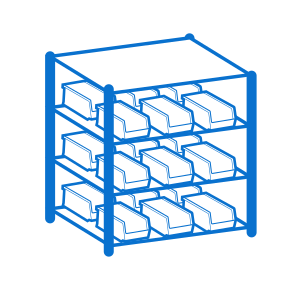
## The Power of Point-of-Use Systems
[Point-of-use (POU) systems](https://blog.bluebin.com/the-power-of-point-of-use-systems-in-hospital-supply-chain-management) like the Kanban method revolutionize hospital inventory management. These systems bring supplies closer to the point of care, improving efficiency and reducing waste. By leveraging technology, POU systems enable healthcare providers to easily track inventory usage, ensuring that supplies are always available when and where they are needed most.
### Eliminating Guesswork in Reordering
Conventional inventory management often relies on manual counting and subjective judgments of stock levels. In contrast, point-of-use systems provide a standardized, visual approach to managing inventory. By employing two-bin systems or electronic PAR-level indicators, staff can easily see when it's time to reorder, removing the guesswork and significantly reducing the potential for human error.
### Reducing Errors and Stockouts
One of the most significant benefits of POU systems is their ability to reduce stockouts and overstock situations dramatically. Maintaining optimal inventory levels ensures that critical supplies are always available when needed, enhancing patient care and safety. At the same time, these systems prevent overstocking, which ties up valuable financial resources and increases the risk of [product expiration](https://blog.bluebin.com/sustainability-and-cost-savings-the-hidden-benefits-of-optimized-hospital-supply-chains).
### Freeing Up Clinical Staff to Focus on Patient Care
In numerous hospitals, clinical staff often spend considerable time managing supplies, which could otherwise be spent on patient care. Point-of-use systems automate inventory management, alleviating this burden from healthcare professionals. This enhances job satisfaction and enables staff to focus more on their core responsibility: providing care to patients.

## Automation and Technology Integration
Automation and advanced technologies are elevating point-of-use systems to new heights, delivering unmatched efficiency and accuracy in supply chain management. These innovations are especially valuable in hospital environments, where precision and timely resource management are critical.
### RFID Tracking for Real-Time Inventory Updates
RFID technology enhances point-of-use accuracy by automatically detecting when items are added or removed from supply cabinets and shelves — eliminating manual counts at the point of care. This real-time visibility reduces labor costs and generates usage data that feeds directly into analytics and reordering workflows, strengthening the POU system rather than replacing it.
### AI-Driven Predictive Analytics for Smarter Ordering
AI-driven predictive analytics go further by analyzing specialty-specific usage patterns to recommend dynamic PAR level adjustments by department. Rather than applying uniform reorder thresholds across a facility, AI systems account for the different supply rhythms of orthopedics, the ICU, the ER, and the OR — forecasting shortages before they occur and preventing costly overstock in parallel.
### Integration with Electronic Health Records for Seamless Patient Care
Integrating supply chain systems with Electronic Health Records (EHR) is one of the most consequential advances available to healthcare supply chain leaders today. Where previous improvements — RFID, automated reordering, predictive analytics — optimized the supply room itself, EHR integration creates a closed loop between clinical orders and supply availability, transforming inventory management from a parallel function into an active component of patient care delivery.
In practice, when a physician places a procedure or treatment order in the EHR, a connected supply system can simultaneously verify stock availability, flag potential shortfalls, trigger a reorder from the supply room or distributor, and surface clinically equivalent alternatives if a preferred item is unavailable — all before the care team needs the item. This eliminates the reactive scramble that has historically added stress and delay for both supply staff and clinicians. It also improves charge capture accuracy by automatically attributing supplies to the specific patient encounter in which they were used, reducing revenue leakage from unbilled or misbilled supply usage.
Over time, EHR-integrated supply data creates a longitudinal record of supply consumption tied to patient care events — enabling supply chain leaders to make standardization and formulary decisions grounded in actual clinical evidence, not estimates. BlueBin's analytics platform, [BlueQ Analytics](https://bluebin.com/healthcare-supply-chain-solutions/blueq-analytics), is designed to support this connected ecosystem, providing the real-time supply room visibility and reporting infrastructure that makes EHR integration actionable at scale.

## Ensuring Consistent Use of the System
Consistency is the backbone of successful automation in hospital supply chains. To fully benefit from these systems, it's essential to ensure all users are on board and committed to correctly using the technology. This often begins with **effective training programs** that cater to diverse learning styles, allowing all staff members to understand the system's functionalities and advantages.
### Reducing Human Error
Even the most meticulous staff can make errors when managing inventory manually. Automated systems significantly reduce these human error risks. For instance, RFID technology tracks item removal in real-time, providing accurate usage data without manual counting. Similarly, barcode scanning systems ensure products are correctly stocked in their designated locations, preventing potentially serious mix-ups in a healthcare environment.
### Increasing Overall Efficiency
Automation minimizes errors and significantly enhances the speed and efficiency of the entire supply chain process. Automated systems can handle reorder requests instantly, update inventory levels in real-time, and produce reports and analytics without manual intervention. This boost in efficiency leads to time savings for staff, cost reductions for hospitals, and, ultimately, improved patient care.
## Conclusion
Integrating clinical perspectives, point-of-use systems, and advanced technologies into hospital supply chains can revolutionize how healthcare facilities manage their resources. Hospitals can ensure a consistent, accurate, and efficient supply chain by understanding and addressing each department's unique needs, utilizing efficient POU systems, and embracing automation and technology. This enhances patient care, optimizes resource allocation, reduces waste, and improves overall hospital efficiency.
Innovative solutions that BlueBin offers play a crucial role in this [transformation](https://bluebin.com/speed-to-quality-transformation/). By offering real-time data and user-friendly interfaces, BlueBin helps healthcare facilities minimize manual errors, streamline processes, and ensure the timely availability of supplies. Our supply chain management expertise and personalized support position us as partners in driving efficiency and enhancing patient care. Let us help you redefine your hospital's supply chain for a more responsive and reliable future.
[Download the Whitepaper Now](https://www.bluebin.com/en-us/ultimate-hospital-supply-chain-replenishment-guide). Catch on early to supply chain inefficiencies that hold your hospital back. Take the first step towards a more efficient, cost-effective, patient-centered supply management system today.
[](https://blog.bluebin.com/hs/cta/wi/redirect?encryptedPayload=AVxigLJCejx8eMt0Ul21t9ApHvvEUCgXmLAJvxw62L4zNyMqImhxqp866IHC4mPJIDu6Wne6SN1YvVBcwRijy24Qy7UGLKfuXTwqOCEFvNfMfEuz%2Fpdxc0LReIRY9lH76xfjw2K6YmXsb0hVg7gf%2Bz4hDl%2BXS%2Ba9T5JM1%2FE1o6%2FA51sKDGnuL%2B0IL7kcXuq9i8wOpfMI0wCGMu6MdACxFrHm4Bps4AZsaeUAnK5Gk4sMSdjzEtYJ&webInteractiveContentId=175705871402&portalId=9067872)
## Frequently Asked Questions
### What is point-of-use supply chain management in hospitals?
Point-of-use (POU) supply chain management places supplies at or near the point of patient care, rather than in a central storeroom. Systems like two-bin Kanban and PAR-level indicators make reorder signals visual and automatic, reducing stockouts, cutting the time staff spend managing inventory, and ensuring supplies are available when and where they are needed.
### How does EHR integration improve hospital supply chain efficiency?
Integrating the supply chain with Electronic Health Records creates a closed-loop system in which clinical orders trigger automated supply checks and reorders. This eliminates reactive stockouts, improves charge capture accuracy, and generates usage data tied to patient care, giving supply chain leaders better data for standardization and procurement decisions.
### What role does AI play in hospital supply chain management?
AI-driven predictive analytics analyze historical usage and specialty-specific patterns to forecast supply needs before shortages occur. Rather than relying on static PAR levels, AI systems recommend dynamic adjustments by department — reducing both overstock and critical supply shortfalls across the OR, ICU, ER, and other care areas.
### How can hospitals reduce supply chain errors with automation?
Automation reduces human error through multiple mechanisms: RFID tracks item removal in real time without manual counting; barcode scanning ensures correct stocking locations; automated reorder systems eliminate missed reorders; and EHR integration validates that the right supplies are available before procedures begin.
### What is the first step to improving a hospital supply chain?
The most effective first step is engaging clinical stakeholders, nurses, department heads, and physicians, to understand specialty-specific supply needs and workflows. This clinical foundation ensures that any system you implement addresses real operational pain points rather than applying a generic solution that staff won't adopt consistently.

Post by [Tomer Cohen](https://blog.bluebin.com/author/tomer-cohen)
Oct 24, 2024, 8:00:00 AM
Tomer Cohen is a Business Development Executive at BlueBin, where he has spent four years helping healthcare systems identify and implement supply chain solutions that improve operational efficiency and patient care. Before joining BlueBin full-time, he gained firsthand experience working as a Program Specialist inside a major children's hospital, giving him an on-the-ground perspective on the procurement and operational challenges facing healthcare organizations. Tomer holds a Bachelor of Business Administration in Finance.
[Follow me on LinkedIn](https://www.linkedin.com/in/tomer-cohen-b467ab195/)
###### Explore Topics
- [Automation](https://blog.bluebin.com/tag/automation)
- [Clinical/Patient care](https://blog.bluebin.com/tag/clinical-patient-care)
- [Cybersecurity](https://blog.bluebin.com/tag/cybersecurity)
- [Data Standards](https://blog.bluebin.com/tag/data-standards)
- [ERP](https://blog.bluebin.com/tag/erp)
- [Financial](https://blog.bluebin.com/tag/financial)
- [Inventory management](https://blog.bluebin.com/tag/inventory-management)
- [Kanban](https://blog.bluebin.com/tag/kanban)
- [Leadership](https://blog.bluebin.com/tag/leadership)
- [Operations](https://blog.bluebin.com/tag/operations)
- [Optimization](https://blog.bluebin.com/tag/optimization)
- [Ordering & Receiving](https://blog.bluebin.com/tag/ordering-receiving)
- [Replenishment](https://blog.bluebin.com/tag/replenishment)
- [Reporting & Analytics](https://blog.bluebin.com/tag/reporting-analytics)
- [Resilience](https://blog.bluebin.com/tag/resilience)
- [Sustainability](https://blog.bluebin.com/tag/sustainability)
- [Warehousing](https://blog.bluebin.com/tag/warehousing)
- [supply chain disruption](https://blog.bluebin.com/tag/supply-chain-disruption)
- [transformation](https://blog.bluebin.com/tag/transformation)
###### Recent Articles
[Hospital Supply Chain Management Software: 7 Factors to Evaluate Before You Sign](https://blog.bluebin.com/hospital-supply-chain-management-software)
[9 Best Hospital Inventory Management Systems for ROI in 2026](https://blog.bluebin.com/best-hospital-inventory-management-systems-2026)
[AHRMM26 Recap: What Healthcare Supply Chain Leaders Are Prioritizing in 2026](https://blog.bluebin.com/ahrmm26-recap-supply-chain-trends-2026)
[When a Distributor's Warehouse Burns Down: What One Warehouse Fire Reveals About Healthcare Supply Chain Vulnerability](https://blog.bluebin.com/warehouse-fire-exposes-healthcare-supply-chain-vulnerability)
[54% of Healthcare Leaders Need Supply Chain ROI in 12 Months](https://blog.bluebin.com/ahrmm26-healthcare-supply-chain-roi)
[Hardware Solutions vs. Transformation: Why Storage Optimization Alone Isn't Enough](https://blog.bluebin.com/hardware-solutions-vs-transformation-why-storage-optimization-alone-isnt-enough)
[True Cost of Ownership: Comparing Kanban, Cabinets, and Manual PAR Systems](https://blog.bluebin.com/true-cost-ownership-comparing-kanban-cabinets-manual-par-systems)
[Hospital Supply Chain Disruption in 2026: What the Iran Conflict Reveals](https://blog.bluebin.com/hospital-supply-chain-disruption-2026)
[ESG and Healthcare: How Supply Chain Waste Reduction Supports Green Bond Eligibility](https://blog.bluebin.com/esg-healthcare-how-supply-chain-waste-reduction-supports-green-bond-eligibility)
[Hospital Supply Chain Resilience: From COVID-19 to Geopolitical Disruption](https://blog.bluebin.com/supply-chain-resilience-after-covid-19)
[](https://bluebin.com/)
Improving the healthcare supply chain process, ensuring that clinicians have the right supplies at the right time.
-
-
-
-
-
### CONTACT
- [bluebinsales@capsahealthcare.com](mailto:bluebinsales@capsahealthcare.com)
- (855) 896-2467
- 8170 Dove Pkwy
Canal Winchester, OH 43110
- QUICK LINKS
- [Supply Chain Solutions](https://bluebin.com/solutions/)
- [Healthcare Kanban](https://bluebin.com/solutions/hospital-kanban/)
- [BlueQ Analytics](https://bluebin.com/solutions/blueq-analytics/)
- [BlueQ SmartScan](https://bluebin.com/solutions/blueq-smartscan/)
- [Supply Chain Consulting](https://bluebin.com/solutions/consulting/)
- [Case Studies](https://bluebin.com/results/case-studies/)
- [About Us](https://bluebin.com/company/our-team-our-story/)
- - [Whitepapers](https://bluebin.com/resources/whitepapers/)
- [Guides & Checklists](https://bluebin.com/resources/guides/)
- [Calculators](https://bluebin.com/resources/calculators/)
- [Blog](https://blog.bluebin.com/)
- [Careers](https://bluebin.com/company/careers/)
- [Contact](https://bluebin.com/contact/)
- [Support](mailto:bluebin.support@capsahealthcare.com?subject=Bluebin%20Support%20Request)
© 2026 BlueBin Inc. All Rights Reserved
[Sitemap](https://bluebin.com/page-sitemap.xml?__hstc=51647990.6d18215ae56f1f7281d0f59df56a7960.1616739528041.1616739528041.1616739528041.1&__hssc=51647990.19.1616739528042&__hsfp=1866732115)
```json
{
"@context" : "https://schema.org",
"@type" : "BlogPosting",
"author" : {
"@type" : "Person",
"name" : "Tomer Cohen",
"url" : "https://blog.bluebin.com/author/tomer-cohen"
},
"dateModified" : "2026-05-13T23:53:10.181Z",
"datePublished" : "2024-10-24T15:00:00.000Z",
"headline" : "From Clinical Insights to Hospital Supply Chain Automation",
"image" : [ "https://blog.bluebin.com/hubfs/hospital-business-data.jpg" ],
"mainEntityOfPage" : {
"@id" : "https://blog.bluebin.com/hospital-supply-chain-automation-clinical-insights",
"@type" : "WebPage"
},
"publisher" : {
"@type" : "Organization",
"logo" : {
"@type" : "ImageObject",
"url" : "https://blog.bluebin.com/hubfs/bluebin-logo.png"
},
"name" : "BlueBin"
}
}
```
```json
{
"@context": "https://schema.org",
"@type": "FAQPage",
"mainEntity": [
{
"@type": "Question",
"name": "What is point-of-use supply chain management in hospitals?",
"acceptedAnswer": {
"@type": "Answer",
"text": "Point-of-use (POU) supply chain management places supplies at or near the point
of patient care rather than in a central storeroom. Systems like two-bin Kanban
and PAR-level indicators make reorder signals visual and automatic, reducing
stockouts, cutting time staff spend managing inventory, and ensuring supplies
are available when and where they are needed."
}
},
{
"@type": "Question",
"name": "How does EHR integration improve hospital supply chain efficiency?",
"acceptedAnswer": {
"@type": "Answer",
"text": "EHR integration creates a closed-loop system where clinical orders trigger
automatic supply checks and reorders. This eliminates reactive stockouts,
improves charge capture accuracy, and generates usage data tied to patient
care — giving supply chain leaders better data for standardization and
procurement decisions."
}
},
{
"@type": "Question",
"name": "What role does AI play in hospital supply chain management?",
"acceptedAnswer": {
"@type": "Answer",
"text": "AI-driven predictive analytics analyze historical usage and specialty-specific
patterns to forecast supply needs before shortages occur. AI systems recommend
dynamic PAR level adjustments by department, reducing both overstock and
critical supply shortfalls across the OR, ICU, ER, and other care areas."
}
},
{
"@type": "Question",
"name": "How can hospitals reduce supply chain errors with automation?",
"acceptedAnswer": {
"@type": "Answer",
"text": "Automation reduces human error through multiple mechanisms: RFID tracks item
removal in real time without manual counting; barcode scanning ensures correct
stocking locations; automated reorder systems eliminate missed reorders; and
EHR integration validates supply availability before procedures begin."
}
},
{
"@type": "Question",
"name": "What is the first step to improving a hospital supply chain?",
"acceptedAnswer": {
"@type": "Answer",
"text": "The most effective first step is engaging clinical stakeholders — nurses,
department heads, and physicians — to understand specialty-specific supply
needs and workflows. This ensures any implemented system addresses real
operational pain points rather than applying a generic solution staff
will not adopt consistently."
}
}
]
}
```
```json
{
"@context" : "https://schema.org",
"@type" : "Person",
"jobTitle" : "Business Development Executive",
"name" : "Tomer Cohen",
"sameAs" : "https://www.linkedin.com/in/tomer-cohen-b467ab195/",
"url" : "https://blog.bluebin.com/author/tomer-cohen"
}
```