

Key Takeaways
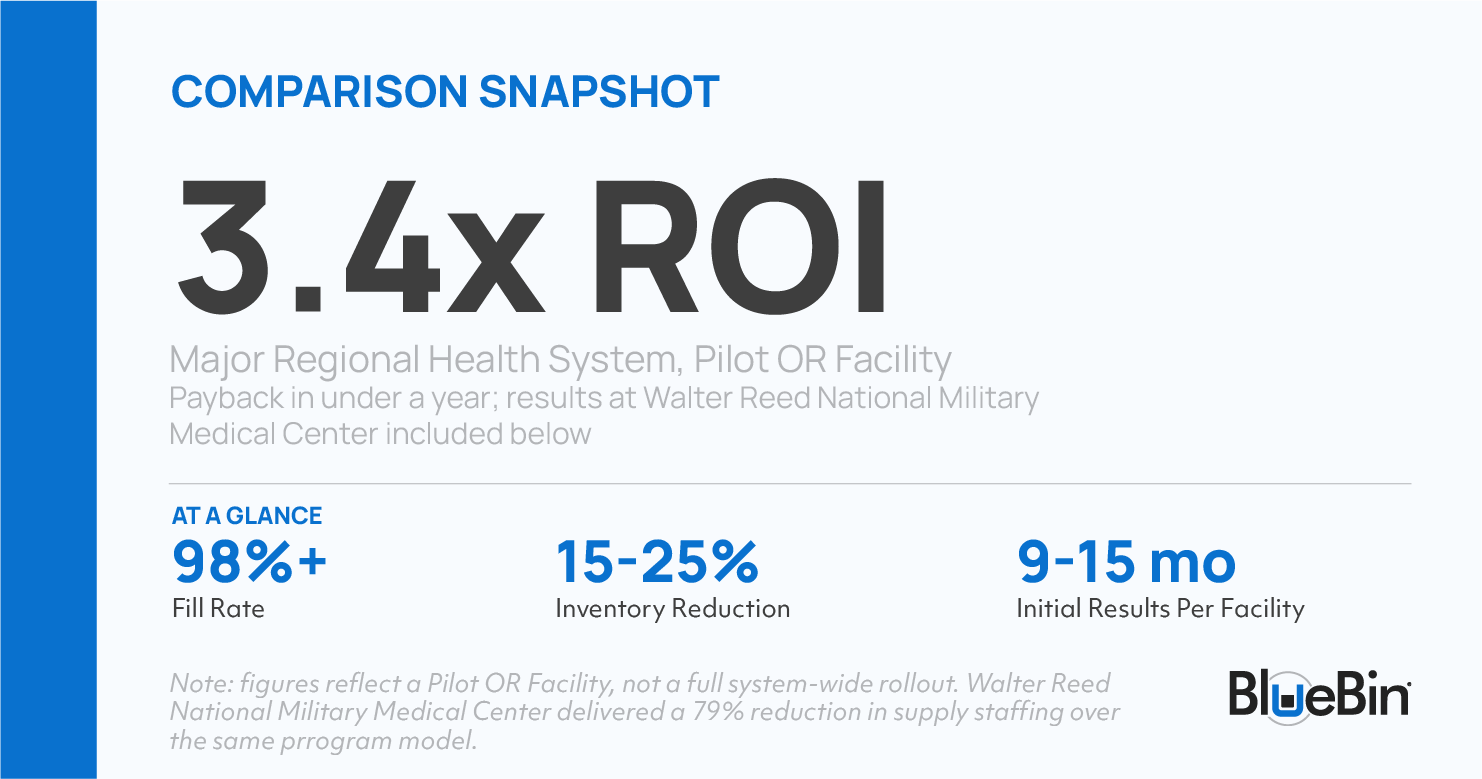
- BlueBin ranks #1 for measurable ROI, with a documented 3.4x return and sub-1-year payback at a major regional multi-hospital health system's Pilot OR Facility.
- Non-biased Black Book Research named BlueBin the #1 client-rated vendor in Inventory, Warehouse, Point-of-Use, and Replenishment Automation in its 2026 State of Healthcare Supply Chain Technology report.
- Healthcare organizations using BlueBin typically see 15-25% inventory reductions and 98% fill rates.
- Individual facilities show measurable initial results in 9-15 months, about four times faster than the 3-5 year timeline of a typical internal transformation program.
- The two-bin Kanban plus BlueQ Analytics approach provides real-time visibility and 100% ERP compatibility.
- This guide compares nine leading platforms, BlueBin alongside direct point-of-use competitors and adjacent enterprise and distribution options, across fill rate, implementation timeline, and support model.
Hospital supply chain leaders face mounting pressure to reduce costs while maintaining patient care standards. Finding the right hospital inventory management system can mean the difference between a supply chain that drains resources and one that delivers measurable ROI within months.
BlueBin delivers healthcare supply chain solutions with documented results across real hospital transformations, from a 3.4x ROI at a major regional health system's Pilot OR Facility to a 79% reduction in supply staffing at Walter Reed National Military Medical Center, using a proven two-bin Kanban approach. This guide compares the platforms that matter most to supply chain managers seeking real results in 2026.
Quick Guide: 9 Hospital Inventory Management Systems for Supply Chain Leaders
- BlueBin: The top choice for measurable ROI and 98% fill rates in healthcare settings
- PAR Excellence: Automated weight-based replenishment for large academic medical centers
- Jump Technologies: Cloud-native point-of-use inventory with nursing-friendly deployment
- LogiQuip: No-scan Kanban hardware with a full-lifecycle storage design service model
- IDENTI Medical: AI image recognition for OR and surgical charge capture
- GHX Inventory Management: Procurement-focused platform for multi-location hospitals
- Tecsys Healthcare: Point-of-use tracking with RFID capabilities
- Omnicell: Automated dispensing cabinets for point-of-use supply control
- Owens & Minor: Distribution-integrated inventory management services
How We Chose Hospital Inventory Management Systems for This List
Selecting the right inventory management platform requires understanding what actually drives results in hospital settings. You need a solution that works for your clinical teams, not against them. For the full picture of what BlueBin's solution suite covers, see our overview of hospital inventory management solutions.
- Measurable ROI within 12-18 months: Your CFO wants to see financial returns, not just operational improvements. The platforms here have documented track records of delivering inventory reductions and cost savings.
- Fill rate accuracy above 95%: Stockouts delay procedures and frustrate nurses. You need a platform that keeps supplies where they belong, when they are needed.
- Implementation timeline under 18 months: Some programs take years to show results. The platforms on this list can deliver value faster than traditional approaches.
- Real-time inventory visibility: Dashboards and analytics that show what is happening now, not what happened last month, give you the data to make informed decisions.
- ERP compatibility: Your new inventory platform must integrate with existing systems like Oracle, SAP, or Workday without creating data silos.
- Clinical workflow integration: A system that nurses and clinical staff can use without extensive training reduces adoption friction and improves outcomes.
The 9 Hospital Inventory Management Systems for Supply Chain Efficiency
1. BlueBin: The Top Hospital Inventory Management System for ROI
BlueBin stands apart by delivering measurable financial returns that supply chain leaders can take to their C-suite. The platform combines a visual, two-bin Kanban replenishment approach with BlueQ Analytics to provide end-to-end visibility across your hospital supply chain.
Healthcare organizations using BlueBin typically see 15-25% inventory reductions and a release of working capital within the first year. At one major regional multi-hospital health system, the Pilot OR Facility alone saw a 12-17% reduction in supply expenses, a $1.51 million one-time inventory reduction, a 3.4x ROI with payback in under a year, and the elimination of legacy automated dispensing cabinet costs. At Walter Reed National Military Medical Center, BlueBin's two-bin Kanban system helped cut supply function staffing 79%, from 67 to 14 people, while returning roughly 40% of clinicians' time to patient care.
What sets BlueBin apart is the focus on building internal capability. The BlueBelt Certification program ensures your team can sustain improvements long after implementation ends. This approach prevents the common pattern where lean initiatives lose momentum and results fade.
BlueBin features
- Two-bin Kanban replenishment: Visual management ensures supplies arrive at the right place, in the right quantity, at the right time, virtually eliminating clinician supply hunts and freeing up to 60 minutes per shift for patient care. Learn more about our two-bin Kanban system.
- BlueQ Analytics with Pulse: Real-time dashboards track supply chain performance across operations, warehouse, and sourcing with predictive ML alerts for backorders and supplier disruptions.
- BlueQ SmartScan: Mobile scanning replaces expensive ERP handhelds with route control, warehouse management, and direct access to analytics from anywhere.
- 99.9% bin-fill accuracy: Near elimination of stockouts means procedures run on schedule and clinical staff spend time on patient care, not hunting for supplies.
- 100% ERP compatibility: Bi-directional sync works with Oracle, SAP, Workday, and other major enterprise systems without creating data integration headaches.
- Embedded coaching and BlueBelt certification: Dedicated implementation teams work on-site to build internal capability, ensuring improvements stick and preventing the common stall that derails other programs.
BlueBin pros and cons
Pros:
- Documented 3.4x ROI and sub-1-year payback at a major regional health system's Pilot OR Facility, plus a 79% reduction in supply staffing at Walter Reed National Military Medical Center.
- Individual facilities show measurable initial improvements within 9-15 months, about four times faster than typical internally run programs.
- BlueBelt certification builds internal expertise so you maintain results independently.
- Independently ranked #1 client-rated vendor in Inventory, Warehouse, Point-of-Use, and Replenishment Automation by vendor agnostic, non-biased Black Book Research's 2026 State of Healthcare Supply Chain Technology report.
Cons:
- The turnkey implementation model requires commitment to the full program approach
- Organizations with very small supply budgets may find dedicated transformation teams more than they need
- The Kanban approach works differently from traditional approaches, requiring some adjustments to the workflow.
2. PAR Excellence: Automated Weight-Based Replenishment for Large Health Systems
PAR Excellence has served healthcare supply chain teams since 1993, building one of the largest reference bases in the category with 317 client hospitals and networks. The company was acquired by OceanSound Partners in 2024 and has since added RFID and recall management capability through its TrackCore and NotiSphere acquisitions.
The platform centers on automated, weight-based replenishment tracking paired with a cloud management layer, giving supply chain teams a hands-off way to trigger reorders as bins are drawn down.
PAR Excellence Features
- Weight-based automated replenishment: Automated replenishment triggers based on real-time weight-scale tracking, reducing manual counting.
- RFID and recall management: RFID tracking and recall management added through the TrackCore and NotiSphere acquisitions.
- 98%+ reported fill rate: Client base reports 98%+ bin fill rates, in line with category leaders.
PAR Excellence Pros and Cons
Pros:
- 30+ years of healthcare-exclusive experience with 317 client hospitals and networks.
- Documented client savings ranging from $100K (Boston Children's OR inventory reduction) to $744K+ (Cincinnati VA Medical Center overstock elimination), with a reported 27%-32% ROI within three to four years.
- Strong references, including Boston Children's, Rush University, and Allina Health.
Cons:
- No independent third-party review presence on platforms like G2 or Capterra.
- Post-acquisition integration complexity following the TrackCore and NotiSphere deals.
- Custom pricing only, with no public pricing transparency.
3. Jump Technologies: Cloud-Native Point-of-Use Inventory
Jump Technologies is a Minnesota-based cloud-native platform built for point-of-use inventory and case-pick optimization. It targets health systems and independent hospitals that want a faster, lighter-IT-footprint deployment than on-premise alternatives.
The platform is one of the few in this category with a publicly listed starting price, a differentiator in a market where most vendors require a sales call to learn pricing.
Jump Technologies Features
- Cloud SaaS architecture: Deployment with minimal IT overhead compared to on-premise systems.
- Virtual Pick List: Reduces physician preference card waste through machine-learning-driven pick lists.
- Mobile barcode scanning: Captures consumption data at the point of care.
Jump Technologies Pros and Cons
Pros:
- Faster deployment than on-premise systems thanks to cloud architecture.
- Patent-pending Virtual Pick List uses machine learning to flag physician preference card items that go unused, a genuine differentiator that few competitors in this category have in production today.
- Publicly listed starting price near $100K per year, a rare degree of transparency in this category.
Cons:
- Performance and lag issues were reported, with users citing 2-3 hours per day lost waiting for modules to load.
- Only 64% overall user satisfaction on SelectHub, the lowest among this peer group.
- Expiration date tracking inaccuracies that require manual correction.
4. LogiQuip: No-Scan Kanban Hardware With Full-Lifecycle Service
LogiQuip has focused exclusively on healthcare storage and smart inventory systems since 1992, operating out of Galesburg, Michigan, and employing roughly 55 people. The company pairs physical storage hardware with a no-scan Kanban tracking layer, positioning itself as a bridge between physical and digital inventory management.
LogiQuip also holds exclusive VA and DoD market access through a partnership with Alliant Healthcare, an SDVOSB, making it a notable option for government-affiliated facilities.
LogiQuip Features
- Intelli-Flip system: A no-scan, no-weight-calibration Kanban system built into an IoT-enabled dashboard.
- Full-lifecycle "360 Service Model": Analysis, CAD design, installation, and ongoing support delivered as one continuous engagement.
- Government market access: Exclusive VA and DoD market access through an SDVOSB partnership.
LogiQuip Pros and Cons
Pros:
- Unique integration of physical storage hardware and digital tracking in one solution.
- Reports up to 50 minutes saved per day per PAR location.
- Award-winning, healthcare-exclusive support team with 30+ years of focus.
Cons:
- Small company size (about 55 employees) creates capacity constraints at scale.
- No presence on G2, Capterra, or Trustpilot.
- Primarily a physical storage niche, with a narrower total addressable market than full software platforms.
5. IDENTI Medical: AI-Powered OR and Surgical Charge Capture
IDENTI Medical, founded in 2017 and publicly traded on the Tel Aviv Stock Exchange, brings a narrower but sharply focused offering: AI-powered charge capture and RFID implant tracking for OR and surgical settings. The company serves more than 100 facilities globally and has a partnership with Medline.
Its patented SNAP&GO image recognition technology is the platform's standout feature, capturing surgical supply usage in about three seconds per case.
IDENTI Medical Features
- SNAP&GO AI charge capture: Captures 100% of surgical usage in about three seconds through patented image recognition.
- EHR certification: Epic and Cerner certifications support direct clinical system integration.
- Supplier partnerships: Strategic relationships with Medline, Johnson & Johnson, and Medtronic.
IDENTI Medical Pros and Cons
Pros:
- 2022 Frost & Sullivan New Product Innovation Award winner.
- Reports 40% inventory cost reduction and $2-3M in average savings per client.
- Average hospitals recover $380K-$1.2M in missed OR charge-capture revenue in year one, according to IDENTI's own published figures.
Cons:
- Newer entrant (founded 2017) with a limited US market track record versus incumbents.
- Primarily OR and surgical focused, with a narrower scope than full hospital supply chain platforms.
- No independent review platform presence.
6. GHX Inventory Management: Procurement-Focused Multi-Location Platform
GHX has served healthcare supply chain teams for over 20 years with a focus on procurement automation and supplier connectivity. Its Warehouse and Distribution product manages perpetual inventories across multiple locations.
The platform supports integration with ERP, EHR, and MMIS systems to provide traceability from the receiving dock to clinical areas, and it works with several replenishment methodologies, including perpetual, two-bin Kanban, and hybrid approaches.
GHX Inventory Management Features
- Multi-location warehouse management: Manages perpetual inventories across warehouse and non-warehouse locations with configurable workflows.
- Mobile data capture: Captures product ID, PO, LOT, and serial numbers using mobile scanning technologies.
- Expiration tracking: Proactively manages expiring products to reduce waste.
GHX Inventory Management Pros and Cons
Pros:
- Established supplier network with connections to major healthcare manufacturers.
- Supports multiple replenishment methodologies, including Kanban.
- Package tracking provides end-to-end parcel visibility.
Cons:
- Primary focus on procurement rather than clinical workflow optimization.
- Implementation requires coordination with existing ERP and EHR systems.
- Point-of-use functionality is less developed than dedicated clinical supply solutions.
7. Tecsys Healthcare: Point-of-Use Tracking with RFID
Tecsys offers point-of-use solutions for tracking supplies in clinical and procedural care settings. The platform includes RFID, barcode, and mobile tracking technologies for inventory visibility.
The Hospital POU application focuses on capturing accurate consumption data and managing case costing. Tecsys recently introduced ESL+, an interactive shelf labeling solution for hospital inventory management.
Tecsys Healthcare Features
- RFID two-bin Kanban: Reduces manual counting and stockout risk through automated tracking
- Case cart management: Plans procedure supply needs in advance with optimized clinical workflows
- Hospital receiving dock: Single point of entry for all deliveries, including med-surg, pharmacy, and specialty items
Tecsys Healthcare pros and cons
Pros:
- Case costing analytics help identify per-procedure and per-physician cost variations
- RFID capabilities enable automated tracking of high-value items
- Named a Challenger in the 2026 Gartner Magic Quadrant for Warehouse Management Systems
Cons:
- RFID infrastructure requires additional hardware investment
- Platform complexity may exceed the needs of smaller facilities
- Implementation typically requires dedicated IT resources for integration
8. Omnicell: Automated Dispensing Cabinets for Point-of-Use Supply Control
Omnicell is one of the most recognized names in point-of-use medical supply automation, best known for its XT line of automated dispensing cabinets. Hospitals evaluating hardware-based cabinet systems alongside bin-based Kanban approaches will most often encounter Omnicell as the incumbent.
The platform pairs cabinet hardware with a software layer, SupplyXpert for descriptive analytics and Insights for predictive and prescriptive analytics, to give supply teams visibility into consumption.
Omnicell Features
- XT Automated Dispensing Cabinets: Automated inventory tracking with real-time restock and receipt data.
- SupplyXpert and Insights: Descriptive and predictive analytics layered on top of cabinet hardware.
- Consumption and charge-capture reporting: Company-published results report a 32% reduction in supply consumption and a 45% increase in charge capture.
Omnicell Pros and Cons
Pros:
- Broad brand recognition and an end-to-end hardware-plus-analytics platform.
- Established presence across pharmacy and supply automation for systems standardizing on one vendor.
- Strong reporting and charge-capture tools for billable supply items.
Cons:
- Cabinet-based hardware carries a higher capital cost and maintenance burden than bin-based Kanban systems.
- BlueBin's own analysis of automated dispensing cabinets found they often fall short of projected ROI for everyday, non-billable supplies. See why automated dispensing cabinets fall short on ROI.
- Public pricing is not published, so a direct sales conversation is required.
9. Owens & Minor: Distribution-Integrated Inventory Management
Owens & Minor is a large, publicly traded healthcare logistics and distribution company that layers inventory management services onto its distribution relationships. It's a natural fit for hospitals that already source the bulk of their supplies through Owens & Minor.
The company reports managing roughly $2 billion in owned and unowned inventory across its network, backed by more than a century of healthcare logistics experience.
Owens & Minor Features
- QSight and PANDAC: Platforms providing real-time supply chain visibility.
- On-site staffing model: Teammates who manage ordering, receiving, and inventory five days a week.
- Broad inventory category coverage: Covers physician preference, PPE, direct, bulk buy, buy/sell, and consigned inventory.
Owens & Minor Pros and Cons
Pros:
- Deep distribution scale backed by more than a century of healthcare logistics experience.
- On-site staffing model reduces the day-to-day burden on internal supply chain teams.
- Broad category coverage spanning physician preference, PPE, and consigned inventory.
Cons:
- Inventory management is tied to Owens & Minor, the primary distributor, in a distributor-bundled model.
- Less flexibility for hospitals pursuing a multi-distributor sourcing strategy.
- Public fill rate and implementation timeline data are not independently published.
Comparison table: Hospital Inventory Management Systems for 2026
| Platform | Fill Rate Guarantee | Implementation Timeline | Dedicated On-Site Teams |
|---|---|---|---|
| BlueBin | 98%+ | 9-15 months |  |
| PAR Excellence | 98%+ (reported) | 12-24 months (ROI) Payback | Not Specified |
| Jump Technologies | Not specified | Not specified (cloud SaaS, faster deployment) |  |
| LogiQuip | Not specified | Not specified | Not specified (full-lifecycle service model) |
| IDENTI Medical | Not specified | Not Specified | Not specified |
| GHX Inventory Management | Not specified | 6-18 months | |
| Tecsys Healthcare | Not specified | 12-18 months | |
| Omnicell | Not specified | Not specified | Not specified |
| Owens & Minor | Not specified | Not specified | |
| All figures are drawn from vendor-published materials, our internal competitive analysis, or company websites. Cells marked "Not specified" indicate the vendor does not publish that data point, or that a previously cited figure could not be independently verified. | |||
How Do You Calculate ROI for a Hospital Inventory Management System?
Calculating ROI requires looking beyond software costs to include the full financial picture. Start with your current medical supply expenses, inventory carrying costs, and labor spent on supply-related tasks.
Most hospitals find that inventory reductions of 15-25% are achievable with the right system. At a major regional multi-hospital health system, the Pilot OR Facility alone documented a $1.51 million one-time inventory reduction, $498,000 per year in eliminated legacy cabinet lease costs, and a 3.4x ROI with payback in under a year. At Walter Reed National Military Medical Center, a $5.2 million one-time excess-inventory recovery outpaced BlueBin's total program cost there by more than 2x, before accounting for the ongoing value of a 79% smaller supply-staffing footprint. Across BlueBin's full client base, customers have estimated more than $845 million in cumulative savings; that figure is a modeled aggregate spanning all engagements, so treat it as directional context rather than a per-facility guarantee.
Labor savings often exceed expectations. Clinician supply hunts are virtually eliminated with the right system, freeing up to 60 minutes per shift for patient care. A hospital with 500 nurses, recovering even a fraction of that time per shift, can realize meaningful productivity gains that a well-run inventory system can redirect toward patient care.
What Features Matter Most for Hospital Supply Chain Efficiency?
Real-time visibility tops the list for most supply chain leaders. You cannot optimize what you cannot see. Dashboards that show current inventory levels, consumption trends, and predicted stockouts enable proactive management rather than reactive firefighting.
Integration capability determines long-term success. BlueBin offers 100% ERP compatibility with bi-directional sync, ensuring data flows where it needs to go without manual intervention.
- Visual replenishment: Two-bin Kanban systems make it clear when supplies need to be reordered, reducing the risk of stockouts
- Mobile scanning: Staff can update inventory from anywhere without returning to a workstation
- Predictive analytics: ML-powered alerts warn of potential stockouts before they occur
- Expiration tracking: Automated alerts reduce waste from expired products
Why BlueBin is the Top Hospital Inventory Management System for Supply Chain ROI
BlueBin earns the top position by delivering what supply chain leaders need most: measurable results you can show your CFO. A 3.4x ROI at a major regional health system's Pilot OR Facility and a 79% reduction in supply staffing at Walter Reed National Military Medical Center demonstrate what a focused approach to healthcare supply chain can accomplish, in settings as different as a civilian OR and a military medical center. That leadership position is now backed by independent research: Black Book Research named BlueBin the #1 client-rated vendor in Inventory, Warehouse, Point-of-Use, and Replenishment Automation in its 2026 State of Healthcare Supply Chain Technology report, based on responses from 1,335 supply chain professionals across 1,019 provider organizations.
The difference comes down to methodology. BlueBin does not just install software and walk away. Dedicated implementation teams work on-site to ensure adoption, while the BlueBelt Certification program builds internal expertise that sustains results. This turnkey approach prevents the common pattern where lean programs stall and improvements fade.
For supply chain managers tired of promises without proof, BlueBin offers documented outcomes: 15-25% inventory reduction, 98%+ fill rates, and per-facility implementation timelines that deliver value in months, not years. When your organization needs real supply chain ROI, BlueBin provides a path to achieve it.
For a detailed look at what a full transformation looks like in practice, see our hospital supply chain case study on a large regional health system's turnaround, or the Walter Reed National Military Medical Center case study for results at a flagship military medical center.
Contact BlueBin to discuss how a healthcare supply chain assessment can identify opportunities for improvement at your organization.
Frequently Asked Questions
