


Key Takeaways
- Most hospital supply chain software does not fail technically. It fails because the evaluation asked about features instead of fit.
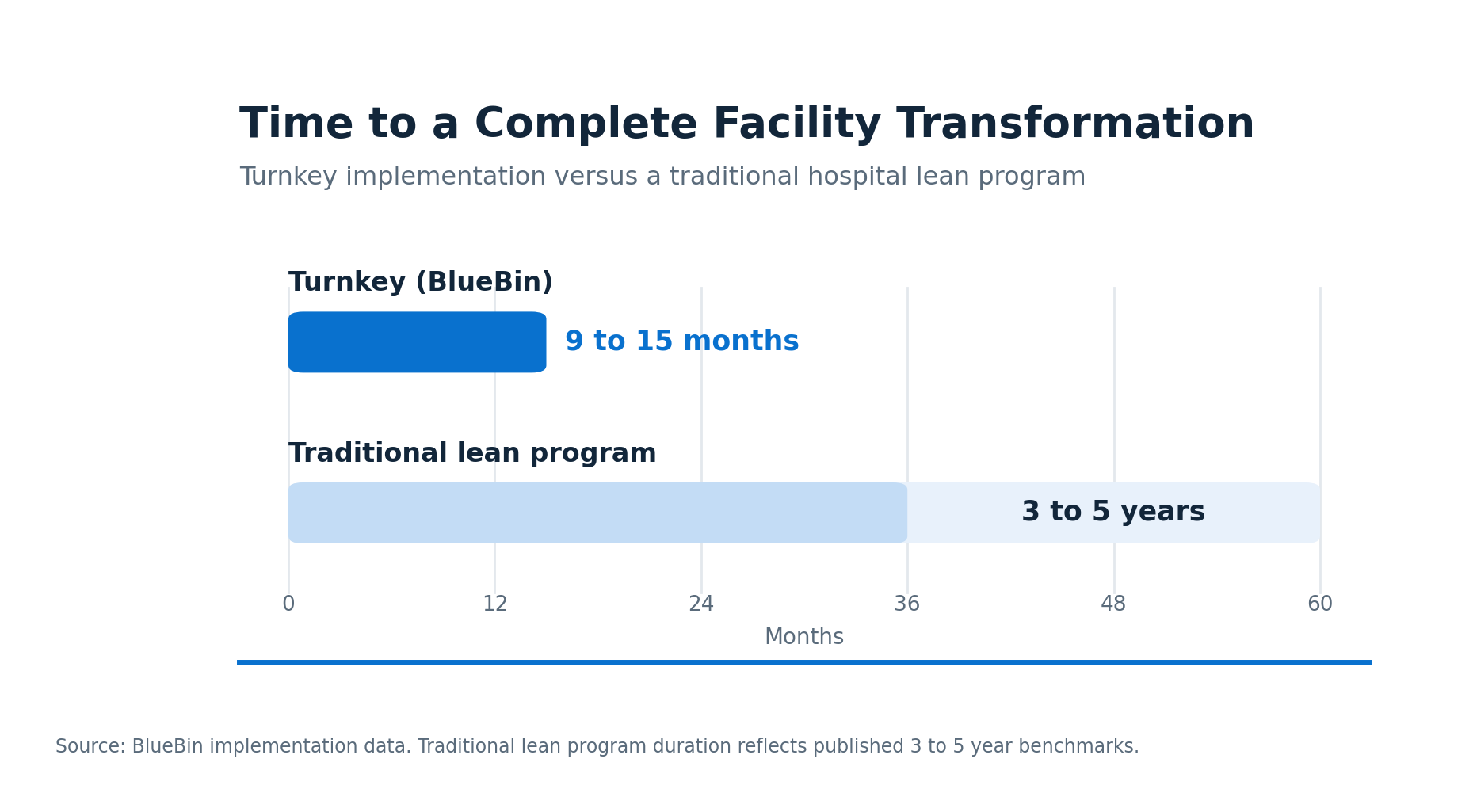
- Ask for the date of measurable results, not the go-live date. In-house lean implementations commonly run 3 to 5 years; turnkey implementations deliver a full facility transformation in 9 to 15 months, roughly four times faster.
- The best predictor of adoption is how little clinical staff have to touch the system. Visual replenishment signals ask nurses for nothing.
- Price the 36-month total, including your own internal labor. Licensing is usually the smallest line in the quote.
- Ask which promised numbers go in the contract. BlueBin's typical fill rate across customers is 98%.
Most hospital supply chain software does not fail loudly. The contract gets signed, the platform goes live, the dashboards populate, and eighteen months later, the supply techs are still walking the floor with a clipboard because the system never matched how the units actually run.
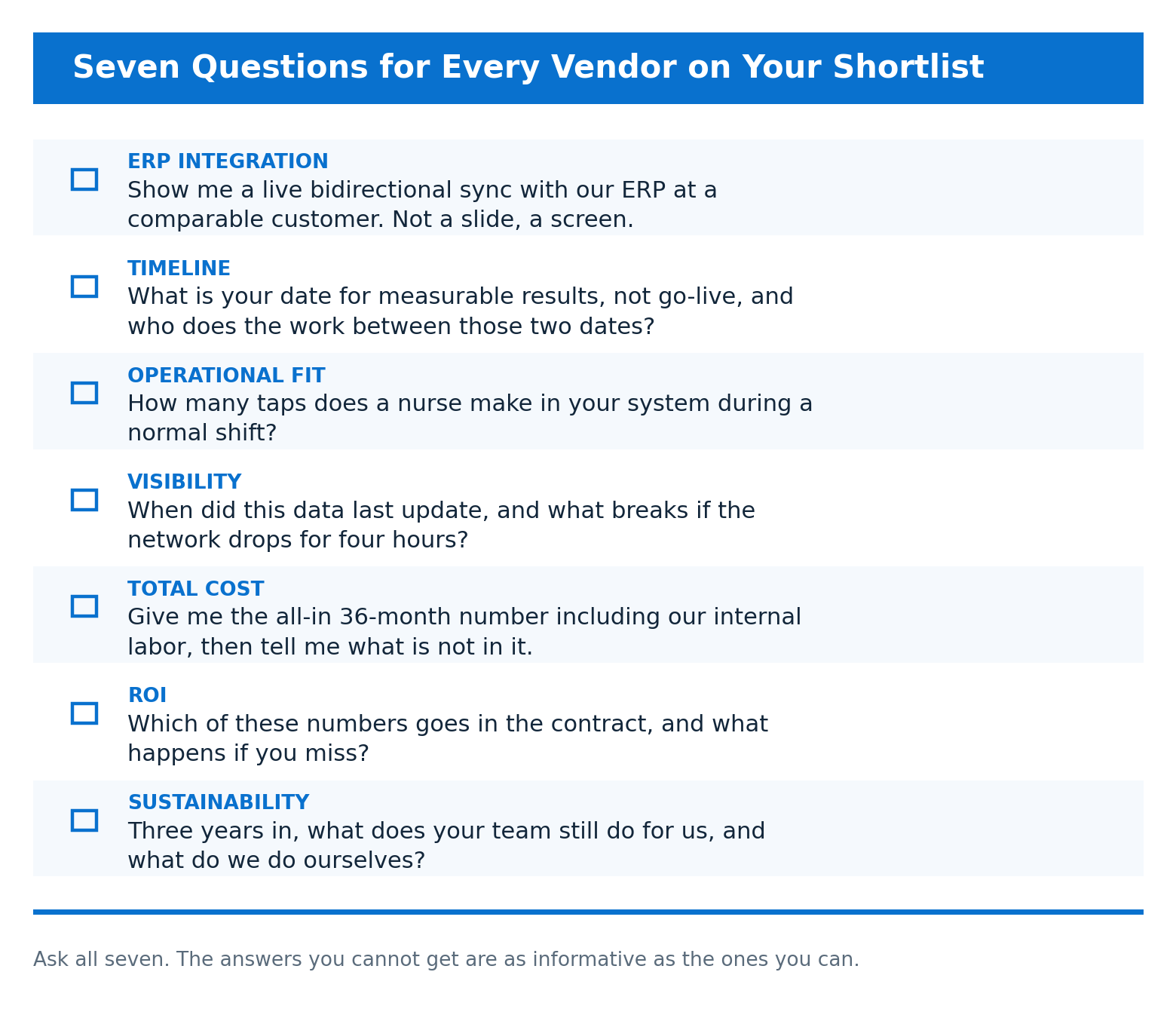
That is rarely a software defect. It is an evaluation defect. The questions that predict whether a platform will hold up are not the ones on a feature matrix, and most of them are awkward to ask in a demo. Below are the seven that matter most in hospital supply chain management, each with a specific question to ask every vendor on your shortlist.
What Hospital Leaders Should Evaluate in Supply Chain Software
The seven factors move in sequence: whether the platform can be installed, whether anyone will use it, whether it pays for itself, and whether the gains survive year three. Most evaluations spend nearly all their time on the first question and almost none on the last, which is exactly the opposite of where programs actually fail.
1. Assess ERP Compatibility Before Anything Else
Your hospital likely runs on Workday, Epic, PeopleSoft, Oracle, or another enterprise platform. Any supply chain software you choose has to integrate bidirectionally with that ERP, or your team inherits reconciliation work that never goes away.
The failure here is subtler than "it doesn't connect." The integration usually exists. It just runs nightly, so PAR data is always a day stale, and by the time anyone notices, the workaround has become the process. Ask how data moves in both directions and how often, and whether the platform sits as a layer on top of your ERP or expects an IT project to install. BlueQ Analytics, for example, is built to sit atop major healthcare ERP systems rather than replace any part of them, with integration typically completed within 30 to 60 days.
Ask this: Show me a live bidirectional sync with our ERP at a comparable customer. Not a slide, a screen.
2. Understand Real Implementation Timelines
Vendors quote to go live. You care about results. Those are different dates, and the distance between them is where most programs quietly lose a year, because configuration, training, and optimization all live in the gap, and none of them appear on the implementation schedule.
Enterprise ERP deployments commonly run 12 to 24 months for a large health system and 18 to 36 months for a multinational rollout, but those are go-live dates, not results dates. In-house lean implementations run longer still, commonly 3 to 5 years in BlueBin's implementation experience, because the work competes with everyone's day job and slows whenever the hospital gets busy. Individual improvement projects can show measurable results in days or weeks, but without a daily management system underneath them, those gains erode. Ask vendors to break the timeline into named phases: assessment, design, build, training, go-live, optimization, and sustainability. Then ask who performs the work in each one. BlueBin's turnkey model delivers a complete facility transformation in 9 to 15 months because dedicated implementation teams do the work alongside your staff rather than handing them a manual and a login.
Ask this: What is your date for measurable results, not go-live, and who does the work between those two dates?
3. Evaluate Operational Fit Over Feature Lists
A platform packed with features becomes shelfware if those features do not match clinical workflow. This is the factor most often overlooked in evaluation because feature matrices are easy to compare, whereas workflow fit is not.
The test is simple and not about capability. Every additional login, menu, and manual count is time a nurse spends away from the bedside, so the best predictor of adoption is how little clinical staff have to touch the system at all. Software that asks nurses to scan is asking them to absorb the cost of the supply chain's visibility.
Visual systems invert that. Two-bin Kanban requires no interaction with technology from clinical staff whatsoever. The empty bin is the signal that removes counting, scanning, and requisitioning from the nursing workflow entirely, freeing up to 60 minutes per shift for patient care. It is also worth understanding why automated dispensing cabinets fall short for everyday supplies, since they are the most common alternative on the shortlist and solve a narrower problem than most buyers assume.
Ask this: How many taps does a nurse make in your system during a normal shift? If the answer is not zero, what are we getting in exchange?

4. Demand Real-Time Inventory Visibility
Quarterly inventory reviews and batch reporting belong to a previous era. Modern hospital operations need real-time visibility into stock levels, consumption patterns, and stockout risk across every location, and "real-time" is a term every vendor uses but few define.
Pin it down. Ask what the refresh interval actually is, whether the platform surfaces predictive alerts before a shortage reaches the bedside [VERIFY: alert lead time], and whether heat maps identify problem areas without someone running a report. Useful real-time supply chain analytics include perpetual inventory tracking, so cycle counting no longer consumes supply chain and clinical staff time. Where scanning genuinely earns its keep, on high-value or consigned items, it should sit with supply chain staff rather than nurses, which is the narrow role a tool like BlueQ SmartScan should play.
Ask this: When was this data last updated, and what happens if the network goes down for 4 hours?
5. Calculate Total Cost of Ownership Including Implementation
Licensing is usually the smallest number in the quote. Implementation services, consultant fees, training, hardware, and ongoing maintenance routinely exceed it by multiples, and the highest omitted cost is almost always your own people's time, which never appears in a vendor proposal because the vendor is not paying for it.
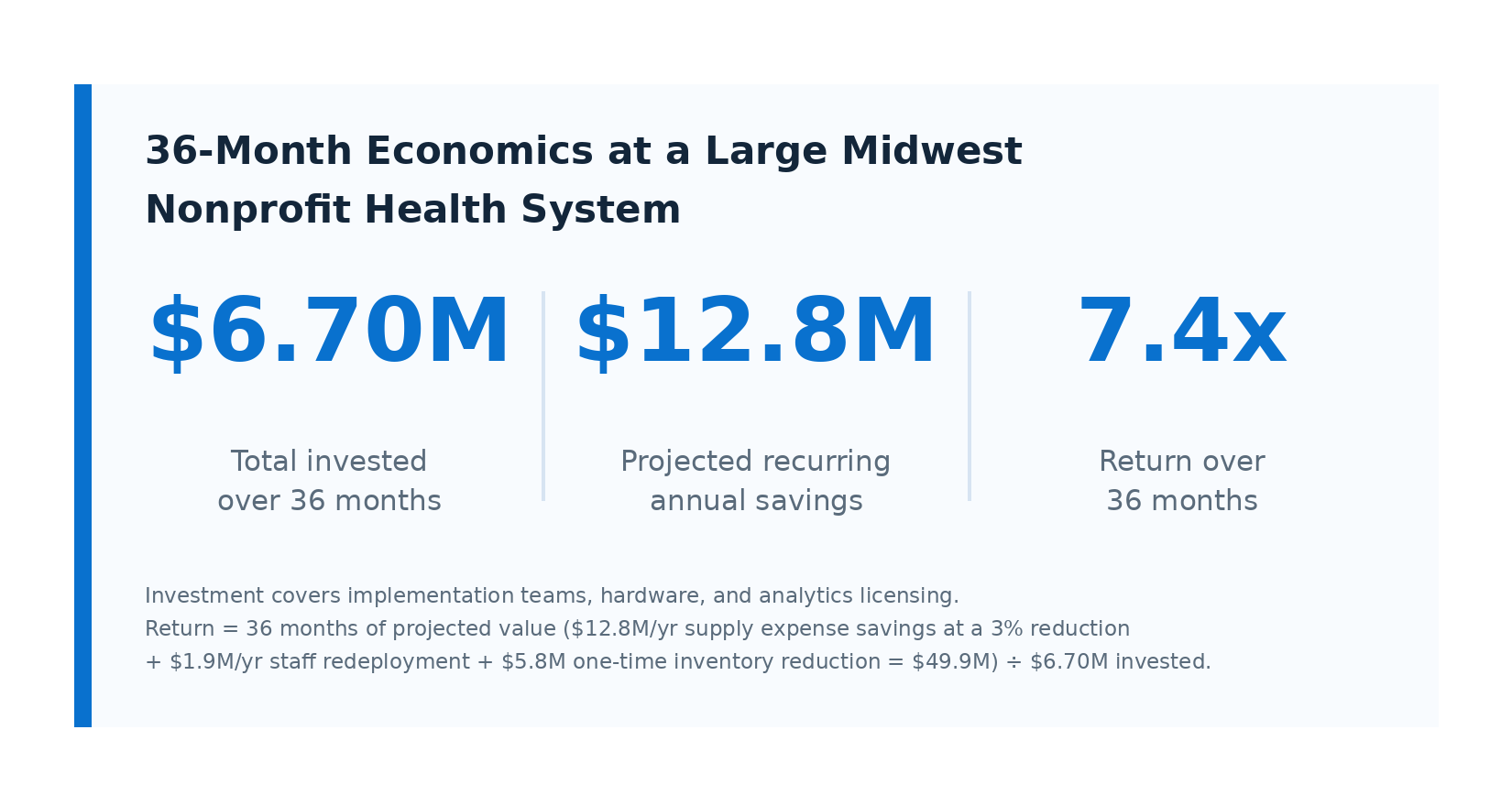
Request a breakdown covering every category over 36 months, rather than for year one. A large Midwest nonprofit health system invested $6.70 million over 36 months with BlueBin, covering implementation teams, hardware, and analytics licensing, and projected $12.8 million in recurring annual savings, resulting in a 7.4x return. Before comparing quotes, model your own facility with the supply chain ROI calculator, so you are negotiating against a baseline rather than a brochure.
Ask this: Give me the all-in 36-month number, including our internal labor, and then tell me which line items are not included.
6. Verify Measurable ROI Frameworks
Promises of "efficiency gains" and "cost savings" mean nothing without a measurement framework to back them up. A serious framework names the metrics, states who measures them, and says what happens when a number is missed.
Look for supply expense reduction (typically 5 to 7% annually), a reduction in inventory holding costs (15% on average), clinical time recaptured, a fill rate against a contractual floor rather than a target, and an expiration rate (less than 1% is achievable). Each should be tracked continuously by the platform, not reconstructed by hand at the end of the project, because a number nobody can produce on demand is a number nobody is managing.
Ask this: Which of these numbers will you put in the contract, and what happens if you miss?
7. Assess Vendor Support for Long-Term Sustainability
Plenty of supply chain initiatives post strong first-year numbers. Far fewer still have them in year three. When external consultants leave, the gains leave with them unless someone inside the building owns the standard work, which is why hospital lean programs commonly stall right around the point the original project team disbands.
This makes sustainability a vendor selection question rather than an operations question. Ask whether the vendor builds internal capability or long-term dependency, and be direct about it, because both models are legitimate and they price very differently. BlueBin's BlueBelt certification trains 1 to 4 supply chain technicians per facility to lead daily huddles, adjust PAR levels, audit standard work, and run continuous improvement without outside help.
Ask this: Three years in, what does your team still do for us, and what do we do ourselves?

How to Select the Right Hospital Supply Chain Software
Run all seven questions at every vendor on your shortlist, and the field usually sorts itself, because the answers a vendor cannot give you are as informative as the ones they can. A vendor who will not commit to a fill rate in the contract has told you something. So has one who cannot say what happens in year three.
Underneath the seven sits a single decision rule: technology does not fix a broken process; it scales whatever process it is given. Solutions that start with process discipline and visual management consistently outperform those that automate existing dysfunction, which is why operational fit and sustainability deserve more of your evaluation time than the feature matrix ever gets.
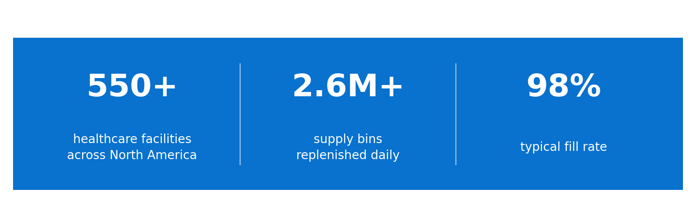
BlueBin applies that principle across 550+ healthcare facilities in North America, replenishing more than 2.6 million supply bins every day. Proven Kanban methodology, mobile replenishment, and real-time analytics together support a typical 98% fill rate and a 15% average reduction in inventory holding costs. If you are still assembling a shortlist, our roundup of the best hospital inventory management systems compares the categories side by side.
Before committing to any platform, request an assessment of your current operations. A baseline is what turns vendor comparisons and ROI projections into something you can defend in a capital request.
Frequently Asked Questions
